The world of college football has been flipped upside down.
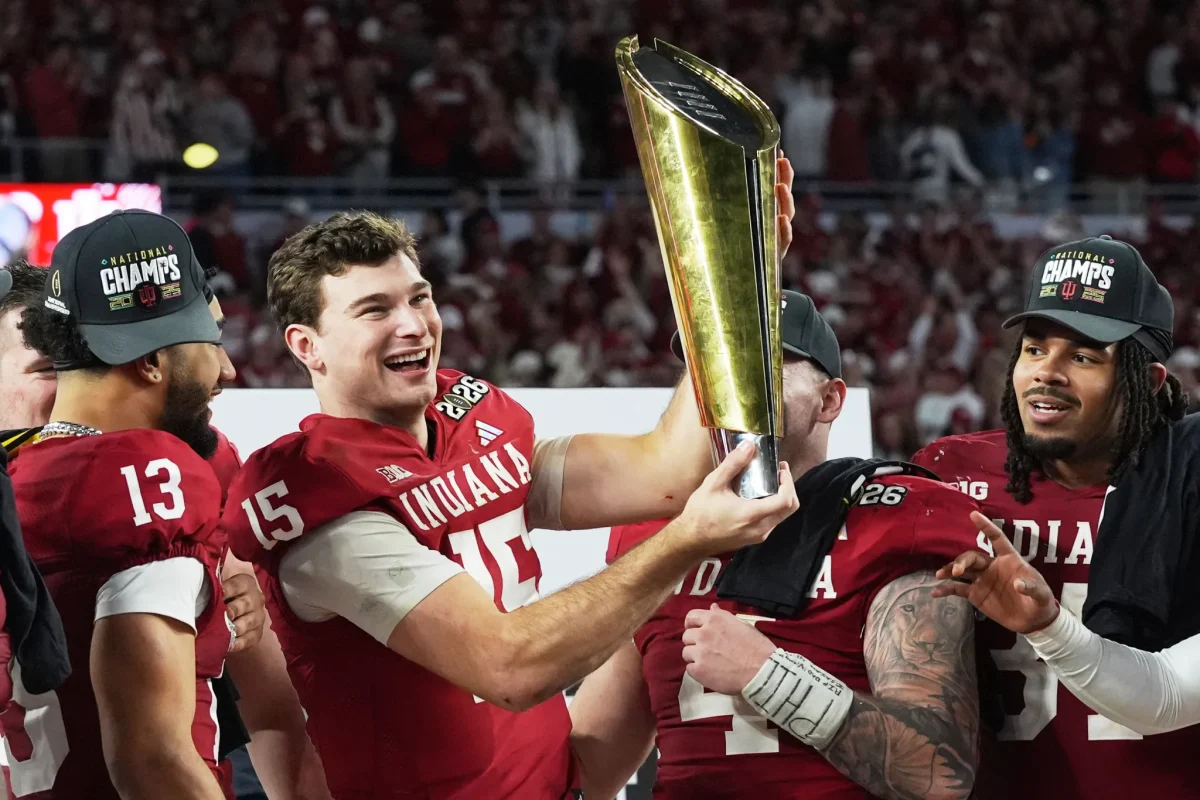
Indiana University defeated the University of Miami on Jan. 19 by a score of 27-21, a cherry on top of a perfect season for the Hoosiers—16 wins and no losses as they were crowned champions.
The game, played on Miami’s home turf at Hard Rock Stadium, was noticeably competitive for the Indiana powerhouse, which, until that point, had coasted through its two previous playoff games. And, apart from the final nerve-racking minutes of the championship game when Miami had a chance to overtake Indiana with a touchdown, Hoosier fans could not be more delighted with how the season went.
The Miami Hurricanes, led by quarterback Carson Beck, were held scoreless during the first half by Indiana’s defense, all the while quarterback Fernando Mendoza led the Hoosiers to ten points against a ruthless and relentless Hurricane front line.
But, after halftime, a 57 yard outside run play by junior running back Mark Fletcher Jr. put Miami right back into the game, reaffirming their place in the championship. However, destiny seemed to stay on Indiana’s side after two huge plays: a blocked punt and a memorable 12-yard rush by Mendoza, both of which resulted in touchdowns.
Miami scored two more touchdowns in the fourth quarter, before a field goal by Indiana gave them a six-point lead with a little less than two minutes left in the game. Carson Beck had 1:42 for the opportunity of a lifetime. Instead, he threw an uncontested interception, and, with no timeouts remaining, the game was effectively over.
“I’ll take full blame for it. We were one drive short of winning the National Championship,” Miami head coach Mario Cristobal admitted following the loss. “I do see pain in moments like this, and we should. If we’re a competitor that’s worth anything, you feel it, and you use it. You give those feelings a direction.”
Miami, a five-time AP national champion, had lost to none other than the losingest loser: Indiana.
What not only Indiana fans, but also everyone who was watching, had just seen unfold before their eyes was unlike anything before. Prior to its 2025 campaign, Indiana had the most losses in college football history, with 715. Now, with a trophy in their hands, they found themselves on top of the college football world.
The success behind Indiana’s victories could obviously be attributed to Fernando Mendoza, who transferred to Indiana after spending his past three years at Berkeley. In his first and only year with Indiana (now that he has declared for the NFL draft, and will likely be taken first overall), Mendoza won this year’s Heisman Trophy, a yearly award given to the best player in college football. But off the field and on the sidelines, it was Mendoza’s top-tier, death-staring coach, Curt Cignetti, who transformed the identity of Indiana in just two years.
“It’s pretty simple. I win. Google me,” Cignetti half-jokingly mentioned at his debut press conference.
But after achieving a 27-2 win-loss record over the last two years and winning the national title, I think Cignetti, surprisingly enough, was erring on the side of humility.
Cignetti’s management of Indiana’s football program has laid the blueprint for how other college football programs can win on the highest stage. Of course, an expansion on name, image and likeness (NIL) deals has allowed universities that receive high amounts of alumni funding for their athletic programs to enjoy increased success. Universities that receive more alumni funding can invest in more modern sports facilities and more staff, thus making their school a more desirable location for the best athletes in the country. But beyond NIL, what worked out in Indiana’s favor was its investment in the transfer portal. When Cignetti arrived at Indiana from James Madison University, he brought thirteen players with him, along with a core of coaches that would become the backbone of Indiana’s coaching staff.
Before the beginning of the 2025 season, Indiana football had 42 incoming players, 19 of whom were transfers. These transfers demonstrated Indiana’s priorities for their roster: experience over talent, time on the field over potential on the sidelines, results now over later.
And after House v. NCAA ended last year in a $2.8 billion settlement that massively loosened restrictions on transferring and student-athletes’ ability to earn money, schools like Indiana could more easily obtain top talent. They would just have to know where to look. By pursuing top athletes at lesser-acclaimed schools and persuading them to join a rejuvenated environment, beating the best suddenly became a possibility.
Thanks to these changes, a school like Indiana, whose football program was irrelevant a few years ago, could enter the College Football Playoff as the one seed. They could play a team like Alabama, historically known for its ability to recruit high-level talent, in the Rose Bowl and win 38-3. They could back that up by beating Oregon, a perennial contender, in the Peach Bowl, where a transfer quarterback such as Fernando Mendoza could cement his Heisman case by throwing five passing touchdowns in a 56-22 victory. And in the championship, a school like Indiana could, and did, win it all. This would be unimaginable if it were not for the changing landscape of collegiate sports.
Naturally, these investments into the transfer portal, let alone NIL deals, require an incredible amount of money, as do scouting, coaching, facilities and more. That is to say, Indiana made it look a lot easier than it actually was. But it’s also the identity and culture of the program that facilitated this win.
“A big constant that we’ve really had on ourselves this year is always bet on ourselves,” Mendoza said. “Whether it’s preseason — no one thinks we can make it.”
Cignetti, now 64 and on an $11.6 million yearly salary, spoke of his team’s success and the path they took to get there.
“Back when I was waxing the staff table at IUP, Thanksgiving weekend and school was shut down for the playoffs, did I ever think something like this was possible? Probably not,” Cignetti said. “But if you keep your nose down in life and keep working, anything is possible.”
Indiana will go into the offseason with the challenge of finding ways to sustain its success even as players like Mendoza declare for the draft or transfer. But, as Indiana heads into the sunset of the 2025 college football season, they stand as champions, and, for now, that’s all that matters.