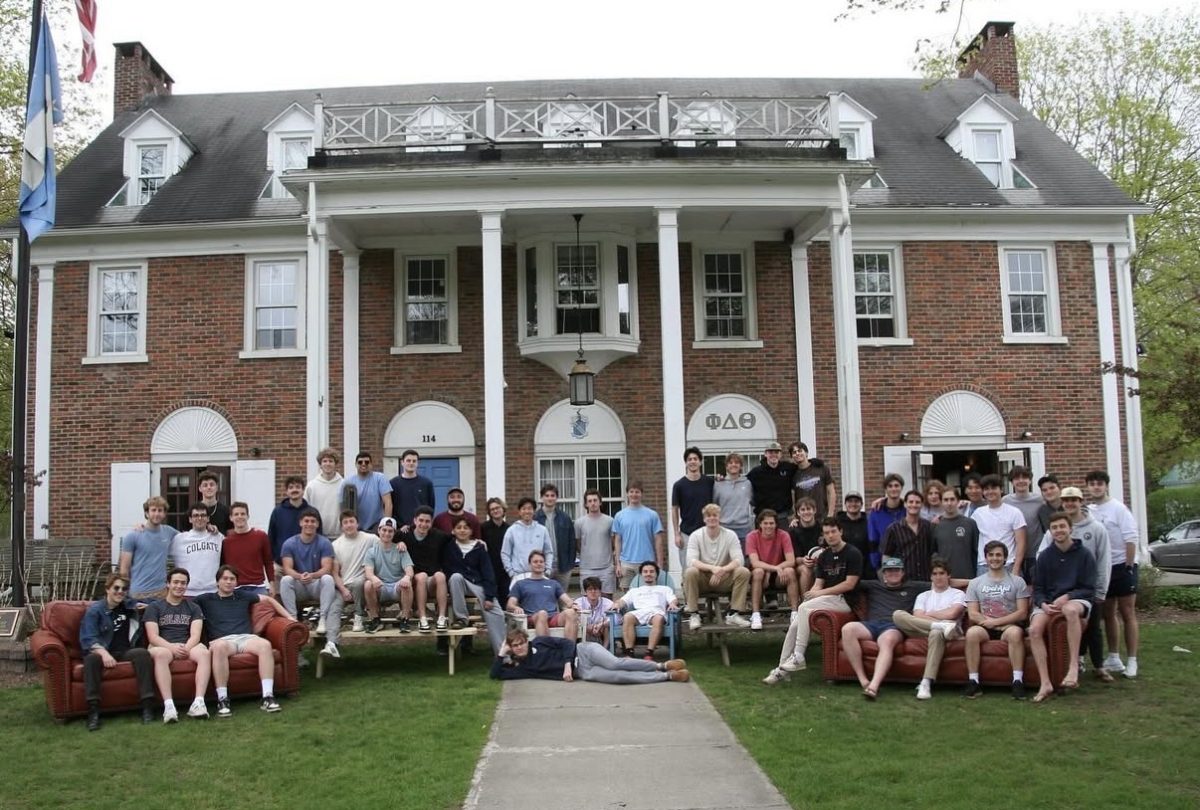
One of the memories every first-year student makes on arrival day is driving down Broad Street and marveling at the mansion-like houses that span all the way into Hamilton. Throughout Colgate University’s history, most of these houses were built as fraternity housing, and later as sorority housing once Colgate opened its doors to these organizations in 1979. Over the years, many of these chapter houses have been converted into interest-based housing. However, the university still currently owns eight active chapter houses.
Students live within their residential commons, or as they are more likely to call it, “up the hill” their first two years. As students become upperclassmen, they are given the chance to move closer to town and off of Colgate’s main campus, with most Greek-affiliated students opting to live within their chapter houses.
Most students don’t consider what living in these chapter houses would be like until the time comes to move in. Mei McGuiness, a junior living at the Kappa Kappa Gamma chapter house had this experience.
“I never even considered what living in a sorority house would be like before coming to Colgate, and it’s been a good experience,” McGuiness said. “It’s nice seeing girls around, and doing events together like watch parties. We’re all somewhat on the same schedule with chapter events, and it’s nice to be at the center of it. Living in Kappa is unique because there’s 40 of us, and there’s people that I get close to that I wouldn’t otherwise be able to.”
Common stereotypes of Greek life housing involve being constantly involved in the social events, being in a loud living environment or being constrained to one group of people. However, for students, the reality is grounded in the day-to-day experience.
“I think that being close to town is a full circle moment. Being able to walk in and out of town is great, and enjoying the drive on Oak Drive every day,” McGuiness said.
McGuiness also noted that carpooling and having a chapter house chef makes her day much easier and enjoyable.
Living in Greek housing provides students an opportunity to build stronger relationships and helps cultivate a sense of belonging and community. Christopher Mendina, a junior who only recently started living in the Phi Delta Theta chapter house after returning from an approved program in New Zealand, said that the most important aspect so far has been living with friends.
“One big thing about living in a house compared to anywhere else, is that while I get to have my own room, I am part of this bigger house and once I step out of my room, I’m in hallways where I get to see my friends anytime, or go next door to my friend’s room and hang out with them,” Mendina said.
Many students choose chapter housing over living in apartments or themed housing.
“It’s a lot different from a dorm or apartment, where you might not know the people you live near,” Medina said. “You’re always seeing your friends or being somewhat in touch with them. It’s hard to feel isolated when you’re surrounded by friends constantly.”
Most importantly, living with fellow members of their chapter allows students to learn to live together with large, diverse groups. Senior Tatsu Nishizawa, also living at Phi Delta Theta, noted that there’s aspects to each house that make them unique.
“At Phi Delta Theta we have sit down dinners together, and it’s a great way to spend time with the chapter each day,” Nishizawa said. “Living with so many people is a bit of an adjustment to make at first, but it’s been one of the highlights during my time at Colgate.”
The best way to build community is by learning to co-exist, and the ability to carpool, live down the hallway from one another and eat dinner together is made possible by living with your friends — and soon-to-be-friends — in Greek life housing.