Colgate University’s Department of Middle Eastern and Islamic Studies hosted Wellesley College Associate Professor of Peace and Justice Studies Nadya Hajj for her talk “Rebuilding Amidst Displacement and War: Palestinian Reciprocity and Remittances in Lebanon, Jordan and Gaza” on Tuesday, Feb. 10.
The talk centered on Hajj’s second book, “Networked Refugees: Palestinian Reciprocity and Remittances in the Digital Age,” which examined the digital technologies used by communities during humanitarian crises.
“As a sixth-generation Palestinian, I was told that this was an identity I should really hide [as a professor],” Hajj said. “I no longer think of my identity as a liability — I actually think of it as a superpower.”
Hajj began by differentiating between “technology pessimists” and “technology optimists.” Pessimists argue that digital technology does not benefit any community. Hajj considers herself an optimist.
“[Technology optimists] suggest that technology is indeed a powerful tool, especially in specific contexts where there is a non-democratic state that controls traditional forms of media,” Hajj said. “Technology works best when patterned on these ‘real-world’ community networks.”
Hajj’s research is based on qualitative interviews with Palestinians living in Nahr al-Bared refugee camp, surveys with Palestinians living in the diaspora, statistical analyses of internet usage and data “scraping” using Selenium WebDriver and Google Maps Developer API. Her research sought to answer how, amidst war and displacement, refugee communities rebuild.
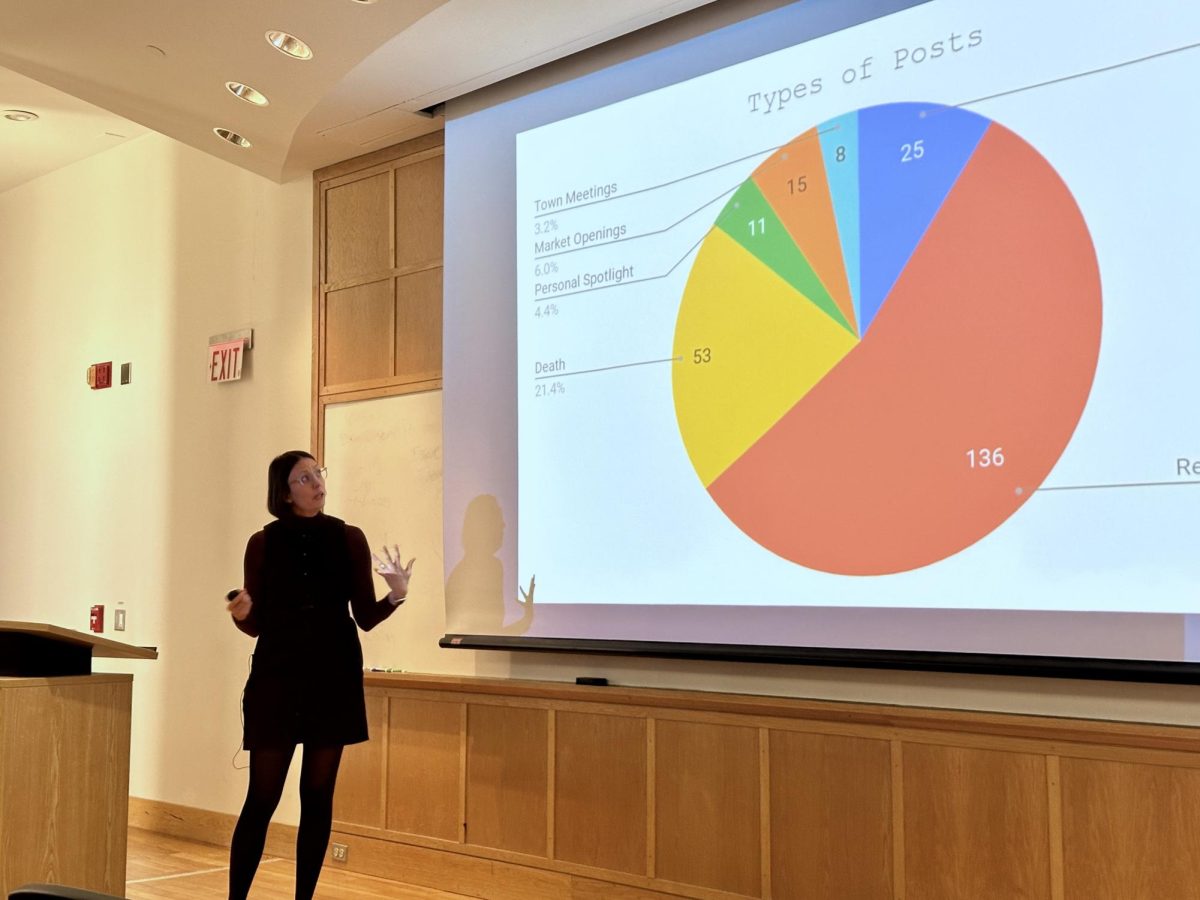
In describing the social media landscape of Palestinians, Hajj pointed to the ubiquity of funeral postings on Facebook, usually including aspects of the Islamic funerary rites, the Jana’iz.
“In the midst of war and displacement, when people display Islamic Jana’iz with digital sites, it generated something specific for the Palestinian community — helping them survive and affirming community connection amid ongoing catastrophe,” Hajj said. “Palestinian networks are, socially speaking, still alive, even in digital spaces.”
Hajj’s work questioned the frequency of religious musings on family Facebook pages, especially amidst the usual funerary and obituary material, as well as the marriage, graduation and birth announcements.
“Religious musings remind someone of both their religious and communal obligation [to those in the camps], even when they are really far away,” Hajj said. “The more one is endeared to the community, the more likely they are to continue to give. Tech is not a magical solution for reciprocity, but it works best when patterned on pre-crisis networks and traditions.”
Associate Professor of Political Science Bruce Rutherford, who first met Hajj at a workshop about Middle Eastern politics, was struck by the resilience of refugees.
“Fifth and sixth generation refugees — who have never seen their home village and probably never will — still feel a deep sense of connection to it,” Rutherford said. “The network of relationships among people and families that existed within the village has continued, despite all the challenges their community has faced.”
Associate Professor of Anthropology and Middle Eastern and Islamic Studies Emilio Spadola similarly drew on the concept of family members abroad funding aid for relatives in the refugee camps.
“While emphasizing the virtues of kindness and mutual aid, the greater self-sacrifices which [Hajj’s] own and other families enact and which make life livable in the refugee camps and occupied territories, Hajj was forthright about the communities’ restrictive cultures as well — the use of shame, for example — and its necessity in the absence of state support,” Spadola said.
While Hajj made a point of not sugarcoating the lives of refugees, she attributes the strength of these communities to their sustained connections and kinship.
“We spend a vast majority of our lives thinking about very different things — our relationships to children, family, fulfilling basic needs and sometimes our hopes and desires. That’s actually how most Palestinians live. The majority of the time, people are seeking connection to one another,” Hajj said.
The message of resilience resonated deeply with audience members, including Spadola.
“I felt personally and professionally inspired, not only by Professor Hajj’s rigorous scholarship, but to recommit to my own communities and extended family as well,” Spadola said.
Hajj lastly emphasized the importance of non-refugees participating to become like family and kin to those in the camps.
“[There are questions about] purity and community and who gets to belong … it upsets me,” Hajj said. “Let’s all welcome everybody, especially when we do not have much.”