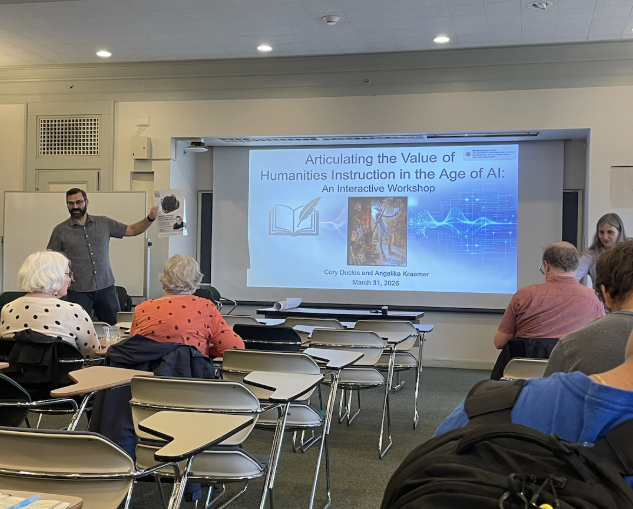
Angelika Kraemer, director of the Language Resource Center at Cornell University, and Cory Duclos, director of Colgate University’s Keck Center for Language Study, brought together participants for an interactive workshop about Artificial Intelligence (AI) on March 31. The workshop confronted a pressing question: How should the humanities redefine their value in the age of AI?
Drawing on their shared background in linguistics, language education and technology-enhancing learning, Duclos and Kraemer framed the session as a collaborative effort to rearticulate the purpose of the humanities. They focused on the necessity of such an endeavor, the new approaches that will be required in an AI-driven world and how students should prepare for the future.
Kraemer cited a rise in calls for faculty to redescribe, defend and justify their roles in an era when AI seems to serve as a replacement, yet also highlighted a more optimistic perspective. As AI systems take over cognitive tasks, uniquely human skills of interpersonal communication, empathy, ethical reasoning and adaptability will become more valuable. Employers are seeking individuals with “soft skills,” which, according to Kraemer, are central to a humanities education. Rather than defend the humanities, Kraemer worked to define and articulate their evolving value clearly.
Duclos expanded on this idea with a literary metaphor drawn from “Don Quixote.” In the novel, the protagonist mistook windmills for giants and attacked them using outdated methods. For Duclos, this served as a warning: if educators faced the problem of AI without considering the ever-shifting state of education and technology, they would risk misunderstanding it and acting ineffectively. Instead, educators must develop new ways of understanding and engaging with technology.
“We have to make sure that we’re not trying to deal with this problem in the same old ways we were doing before,” Duclos said.
He also pointed out the fundamental limitations of AI. Despite their seemingly insurmountable capabilities, AI systems are ultimately statistical models. They generate outputs based on patterns in data but lack true understanding, or a real “stake” in the world. These systems’ internal processes are also difficult, if not impossible, to fully interpret. These limitations created structural constraints that are greater than temporary flaws.
Following Duclos’ argument, Kraemer emphasized that AI should not be seen as an enemy, but instead as a context in which education now operates. In addition to dispersing knowledge, teachers must now also cultivate the broader competencies students require to navigate an AI-integrated world: critical thinking, communication, adaptability and interpersonal awareness.
While AI is embedded in everyday tools, the more relevant question is how students will use these large language models (LLMs) in professional contexts, Duclos said. Current uses in the workforce are relatively basic, mostly limited to summarizing information, generating reports, extracting data or just avoiding asking supervisors questions. As Duclos noted, these applications were “underwhelming” compared to the transformative potential typically attributed to AI.
Integrating AI into the workplace creates significant challenges, which include verifying the accuracy of outputs, managing costs and adapting to changes in job structures. Even as AI use expands, the important skills required from future workers remain consistent. Human skills of digital literacy, critical thinking, creativity and emotional intelligence remain most needed in an AI-driven world.
Participants were then invited to engage directly with these ideas. In small groups, they were asked to identify what AI can and cannot replicate within their respective disciplines. Discussions revealed practical uses, such as generating practice materials, and explored deep concerns about its impact on learning. Many participants noted that AI output often lacks depth and could contain inaccuracies. Some worried that overreliance on AI could erode critical thinking and discourage students from engaging in the essential processes of learning. Participants also reflected on the human elements of education that AI cannot replicate.
Jennifer Lutman, director of University Writing at Colgate, recalled that her most memorable educators were those who initially left her with confusion, rather than instant understanding.
“The reward for that was true learning at the end,” Lutman said. “If I could just sit with ambiguity, complexity and uncertainty for a long enough time, knowing I was in a safe space where I could do exploration … there was reward in that.”
Duclos and Kraemer asked participants to draft “value statements” to articulate what they, as educators, offer the 21st-century student. Their statements underlined the role of educators as mentors who foster critical inquiry and emotional growth.
“Our unique value is defined by the fact that we’re not just teachers of our disciplines, but we guide our students’ competence to global citizenship in today’s world,” Kraemer said.
Although some participants expressed concern that AI might eventually replicate these qualities, Duclos and Kraemer maintained that imitation will never be equivalent to reality. AI might mimic humans, but it fundamentally lacks genuine experience, accountability and investment in the world.
The workshop concluded that while the humanities are not becoming obsolete, they must adapt. Rather than competing with AI, educators should focus on fostering the distinctly human capabilities of critical inquiry, emotional awareness and ethical reasoning that give knowledge its meaning.