Emily Winderman, author of “Back-Alley Abortion: A Rhetorical History,” delivered a talk of the same name at Colgate University on Thursday, April 3. Invited by the department of writing and rhetoric, Winderman, assistant professor of rhetoric at the University of Minnesota-Twin Cities, traveled to Lathrop Hall to speak.
Winderman, who holds a Ph.D. in communication from the University of Georgia, specializes in the rhetoric of health and medicine. She co-directs the oral history project “Healthcare Under Crisis,” which investigates and ultimately challenges Minnesota’s healthcare landscape as a “safe haven.” She won the 2024 Book Award from the Association for the Rhetoric of Science, Technology and Medicine for “Back-Alley Abortion.”
Before Winderman’s presentation, Chair of the Department of Writing and Rhetoric Jennifer LeMesurier introduced Winderman. When asked why the department selected Winderman as a speaker, LeMesurier explained that her areas of scholarship intersect with several topics covered in the department’s courses.
“The writing and rhetoric department teaches a number of courses that deal with gender and race and rhetorics that relate to those aspects of people’s identities, so we felt like it would be a really good fit,” LeMesurier said.
Winderman structured her presentation by first unpacking the origins, uses and implications of the phrase “back-alley abortion.” She also used the four chapters in her book as the framework for introducing her argument on the discourse of the phrase.
“‘Back-Alley Abortion: A Rhetorical History’ traces how this really heterogeneous field of criminalized abortion became condensed into the simplified phrase ‘back-alley abortion,’ giving way to assumptions that all illegal abortions were performed in disgusting surroundings with cruel practitioners using inept techniques,” Winderman said. “It was not.”
Winderman framed the remainder of her talk through a comparative analysis of two cases of two women whose abortions and subsequent deaths were famous: Rosie Jiménez and Becky Bell. As Winderman explained, the two were 10 years apart in age at the time of their respective abortions, and had different class and racial identities and reasons for seeking abortions.
A 27-year-old of Mexican origin from McAllen, Texas, Jiménez sought an abortion, which positioned her to be widely regarded as the first victim of the Hyde Amendment, an annually reauthorized policy rider from 1977 that blocks federal Medicaid abortion funding. On the other hand, Bell, 17 and white, sought an unsafe abortion instead of involving her family, as required by Indiana’s parental notification laws.
In understanding the stories of these two women, she introduced her rhetorical theory of visceral public memory, which involves three features: a reliance upon graphic images or vivid descriptions, the externalization of a body’s reproductive organs for a non-expert audience and the positioning of racial and class-based relationships between victim, perpetrator and communities beside state and national borders.
“In combining visceral publicity and public memory, I wager that visceral public memory externalizes somebody else’s internal organs to vividly orient people in relation to the causes of that bodily harm,” Winderman said. “So, visceral public memory attunes us to the damage created by unsanitary and often non-medical instruments, traversing the bodily envelope, detailing the impact of that fleshy boundary breaking upon a pregnant person’s well-being.”
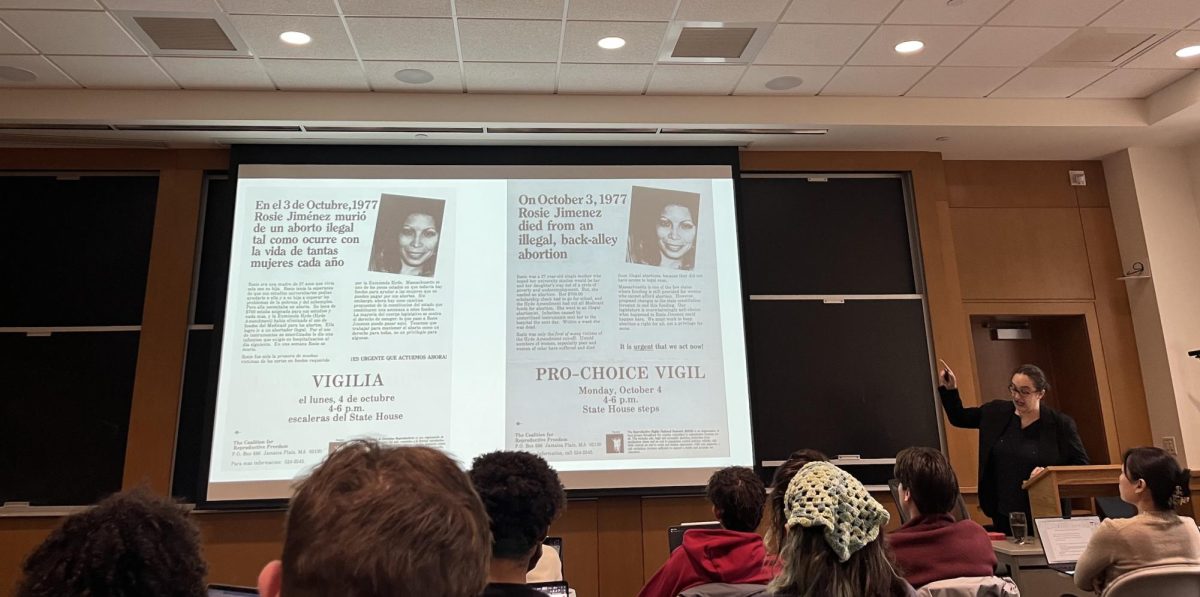
Relevant to Jiménez’s experience, Winderman then critically analyzed the rhetoric used in the English and Spanish versions of the same vigil advertising flyer.
“While both referred to abortion being illegal, the Spanish version specified that these occurred in the lives of many women every year, but without the back-alley modifier,” Winderman said. “The English version individuated Rosie’s experience as the title didn’t really have the same collectivizing appeal to others that also experienced her fate. So these two lives demonstrate how ‘back-alley abortion’ appealed almost exclusively to white, monolingual, English-speaking audiences. Indeed, it was not a coincidence that pro-choice only appeared in the English version and not the Spanish version. The absence of choice was significant because neither ‘pro-choice’ nor ‘back-alley abortion’ could produce a suitable translation.”
Sophomore Ada Linde, an English and Spanish double major, praised Winderman’s dissection of how differences in languages can even reveal more about the use of rhetoric.
“Professor Winderman’s ‘Back-Alley Abortion’ talk on Thursday was incredibly interesting and thought-provoking. She told real stories of women who had experienced back-alley abortions, like Rosie Jiménez and Becky Bell, then spoke about the rhetoric of using the terminology ‘back-alley’ in many different languages — and how people’s perception of these abortions can change as a result of the language they speak,” Linde said. “It was really cool to see her employ a variety of rhetorical techniques to prove her point, while talking about rhetoric.”
Since the public receptions of Jiménez and Bell’s stories speak to the gravity of rhetoric, LeMesurier shared her appreciation for Winderman’s sensitivity to structuring her lecture as to not deconstructively repeat history.
LeMesurier ultimately cautioned against leading stories, especially in journalism, that rely too heavily on pathos if they inhibit the rhetorical purpose of writing.
“There’s an old axiom in journalism that goes ‘if it bleeds, it leads,’ and I think that Professor Winderman’s talk did a really good job of showing how sometimes really emotional descriptions can actually take information away from where it needs to go; it can actually block action from happening,” LeMesurier said. “It’s a really good example that it’s important to be critical of who you listen to, who you read. It’s important who you vote for.
Arnold said that Colgate — being a small campus — might benefit from the sort of community building that has become more prevalent in his line of work following the Dobbs v. Jackson Women’s Health Organization decision. They said that a small student body provides more opportunities to connect with mission-aligned classmates and makes mobilizing more salient.
“Showing up in greater numbers with that community can be really powerful for your administration,” Arnold said. “For instance, if they see a petition that is saying students want emergency contraception on campus, here are the hundreds of people who have signed onto this petition.”