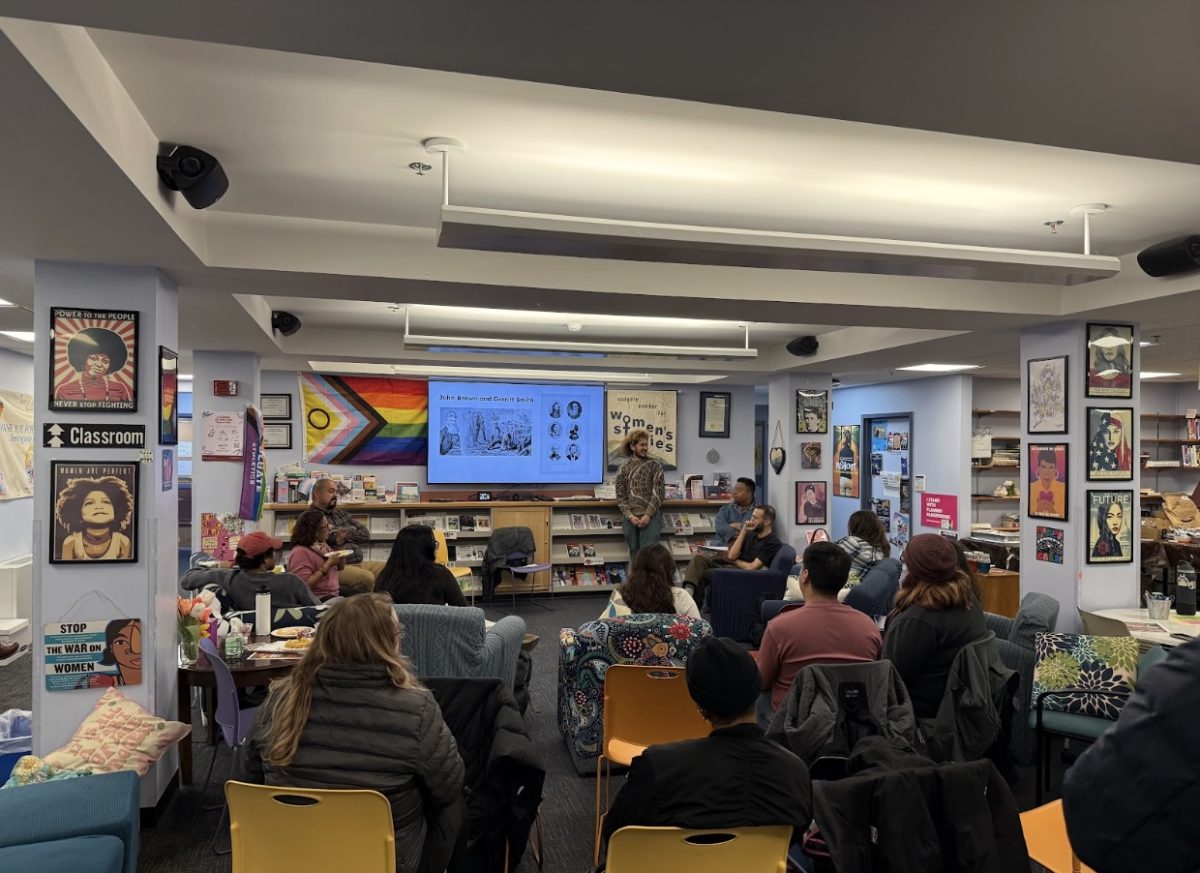
Five faculty members discussed immigration enforcement, policing and resistance strategies during a teach-in facilitated by the Center for Women’s Studies on Thursday, April 2. Teach-ins are a form of activism popularized by students during the Vietnam War, with the principal purpose being to educate communities about a current issue and generate ideas about how to take action.
Associate Professor of Anthropology Santiago Juarez opened the discussion by drawing connections between the current situation in the U.S. and the history of Guatemala. Juarez argued that current immigration enforcement in the U.S. constitutes what he called ‘fascist oppression,’ in which citizens are being killed by a masked police force — ICE, whose officers often wear masks — which he said is nothing new to the Americas. Juarez referenced the 1954 CIA-backed coup in Guatemala, in which the U.S. helped overthrow the democratically elected president, Jacobo Árbenz, and replaced him with a military dictator. During this period, the indigenous Mayan people of Guatemala were targeted and killed by the new dictatorship as a way to establish their authority. This mirrors the current situation in the U.S., where Juarez argued that immigrant groups are being targeted to establish authority. Juarez maintained that the U.S.-led destabilization of the Guatemalan government still plays a role in geopolitics today because of how it influenced immigration patterns.
“There’s still some of this migration pattern that’s coming here to the U.S.,” Juarez said. “And there’s always this frustration, hearing comments from right-wing views, asking, ‘Why are these people still coming here? Why can’t they fix their country?’ The answer is, the U.S. was directly responsible for this.”
Associate Professor of English and Women’s, Gender and Sexuality Studies Nimanthi Rajasingham also mapped connections between U.S. domestic and foreign policy, which she argued are inextricably intertwined. She explained how the Department of Homeland Security was created following the 9/11 attacks, and said that ICE was initially used to repress civilian concerns in the U.S. about the Iraq War. Her emphasis connected the present situation with Iran, where Rajasingham argued that similar false claims about nuclear weapons are being made. The response to 9/11 also militarized the police in a way that has yet to be undone.
Visiting Assistant Professor of Women’s, Gender and Sexuality Studies Omar Alsayyed presented next and connected the issue to indigenous rights. He also compared the War on Terror, as Rajasingham had previously noted, to westward expansion. Alsayyed argued that when the U.S. ran out of land to ‘imperialize’ in its own continent, it expanded outward into international issues, such as Iraq, Iran and Guatemala. He further argued that the U.S. was created out of violence and, therefore, its current state is only a continuation of it. Settler colonialism, on which the country was founded, leads to the imperialism experienced abroad, Alsayyed continued.
“We’re not going to talk about settler colonialism here and imperialism abroad,” Alsayyed said. “There are over 500 [indigenous] nations, and those are just the ones that are recognized by the U.S. state, right? But there are sort of countless hundreds of tribes and nations that existed here that did not cede their land or their sovereignty. And it was taken by force. And so the argument here is that obviously what is foundational to the U.S. as a state, just as we could talk about Israel and other settler colonial states, is the expansion of the frontier further and further westward.”
Assistant Professor of Women’s, Gender and Sexuality Studies Taryn Jordan also discussed tactics for resistance. In particular, she highlighted mutual aid as the most effective strategy. Jordan defined mutual aid as “on the ground” acts of support done to support the community. She provided the example of whistles being used in Minneapolis, Minn., to alert neighborhoods when ICE arrives. Other examples include delivering food to neighbors or jail support, in which protestors wait at a community jail to provide support, refreshments and comfort to those who were arrested.
Senior Daquan Hurt, an environmental studies major and economics and women’s, gender and sexuality studies double minor, commented on the effectiveness of the presentation.
“I think these events are so amazing because it gives a chance for students, staff and faculty to become one, to break down barriers for important discussion,” Hurt said. “It offers a chance for different voices to be heard, honestly and openly, in a safe space, because I think [the Center for Women’s Studies] is a safe spot for a lot of people, especially those who have nonconforming opinions. I think that it’s important for events like this to happen, especially now, because it shows that no matter how dire a situation may seem, or what type of rhetoric is being pushed about how life is supposed to go or will go, there are spaces that still operate to question those narratives, to make sure that they’re inclusive and to understand that a world that doesn’t work for everyone will not be tolerated.”