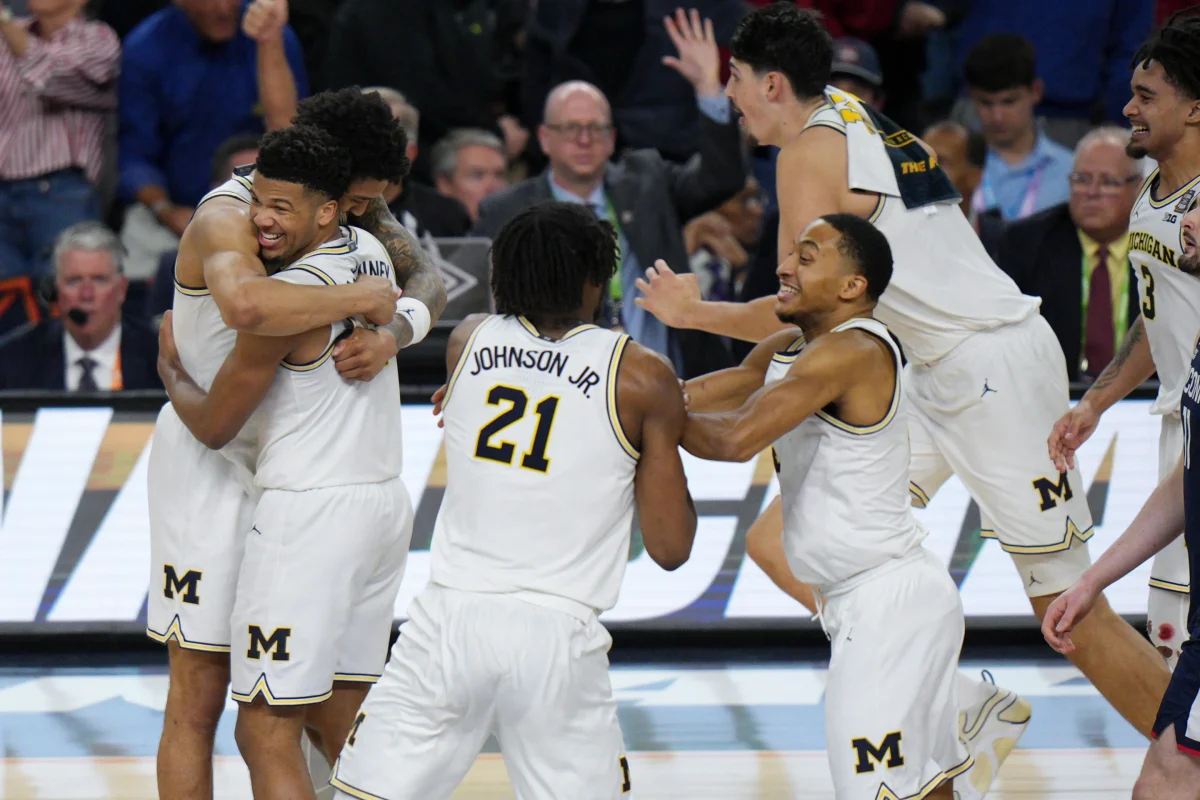
March Madness has come to an end, but fans will surely have no problem with that after the nation’s best collegiate teams delivered on a spectacle of a tournament. Under the bright lights of Lucas Oil Stadium in Indianapolis, Ind., the No. 1 seed University of Michigan Wolverines defeated the No. 2-seeded University of Connecticut (UConn) Huskies 69-63, securing their second championship in program history.
Michigan’s championship win solidified what was already a dominant season. In just his second year as head coach for Michigan, Dusty May guided the Wolverines to a 37-3 overall record, the best in program history. Under May, Michigan’s roster was revamped with student-athletes from the transfer portal, mostly through name, image and likeness (NIL) dealings. As a result, Michigan’s men’s basketball team flourished confidently in both the regular season and in March’s Big Dance, the latter being known for its chaotic and unpredictable nature.
With the loss, UConn was denied their third championship in four years. Head Coach Dan Hurley, who, back in 2024, turned down a six-year, roughly $70 million contract to coach in the NBA with the Los Angeles Lakers, was the underdog heading into the game. But with the kind of grit the Huskies were playing with throughout the postseason, their drive to win was never in doubt.
Unfortunately, however, Michigan would prove to be too much to handle. Michigan guard Elliot Cadeau led the way in scoring for the Wolverines in the championship game, putting up 19 points and going eight for nine from the free throw line, earning him the tournament’s Most Outstanding Player honors.
And, even after rolling his ankle on Saturday night against Arizona and entering the finals with a bone bruise, Michigan forward Yaxel Lendeborg was also able to contribute extensively to Michigan’s offense, scoring 13 and leading the team in playing time. Fellow forward Morez Johnson Jr. led the team in rebounds (10) and blocks (two), allowing for other Wolverine teammates to play in open space while sustaining the team’s defensive position.
Entering the championship, Michigan looked every bit like the powerhouse they played as. They steamrolled past their first five opponents, Howard, St. Louis, Alabama, Tennessee and Arizona, putting up 90 or more points in each contest. Conversely, the Huskies had a much more high-stakes route to the championship. Entering the east region of the bracket as the two-seed, UConn began their tournament with early round wins over Furman University and UCLA. Then, in the Sweet 16, they prevailed against Michigan State to earn a spot in the Elite Eight against tournament-favorite Duke University.
The highlight of the tournament proved to be in this game, as Braylon Mullins hit an insane three-pointer to seal the game against Duke 73-72. Though the shot was only made possible by a turnover on Duke’s part, it still took an unfathomable amount of courage on Mullins’s part to get the job done. All of this to say that Dan Hurley’s Huskies would not go down in the championship without a fight against the Michigan superteam.
But a superteam was exactly what Michigan was. For context, all five Wolverine starters on Monday night were transfers, but the real kicker is that it was also all five players’ first seasons competing for the Maize and Blue. Dusty May’s coaching staff recruited Cadeau from UNC, Lendeborg from University of Alabama at Birmingham, Johnson Jr. from Illinois, guard Nimari Burnett from Alabama and 7’3” center Aday Mara from UCLA. Out of this assembly came one of the most dynamic and productive teams we’ve seen in collegiate history. While transfer portal maneuvering may draw controversy, it’s ultimately fair game and proven to be effective in producing success.
Following the loss, UConn forward Alex Karaban, who has spent his entire collegiate career with the Huskies and led the team in points and playing time Monday, was nonetheless defeated by the outcome.
“I came back ultimately to win [a third national title] and fell short, so it hurts right now. It hurts a lot right now. I’m just reminding myself right now that when I came into UConn how much I’ve grown, and I’m ultimately leaving UConn in a better place right now from where I started,” Karaban said.
Head Coach Dusty Brown celebrated his team’s win after what was also his first appearance in the championship game.
“It still doesn’t feel real,” May rejoiced during the trophy presentation. “These guys have done it all year.”
On the women’s side of the NCAA Championship tournament, UCLA dominated South Carolina 79-51 in a Sunday night match-up in Phoenix, Ariz. It was UCLA’s first ever championship in March Madness history, and South Carolina’s second consecutive blowout loss in the finals after last year’s 82-59 loss to UConn. UCLA Center Lauren Betts earned the Most Outstanding Player award with 14 points and 11 rebounds in the finals, while teammate Gabriela Jaquez led the team to victory with 21 points.
“We’ve been prepping for this since September 25. That was when our first practice was,” Jaquez said after the game. “And for a long time, we set out for this. I’m just so, so proud. What a great way to end it.”
South Carolina has been a consistently powerful force in women’s collegiate basketball, as they’ve collected three championship titles since 2017, but UCLA seemingly had other plans as they paved their way to victory. With the win, UCLA head coach Cori Close also cemented her well-deserved spot in Bruins history. Coaching the team since 2011, Close took UCLA this year to a near-perfect 37-1 record, and handled each opponent in the playoffs with conviction.
“Although we didn’t win, I can swallow it because we lost to a really good human being,” South Carolina Head Coach Dawn Staley told reporters, “and a good team that represents women’s basketball well.”
All in all, this March Madness delivered on all ends. Drama between coaches, rage at the refs and players getting their moments to shine when it mattered most. How can you not love it?