Over her four years at Colgate University, senior Mary Thomas Powell has made a name for herself in sustainability. Powell is an environmental studies and biology double major, but her involvement in these departments extends far beyond the classroom. On campus, she can be found leading the first-year Sustainability Representatives (S-reps) as an intern with the Office of Sustainability or running the Colgate Free Store. Despite this extensive commitment, Powell said she never would have imagined being so involved in the program as a first-year student.
“I have always loved the environment, I have always loved science, but I hadn’t thought about sustainability as a field,” Powell said. “I almost just didn’t have a name for it because I was involved in environmental clubs and promoting recycling in high school, but I didn’t realize how systematic and widespread it could be.”
Powell first got involved with sustainability programs on campus when she joined the S-reps program in her first year. The S-reps program provides opportunities for first-year and transfer students interested in sustainability to incorporate green programs in their communities and experience professional development opportunities. The S-reps lead initiatives on campus, such as the Free Store, a program Powell has helped build from the ground up. The Free Store opened the same semester Powell began as an S-rep.
“That semester involved a lot of trial and error — how we wanted to track the items, how we wanted to quantify how much waste had been diverted from the landfill,” Powell said. “Now, the Free Store has evolved a lot, and there are a lot more items … Our tracking system has also shifted because we realize that we don’t need to be quite as granular with how we track items, and just want the overall weight so we can report to the higher-ups how much waste we’re diverting.”
While S-reps only serve during their first year, Powell has continued her involvement with the team throughout her time at Colgate. In her junior and senior years, Powell has served as a sustainability intern, providing the same mentorship to S-reps that she once received. Over the academic year, she teaches S-reps not only about sustainability but also how to conduct outreach and plan their own events.
“I think that a lot of the mentorship is really rewarding during 13 Days of Green, when the S-reps put on their own events,” Powell said. “It’s really exciting to see that they went from not knowing much about sustainability at Colgate … to then hosting these really successful events of high attendance and [providing] the opportunity for other students to learn about sustainability.”
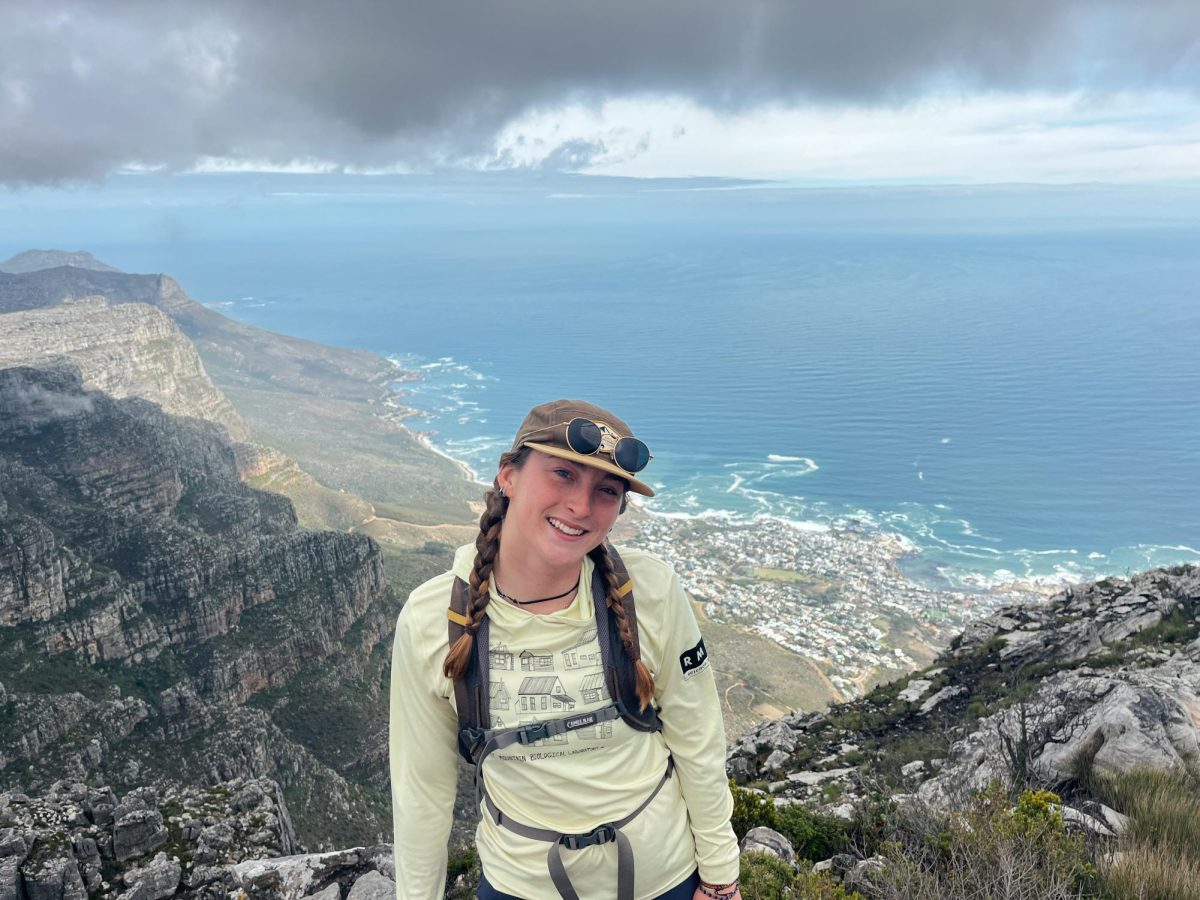
Powell has brought this focus on sustainability to every part of her life at Colgate, sharing that her work as an intern has helped her conceptualize lessons from her classes. Powell’s work extends beyond the borders of Hamilton — she conducted field work in Costa Rica and Peru, where she studied ecological systems firsthand, and spent a semester abroad in South Africa, where she observed how resource constraints shape sustainable practices at a national scale.
Powell described being struck by how South Africa had adapted to resource constraints, including scheduled rolling blackouts — known as load shedding — that pushed communities toward more efficient energy use.
“I got a lot of inspiration from South Africa, and different ways their country had optimized things in a sustainable way — using less water in some instances or using less power due to the load shedding was really cool,” Powell said.
Long term, Powell hopes to bring her new understanding of sustainability to the field of biology. She will begin this process by serving as an environmental educator in the Peace Corps, stationed in Mexico next year.
Reflecting on four years on campus, Powell shared that the peer-to-peer connection is what has stood out to her most about sustainability work.
“Oftentimes, sustainability just has to do with spreading the information as well,” Powell said. “Colgate really has taken a lot of great strides towards making the campus more sustainable. Keeping that in mind as I go on — harnessing what’s already been done and building off the momentum that’s already in place — will be important.”