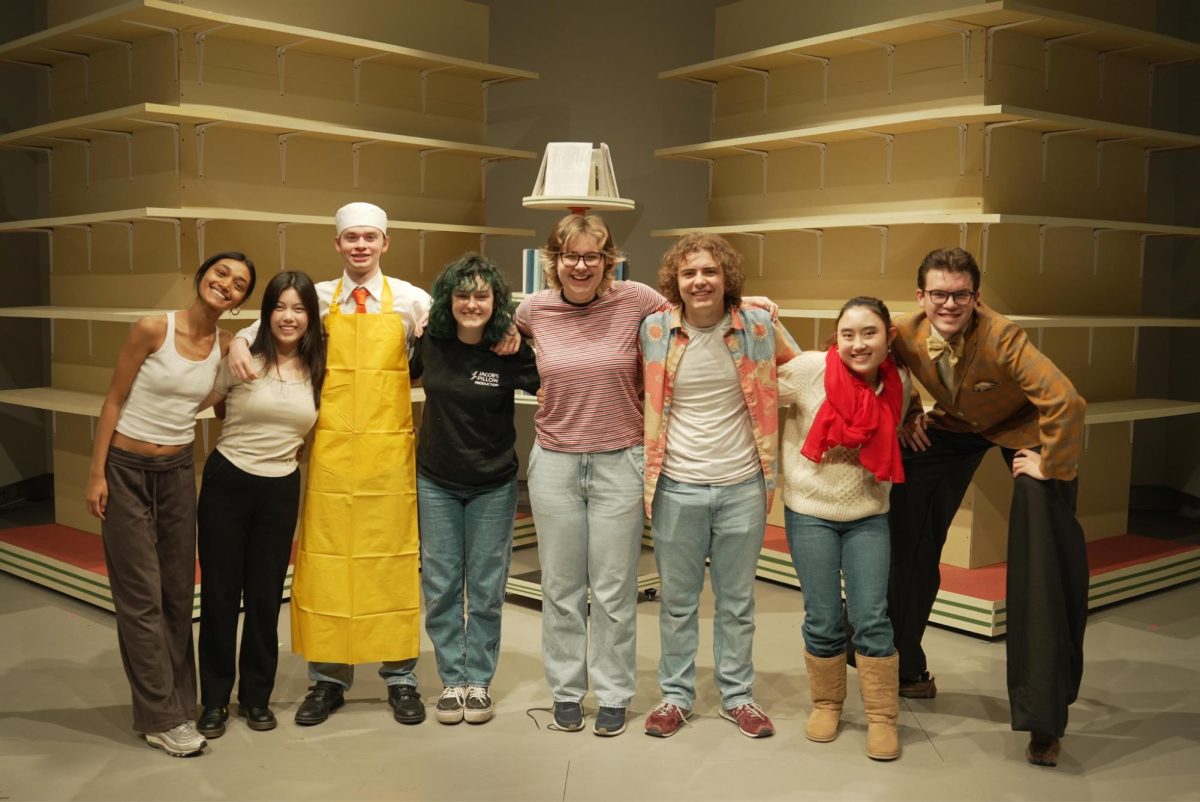
Colgate University Theater premiered “The Lake” in the Dana Arts Center on Tuesday, April 7. Russian playwright Mikhail Durnenkov unveils the emotional complexity of the present moment. On the surface, the characters drink by the lake and engage in petty arguments. Underneath the murky waters lie despair, guilt and fear. Durnenkov leaves the audience to grapple with the distance between normal daily life and the ever-changing world around them.
As the character Nina, played by Katherine McClellan ’25, performs a livestreamed makeup routine, she imagines mundane, awkward and incomplete moments. Her casual, humorous commentary almost obscures the deep existential question: How do we want to be caught at the end of the world? Minutes into the play, the audience confronts the tension between trivial daily life and a crisis-saturated world.
“Where are you right now? Where would you like to be at the moment the world ends? I wouldn’t want to be in a shopping center, or eating, or sleeping, or on an escalator, or on the brink of sneezing,” McClellan says, in character as Nina.
Simona Giurgea, senior lecturer in the University Theater, described what motivated her to direct and stage the production of “The Lake.”
“Durnenkov’s work has been shaped both by the collapse of Soviet-era narratives and by the rise of authoritarianism in the 21st century,” Giurgea said. “His plays reside at the intersection of art and civic courage, a space I’m very interested in.”
The play employs dark humor and surrealism. Six friends meet for a restful weekend on the lake, enjoying carefree activities like charades and fireworks. Beneath the idyllic surface, however, is a world far from perfect. The serene lakeside environment is interrupted by flashbacks of war, violence and crime.
Junior Sasha Wiebler played Viktor, a character the play describes as primitive — a man who keeps a bloodthirsty pitbull and enforces his own brutal code of justice. Throughout the play, Viktor shocks audiences with acts of brutal violence. In one scene, Viktor drags a man by a dog leash, as punishment for his cruel business dealings. Wiebler distinguished his favorite line from the bloody leash sequence.
“‘It means nothing!’ In this response to the terrified Alyona, Viktor makes clear that he did not do them a favor, despite revealing that the couple was being scammed,” Wiebler said. “It cements Viktor as a completely self-interested character in the story, living on his own terms and doing what he wants. It is for this reason that his character is so brutal and off-putting — he is truly animalistic.”
Giurgea discussed the tension between the characters’ ordinary lives and the looming political violence.
“We are marred by the world we live in. There is no refuge from it,” Giurgea said. “I hope that illuminating this idea elicits urgency and emphasizes the importance of practicing agency and integrity.”
Wiebler echoed these sentiments.
“Durnenkov developed [the story] as a commentary about the personal traumas we all face as well as the state of the world right now. All throughout, characters are seen grappling with not only their own relationships but the politics that surround them,” Wiebler said. “The only one that is seemingly impervious to this is Viktor, who, as I mentioned before, is practically an animal. Perhaps Viktor’s character is there to remind us that it is nearly inhuman not to be affected by the circumstances in which we live? I feel that for anyone simultaneously interested in the arts and disturbed by the current state of the world, this play is a must-watch.”
Through his long-standing critical positions, Durnenkov became a prominent dissident figure. Durnenkov uses art to address and analyze global crises. “The Lake,” written during Russia’s invasion of Crimea in 2014, speaks to the regime’s warmongering. The work explores how society constructs a comfortable and artificial reality to hide from disturbing changes.
Giurgea touched on how it is crucial to remain active and informed on the conflict in Ukraine and the traumatic experiences of individuals on the ground.
“The endless stream of images we scroll day and night might foster the illusion that we are only witnessing the world. I think it is imperative to keep in mind that we are also making it and humanity is to be measured first at the level of one’s breath,” Giurgea said.
When Russia invaded Ukraine in 2022, Durnenkov protested the regime’s actions. Pro-Kremlin groups began a targeted campaign against him on social media. Under scrutiny, Durnenkov and his family fled from Russia to Finland. Colgate’s performance of “The Lake” serves as a reminder of how fortunate we are to breathe the air of a free society.
When asked to summarize the play in one word, Wiebler said the word “cerebral” captures the essence of the play.
“A particular word has been stuck in my head since I first learned the production’s premise. Cerebral. I really feel as if it’s a mental portrayal more than a physical one,” Wiebler said. “The lake itself is supposed to be a carefree environment — everything the characters do reinforces this. They get to know each other, drink and eat till they can’t anymore. They light fireworks, laugh. But they are all haunted by problems outside of this bubble. And the brilliance of the play, in my opinion, arises from how such traumas creep into even the show’s most mundane scenes.”
Audience members regarded the play with high marks. Senior Cub Scott attended the performance and expressed his praise.
“I went to the performance on Wednesday night, and was captivated by everyone’s enthusiasm,” Scott said.