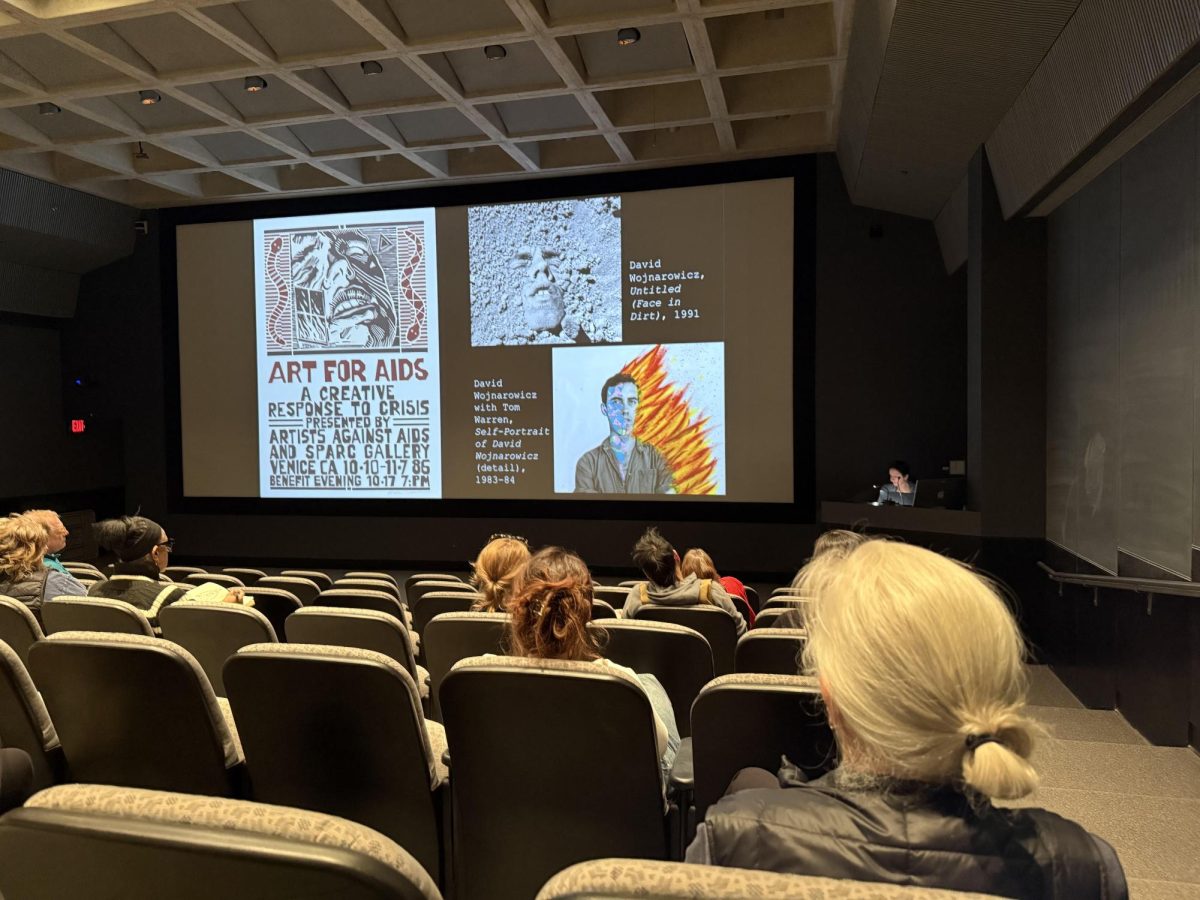
As the last lecture of Colgate University’s Art Lecture Series, the Art Department invited Helena Shaskevich, assistant professor of Modern & Contemporary Art History at Kennesaw State University, to speak on the work of AIDS and LGBTQ+ activist Michael Tidmus. The lecture took place on Wednesday, April 21.
Assistant Professor of Art Rachel Boate introduced Shaskevich and explained why her work was particularly relevant to Colgate students. Having been to graduate school with Shaskevich, Boate was familiar with her work and stressed the interdisciplinary nature of this research.
“I thought her projects would be interesting among students and faculty in the art department, but also computer science, film and media studies, and even LGBTQ[+] studies,” Boate said.
Shaskevich specializes in experimental media art from the 1960s to the present, often through the lens of pornography, women’s healthcare, television and feminist video politics. This lecture, however, strayed away from her typical focus on film and video art and feminist media, and instead centered on early digital activism, specifically how Michael Tidmus used Apple’s HyperCard as a tool for AIDS education, queer community-building and political resistance during the AIDS crisis.
“I think, like, a lot of things, it’s a happy accident — you bump into something that you find curious or interesting in a research archive, and you keep following that thread until it becomes a much larger project,” Shaskevich said.
She began the lecture by discussing Tidmus’ view on the importance of understanding AIDS not as a medical crisis, but as a cultural one as well. She stated that it doesn’t exist as a disease but rather as practices due to the culture and politics of AIDS, often in relation to the queer community.
She discussed “Against Nature: A Show by Homosexual Men,” a 1989 art exhibition created by Dennis Cooper and Richard Hawkins at Los Angeles Contemporary Exhibitions. This catalogue featured up-and-coming queer artists, and explored gay male desire as well as the impact of the AIDS crisis; it confronted conservative, heteronormative customs during the crisis. Tidmus’ contribution to Against Nature can be seen through his 1988 “Health and Morality: a Desultory Discourse,” as featured in Group Material’s book, “AIDS Timeline.”
This was a computer program that challenged the Reagan-Bush Administration and the religious right’s allegations regarding the AIDS epidemic. She also reviewed his 1989 computer program “Next,” which presented information about AIDS, and similarly addressed the Reagan administration’s response to the crisis as well as the consequences of this response. Shaskevich mentioned how Tidmus’ work is often overlooked and even avoided in discussions about nature and AIDS.
“I think both Tidmus himself, his body of work and the hypercard have fallen out of historic records,” Shaskevich said.
She then shifted to Tidmus’ work with Apple’s HyperCard, a software application released in 1987 that allows users to build interactive digital “stacks,” or virtual cards of information. Tidmus used HyperCard to create The AIDS Stack, a database that organized AIDS information into accessible, clickable cards for queer communities during the crisis.
Shaskevich emphasized the care and information-sharing aspects of the Stack.
“There are some really interesting questions that Tidmus’ hypercard projects ask, specifically about what it means to kind of create community out of this moment of crisis, without having the kind of fundamental structures that I think we use today, like the internet itself,” Shaskevich said.
Each card contained data and a set of interactive objects, such as buttons and checks, that everyday users could navigate. Shaskevich explained how the HyperCard was thus part of his broader project of making computing more accessible to the general public. She also mentioned how the Stack, having been one of the first popular forms of hypermedia, has emerged as a conceptual model for computers in our daily lives.
Shaskevich discussed how Tidmus’ work can be interpreted as foreshadowing later digital works and drawing upon others, such as Nam June Paik’s 1973 “Global Groove,” an electronic collage very significant in the world of video art, as well as MCI’s “Anthem,” a 1997 internet commercial. These works, Shaskevich described, framed digital space as raceless, genderless and universally accessible.
Shaskevich elaborated that Tidmus’s work represents an early form of queer digital practice, which often translated complex information away from large institutions like the Centers for Disease Control and Prevention (CDC) and instead into intimate, usable HyperCard stacks for individuals. Therefore, he took widespread knowledge and made it personal, navigable and useful for the queer communities affected by AIDS.
She also focused on a specific work of Tidmus, depicting a crowd of queer men attending an AIDS rally — she emphasized how the photo’s focus is on the crowd rather than the event itself, signifying that the political power of AIDS activism was reliant on communal action and shared resistance from the queer community.
Instead of treating AIDS knowledge as fixed or owned by institutions, his HyperCard stack treated information as something meant to circulate. He even encouraged users to donate to AIDS charities and modify the stack themselves, making the user an active participant rather than a passive viewer, as they may be in a traditional gallery.
Shaskevich also focused on the AIDS memorial quilt at the University of California, Los Angeles, in 1988. She mentioned how walking from one quilt to the next echoes the click of a hypercard, from one card to the next. She also mentioned how his project features a quote by Joseph Stalin: “A single death is a tragedy; a million deaths is a statistic,” underscoring the scale of the AIDS crisis and how Tidmus’s work sought to resist this reduction of people to numbers.
His final hypercard was titled “Feral Street” in 1991, which shifted away from hypercards and instead towards the infrastructure of the World Wide Web, which Shaskevich argues continues to evolve. ArtAIDS is an evolving project that showcases artwork to celebrate and commemorate lives, individuals, voices and creativity, therefore showcasing the continual impact of AIDS. Shaskevich concluded that Tidmus’ hypercards themselves aren’t necessarily early computer art, but rather an early theory of what the computer may be due to their ability to contain intimate information that no other form of technology in 1988 could carry.
Through this lecture, sophomore attendee Mia Abramson gained a new appreciation for digital media.
“I thought it was fascinating to learn about how digital media during the AIDS crisis could be used not only as a tool for art, but also as a way to foster community and share life-saving information,” Abramson said.
Shaskevich is currently working on a larger project regarding the techno community, at what she describes as “the margins of the global village.” The Art Department’s lecture series next year will feature a combination of academic lectures, visiting artists, workshops, exhibitions and screenings.