


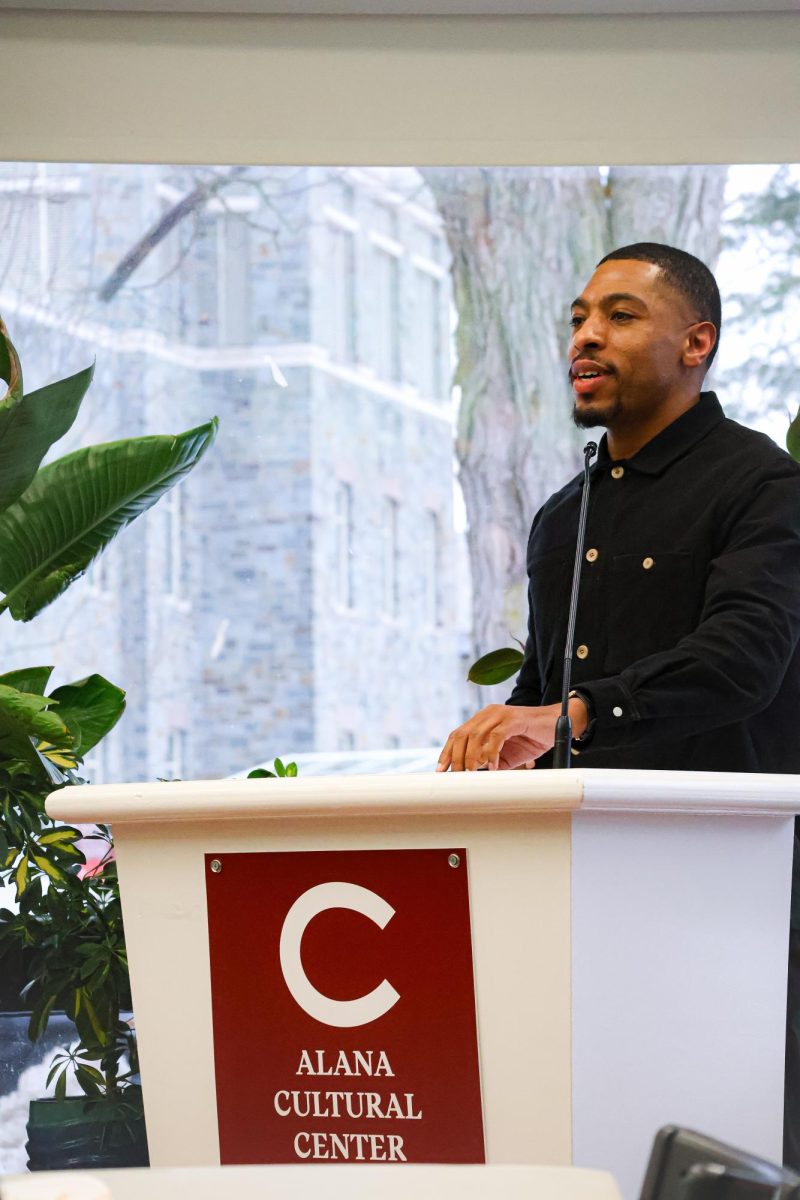
Jarvis R. Givens, a professor of education and African & African American studies at Harvard University, visited the Africana, Latin, Asian and Native American (ALANA) Cultural Center at Colgate University on Friday, Feb. 28 to discuss his research on the history of Black teaching and education in the United States. Givens has published two books on the subject, “Fugitive Pedagogy: Carter G. Woodson and the Art of Black Teaching” and “School Clothes: A Collective Memoir of Black Student Witness.”
The talk was hosted by Brothers, a student organization dedicated to promoting awareness on issues affecting men of color, as an event to cap off Black History Month with a guest speaker. Before the talk began, Givens remarked that organizations and spaces similar to Brothers and ALANA sustained his personal and intellectual life as an undergraduate at the University of California, Berkeley.
Senior Fredy Alvarado-Retana, member of Brothers, explained his connection to Givens.
“I had previously read ‘Fugitive Pedagogy’ for class, so it was a great experience to meet him and hear his insights in person,” Alvarado-Retana said.
Givens attended Berkeley for 10 consecutive years — from his time as an undergraduate to completing his doctorate in African diaspora studies — before becoming a postdoctoral fellow and professor at the Harvard Graduate School of Education, where he pursues research on educational history.
In addition to scholarly writing and editing, Givens’ tenure at Harvard has also been marked by his work toward creating the Black Teacher Archive, an open access online portal which serves as the largest online repository of information on Black teachers.
These two aspects of his academic work were the key points of his talk at ALANA. This work, he said, was motivated by the discovery of an image of a segregated Black classroom before the Supreme Court’s ruling in Brown v. Board of Education. The classroom, patiently awaiting the arrival of Carter G. Woodson, a prominent African-American writer and educational theorist, seemed to dispel the notion that African-Americans had no robust teaching system of their own before desegregation.
“All these stories about unequal and separate Black education before Brown v. Board of Education were factual, but failed to remember the art of Black teaching,” Givens said.
Givens felt that the educational realities of Black teachers working under anti-Black circumstances were missing from the historical record, and so looked to historical archives which might provide him with raw historical evidence to fill in the gaps. Givens said that this task required him to engage in “archival assembly,” or the discovery, preservation and rearrangement of historical collections to address erasure and archival silences.
In the first part of his talk, titled “Assembling a Fugitive Archive on Black Teaching,” Givens used archival findings to tell the story of Tessie McGee, a Black teacher working in Jim Crow-era Louisiana. Through records, including an account of her classroom by one of her students, Givens discovered that McGee consciously engaged what he called “fugitive pedagogy”: efforts by Black teachers to resist anti-Black educational protocols which have been historically underrepresented in archival records.
According to student accounts and other documents, McGee frequently revised Jim Crow-approved curricula and introduced students to the work of Black intellectuals like Woodson, largely hidden from the view of educational authorities. Givens said that this teaching practice was founded in the tradition of fugitive pedagogy that originated among enslaved people’s self-educational resistance to white authority.
“[Fugitive pedagogy] draws a narrative line from enslaved people who pursued education subversively to the subversive education of Tessie McGee,” Givens said.
More than drawing new historical conclusions, Givens’ investigation into fugitive pedagogy revealed holes in the historical archives which he hoped to patch with the creation of the Black Teacher Archive in October 2023. After traveling around the country, Givens found many archives containing information vital to his scholarly work to be underfunded and under-processed.
“What I found after traveling to more than a dozen states and Washington, D.C., was troubling because most of the materials were unprocessed or existed in bits in pieces,” Givens said. “My work as a scholar became about more than looking for these things, but preserving them so that an archive existed for subsequent generations of scholars.”
In the second part of the talk, called “An Assembly of Black Students,” Givens raised the point that his reconstruction of Black educational history saw students, not only teachers, as its subjects and central figures rather than just passive objects.
“For so long, Black students have been written about, held under a microscope, poked and prodded […] but rarely have those gazers considered those students looking back,” Givens said of the treatment of students as historical objects.
He drew notable examples from his book “School Clothes” to describe the active role of Black students in their education, one being that the song “Lift Every Voice And Sing,” widely regarded as the ‘Black National Anthem’, was performed for the first time by schoolchildren in Jacksonville. Another example came from a letter written by Givens’ high school English teacher as a student in the 1950s describing her experience of racism.
The talk closed with a reiteration of Givens’ scholarly and historical interest in archivism and the organization of unaddressed records. He noted that the term ‘assembly,’ as in archival assembly, carries with it connotations of historical resistance of oppression.
“When gathered together, these artifacts become much more than collected material, but an opportunity for a collective memory to awaken,” Givens said.
During a short question and answer session, Givens extended his work to current events. He said that the sorts of educational restrictions which some audience members anticipated were part of a historical trend of responses to threat or resistance which impose pedagogical crackdown.
For first-year Jordan Gonzalez, a member of Brothers, Givens’ closing remarks made sense in historical context. He agreed with Givens about the preservation of the historical record.
“There was a point in the presentation where he stated that librarians have got to be the most — if not one of the most important — roles in society,” Gonzalez said. “The preservation of old texts is fundamental for future contributions in order to paint an image of society’s current state, encouraging civil movements, which is safe to assume that there has been great progress since the Jim Crow Era.”
