


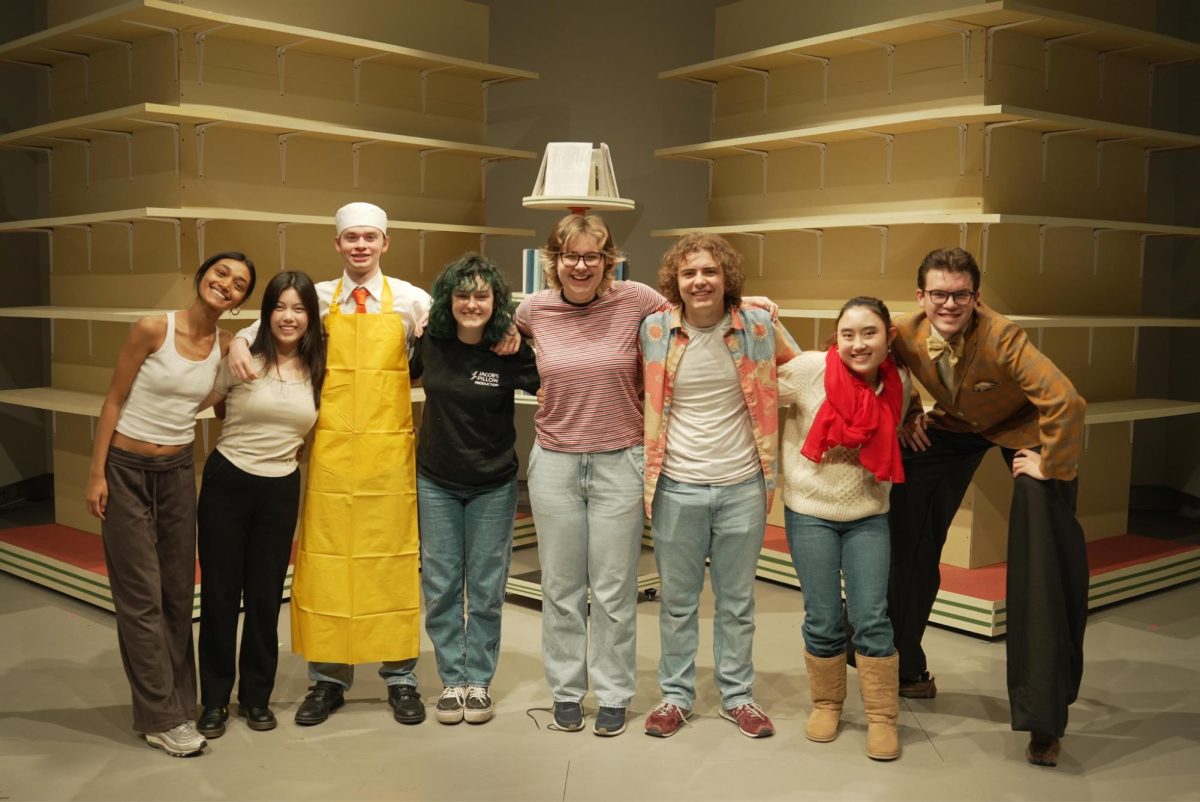
Seniors Tanner Harmon and Vee Vuignier presented their theater thesis project “Everything Must Go” at the Vault in Bernstein Hall on Tuesday, April 21 and Wednesday, April 22. Harmon wrote and directed the play while Vuignier managed the scene and lighting.
The play follows nine-year-old Adam on an existential journey through a grocery store. The play follows Adam as he runs away from his mother in a grocery store and navigates the aisles, encountering characters known as the Reader, the Butcher, the Mother and the Stocker. In a seemingly ordinary setting, Adam faces ignorance, cruelty and false guidance, ultimately confronting his own mortality.
Harmon originally drafted the script as a 10-minute production, then expanded the narrative to an hour-long show over winter break. The production timeline was about four months, giving the cast and crew a short turnaround.
Inspired by the Theatre of the Absurd, the show’s plot and subversive dialogue invite multiple interpretations. Harmon said the audience has viewed it as a religious allegory, a metaphor for death and even a child’s nightmare.
“For me, it actually is very clear and simple because you can’t write something if you think it’s complicated — you have to understand that it’s simple,” Harmon said. “But then every time I hear a different interpretation from someone else, I’m like, ‘Oh, that totally makes sense, I didn’t see that one coming.’”
Even among the cast, interpretations varied, leading to different improvisations and understandings of character. Harmon said balancing the roles of playwright and director was challenging; he felt attached to the text but added that the production’s constant change and improvisation were the most compelling aspects of directing.
“By the end, all of the actors really had an ownership of the show and really did the work of their characters and understood their scenes very, very well,” Harmon said. “As a director, at the end, you just step back, and you throw your hands up, and it’s not your show anymore. To see them care about it so much was really touching.”
The set also took on a life of its own, with gargantuan shelves, towering receptacles filled with books and characters on stilts transporting the audience into the world of “Everything Must Go.” Because it was an original show, Vuignier enjoyed the freedom to experiment with design without any preconceived notions of how the production should look. However, the limitations of the Vault set some parameters.
“So much of [the set] was just based on having no backstage and having to make every single element we brought in super functional and able to provide as many different scenes and locations within the same store,” Vuignier said.
Certain technical elements, such as the scenery and props, were not completed until the dress rehearsal. The production came down to the wire, with the set being painted up to the start of the first performance.
Given the collaborative nature of live theater, happy accidents and improvisations are inevitable, and these unexpected moments can inspire creative choices that end up making the whole show.
“I think so many of the things that might end up looking like the most interesting, most thought-out artistic choices have ended up just being accidents that you set yourself up for,” Vuignier said. “Those moments, especially in the depths of tech when you’re just trying to get through it all and then something magical happens, and the whole room just freaks out for a second, and it all just lights up — that’s really just a magical moment.”
In creating “Everything Must Go,” Harmon hoped to introduce the Colgate audience to existential themes, having them sit internally with the big questions the performance poses.
“I think that the concerns of the play permeate, especially with a Colgate culture of, to a certain extent, conformity and being in this comfortable little crimson bubble. I think that for that reason, a lot of these big uncomfortable problems and questions kind of sit under the surface, such that they’re always kind of brewing and bubbling and bothering you, but we’re never given the opportunity to confront them,” Harmon said. “My goal with the play is to give people an opportunity to not just have those existential fears sit underneath them but to give them a chance to experience them cathartically.”
Whether audience members engaged on this deeper level or attended to support their friends, viewers appreciated the show’s eccentricity. First-year Solana Loney enjoyed the technical aspects of the production, along with how the show’s meaning was up to interpretation. As a fellow actor, she also appreciated the strong characterization her peers displayed.
“I really liked the setup of how they moved everything from the freezer and all of the lighting cues. The acting just really went along with everything,” Loney said.
The end of “Everything Must Go” broke the fourth wall, though the production did not leave the audience with a single, defined answer. Instead, the show’s ambiguity lingered with viewers after the performance.
“At the end, all you’re left with is mortality and the questions answered with questions, and then we have to save Adam at the end of the play,” Harmon said. “He thanks the audience at the end because if they weren’t there to see it, he would have gone through it for nothing.”


