



For decades, Miles Burton “Burt” Marshall was a fixture of Hamilton life — the tax man, the insurance agent, the neighbor. He offered deals that sounded too good to pass up: an 8% annual return on investment, backed by what he claimed was a thriving local real estate portfolio. Nearly 1,000 people said yes to Marshall. On Tuesday, April 28 — three years after the investigation was launched — Marshall stood in Madison County Court and admitted that he had been stealing this money for years.
Marshall, 74, pleaded guilty to second-degree grand larceny, securities fraud and first-degree scheme to defraud. He will be sentenced on June 11 to between four and 12 years in state prison. As part of the plea agreement, a bankruptcy court will enter a $94.6 million judgment against him — a large sum of money that both the prosecutor and defense attorney agree Marshall cannot pay.
New York State Attorney General Letitia James’ office says that Marshall ran this classic Ponzi operation from the early 1990s through March 2023. He told investors that their money would fund property purchases and the upkeep of rental units across Madison County. He accumulated more than 100 rental properties in the area, most of them in and around Hamilton. What he did not tell them was that he was paying earlier investors with money from newer ones, all while the whole structure quietly collapsed underneath him. Investigators found that by 2016, Marshall’s liabilities exceeded his assets by more than $40 million. Still, he kept soliciting new investors.
The gap between what Marshall owed and what he owned was not accidental. Part of what drove that figure so high was the structure of the investment itself. Victims who withdrew their 8% annually recovered at least some of their principal over time. But those who did the financially prudent thing — leaving their money in to compound — lost everything. At 8% compounded annually over decades, paper balances ballooned far beyond what Marshall’s real assets could ever cover, which is why a portfolio of roughly $25 million in properties came to support nearly $95 million in claimed obligations.
Chuck Fox ’70 has lived in Hamilton for decades and knew Marshall personally. He says that Marshall was still drumming up new investments even after he had been notified that he was under investigation, all the while sending his standing clients falsified documents showing healthy, fictitious account balances.
“Because [Marshall] had been around for a long time — his business had been around, and his family had been around — people assumed that this was okay, but all they really got when they invested was a note, like an IOU: ‘you give me $100,000 and here’s a note that says you gave me $100,000,’” Fox explained. “He was one of only two insurance people in town. He’d done everybody’s taxes — he had firsthand knowledge of the finances of a whole bunch of people, and he would use that to solicit them.”
Fox elaborated on the community impact of Marshall’s scheme.
“Once this became public, there was no conversation in Hamilton that went for more than 15 minutes before [Marshall] came up,” Fox said. “Everybody knew him, and everybody just intuitively assumed he was a straight shooter, and he wasn’t.”
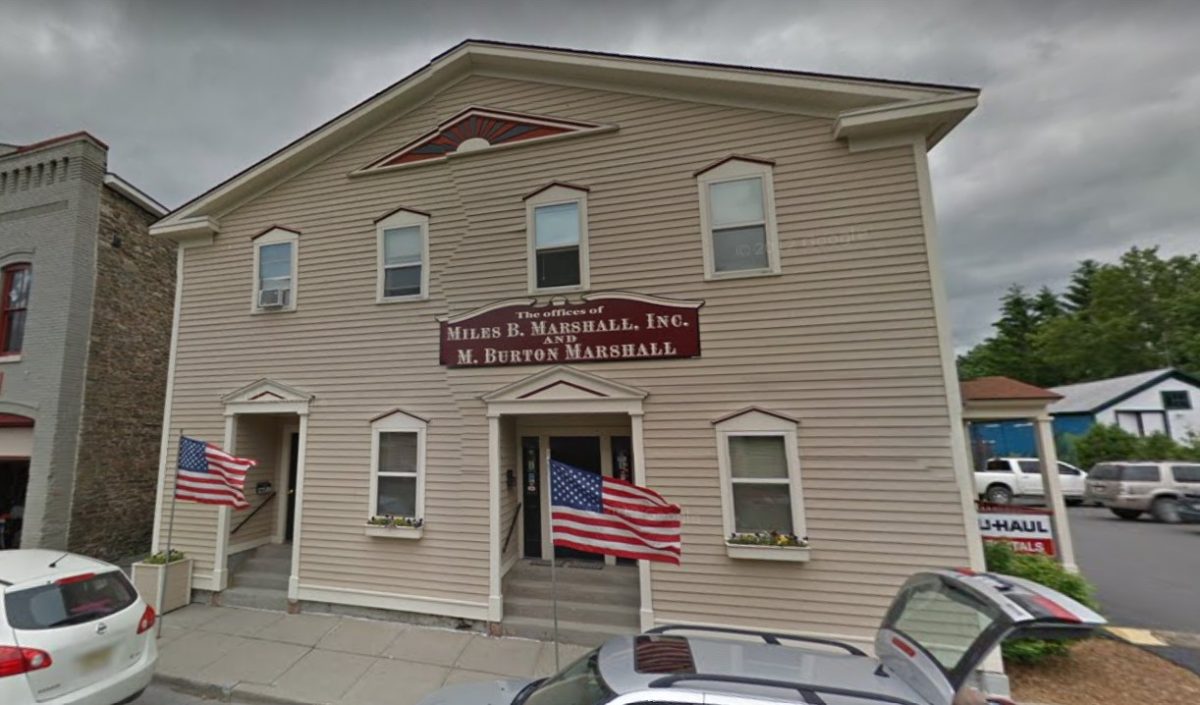
When Marshall finally filed for bankruptcy in 2023, he reported owing $94.6 million in principal and accumulated interest to 988 investors. A bankruptcy court trustee’s sale of Marshall’s rental properties and two personal homes generated proceeds that were largely absorbed by legal fees and real estate costs, leaving victims with almost nothing. The 988 investors who trusted Marshall stand to recover just four cents on the dollar.
“Under most other circumstances, if somebody’s offering something like this, it would be more of an arm’s-length transaction, and you would check with your advisors, and make sure this is okay,” Fox said. “But again, [Marshall] was around — a long time he has been here. Everybody knows [Marshall], and so even though he’s a little wacky, everybody thought this is okay.”
The theft extended well beyond individual investors. Marshall also drained funds from nonprofit organizations throughout Madison County. The Brookfield Rural Cemetery Association lost $170,000 designated to maintain the cemetery grounds. Local fire departments and churches were among the other community institutions affected.
With the money siloed from these unwitting investors, Marshall maintained a consumerist, jet-setting lifestyle. Pay logs show hefty expenses at American Airlines, Lululemon, Priceline, restaurants and yoga studios.
What makes the case particularly painful for many victims is the intimacy of the betrayal. Marshall was not a stranger cold-calling from a brokerage. He was the man who knew your financial life in granular detail, who sat across from you at tax time and asked after your family. His insurance and tax preparation businesses gave him access to people at their most financially vulnerable and trusting. Fox’s family had their insurance through Marshall. Marshall’s wife was even the Fox family’s first babysitter.
“That’s the sad part — everybody in town knew him,” Fox said. “[Marshall] was an odd guy at best. Again, that’s the thing: this is a big deal in a small community.”
According to Fox, Marshall’s character was a contradiction. He was a member of the Odd Fellows, a community organization that has a float in Hamilton’s annual July 4 parade. Fox remembers Marshall riding shirtless on the float, armed with a water soaker gun, drenching bystanders while the crowd waved back at him.
“It was the weirdest thing. And people are pissed, you know, he’s having a great time,” Fox said.
In a press release from the attorney general’s office, New York State Police Superintendent Steven G. James further addressed the havoc Marshall wreaked.
“Today’s conviction is verification that we will not tolerate the actions of those willing to misguide and victimize unsuspecting individuals for money,” James said. “Mr. Marshall thought only to enrich himself at the expense of others, with no regard to their well-being.”
Fox described Marshall as someone who could pivot from arrogant to generous depending on the day. He supported local projects and participated in community life, even as he was quietly draining it. That duality has made the fallout harder to process for some residents, and the online anger following his arrest spilled over onto people who had nothing to do with the scheme, including Marshall’s family.
“[Marshall] is a bad guy, but not his family. They had nothing to do with this — they didn’t know about this. So just leave them out of this,” Fox said.
Investigators from the attorney general’s Criminal Enforcement and Financial Crimes Bureau, working alongside the New York State Police’s Major Investigations Unit, built the case over the years. The Financial Industry Regulatory Authority, the U.S. Securities and Exchange Commission and local law enforcement all contributed to the investigation.
“[Marshall] scammed his clients out of their life savings and used their hard-earned money to fuel a classic Ponzi scheme,” James said. “My office will not tolerate anyone who breaks the law and misleads investors to line their own pockets. I thank the New York State Police and our partners in law enforcement for their work to secure this conviction and help those who were cheated get their money back.”
Marshall’s defense attorney, Jeffrey Parry, told reporters after Tuesday’s plea that the bankruptcy proceeding left Marshall with no money. The $94.6 million judgment is effectively symbolic. That reality sits bitterly with many victims. Some have spent years not knowing whether Marshall would face any accountability at all. For those who lost retirement savings, inherited family wealth or money set aside for future generations, a four-year minimum sentence feels like a poor trade.
Still, Tuesday’s guilty plea marked something. For a community that spent years watching Marshall operate freely, sitting on the other side of the desk from the very people he was defrauding, it was, at a minimum, an acknowledgment that the harm was real. Fox says people in Hamilton are not sorry to see Marshall face prison time. But Fox was also careful about what conclusions to draw from one man’s long con.
“Most people understand that this is a very unusual thing, and it’s a one-off. This is not an indictment of small businesses or local businesses. That’s one of the real beauties of living in a small community like Hamilton — you do trust,” Fox said. “It is definitely a wake-up call for people to be careful when something sounds maybe too good to be true.”
Sentencing was scheduled for June 11 before Judge Rhonda Youngs in Madison County Court.
