The U.S. Open delivered on its usual spectacle of tennis greatness and cultural affluence, concluding Sept. 7 in Flushing Meadows. Both the men’s and women’s draws had faces of the old and new guard, but judging by the outcomes witnessed over the weekend, it’s hard to deny that tennis is entering a new age of competition and excitement.
The women’s finals, played on Saturday, saw Aryna Sabalenka of Belarus face the homegrown American Amanda Anisimova. Sabalenka won the matchup handedly, beating Anisimova in just two sets, though the latter set was close by virtue of a tiebreak. The final score was 6-3, 7-6 (7-3), marking her fourth win in Grand Slam tournaments, having won the U.S. Open last year as well.
Going back to back, Sabalenka is the first woman since Serena Williams in 2013 to win the U.S. Open multiple years in a row. Sabalenka’s tennis is renowned for its power and ferocity, and she has been no stranger to playing on the biggest stages of the tennis world. The Belarusian lost to Anisimova in the semi-finals of this summer’s Wimbledon and lost in the finals of this year’s Australian Open and French Open, losing to Americans Madison Keys and Coco Gauff, respectively.
Rejoicing in the breaking of her championship losing streak, Sabalenka gave personal and heartfelt thanks to her team in her champion’s speech.
“I mean, it’s been tough this year, and in those finals I was really terrible towards you [guys], but come on, it’s worth it, right?” Sabalenka said.
Anisimova, the runner-up, was playing in just her second Grand Slam final after having lost to Iga Świątek at Wimbledon this past summer, and faced a tough road up to the championship round. Anisimova dropped only one set through the round of 16 and would go on to defeat Świątek in the quarter-finals, followed by an intense win in the semi-finals over the resurging Naomi Osaka, who won the tournament in 2017 and 2019.
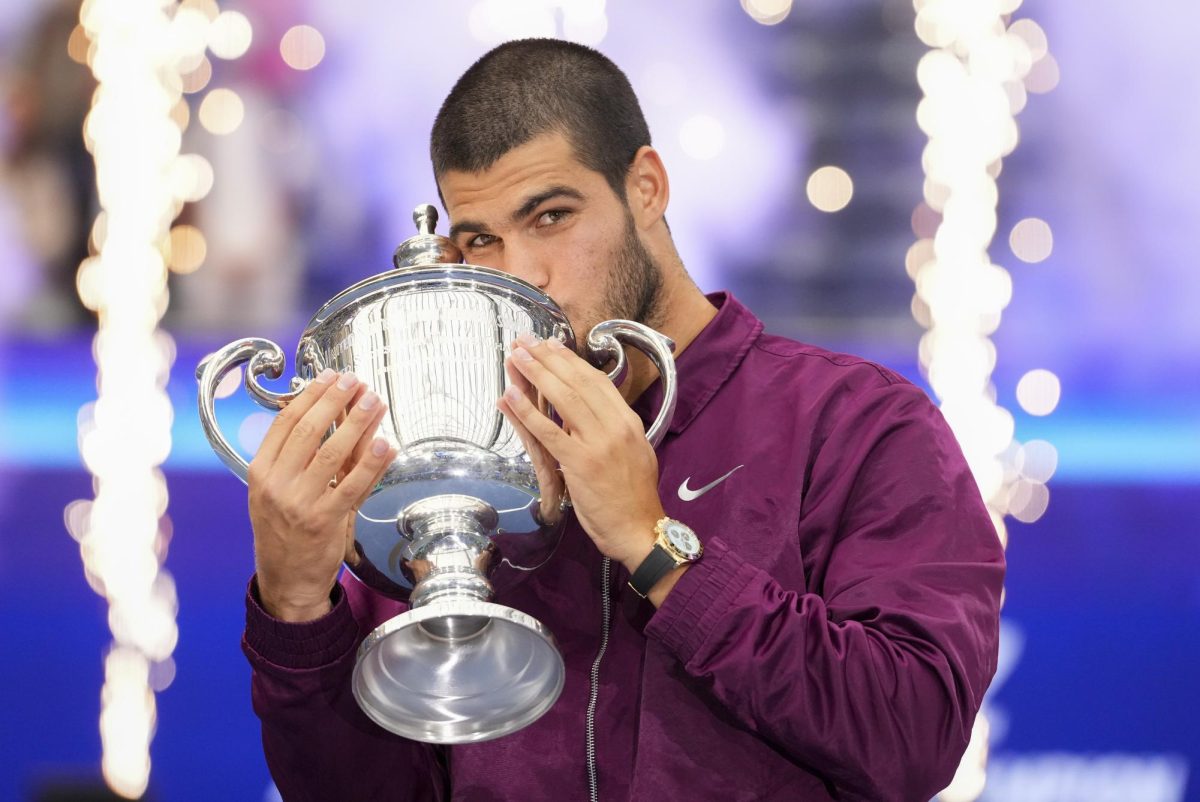
The men’s championship was held the day after and showcased the usual suspects: Jannik Sinner and Carlos Alcaraz. The history between these two, though Sinner is 24 and Alcaraz is only 22, has already generated much promise and drama for this new era of tennis, and Sunday was nothing short of that. No. 2-seeded Alcaraz defeated No. 1-seeded Sinner 6-2, 3-6, 6-1, 6-4 to reclaim the US Open title.
Each of the men’s finals in Grand Slam tournaments this year ended with either Sinner or Alcaraz crowned champion, which comes as no surprise after the same pattern had occurred throughout the 2024 season as well. This year, Sinner had defeated Novak Djokovic in the Australian Open and Alcaraz at Wimbledon, but he had also lost to Alcaraz in a five set marathon on the clay courts of the French Open, thus marking both players as reasonable adversaries, in which neither is clearly treated as the underdog or favorite.
Heading into the finals, Sinner was looking to defend his U.S. Open title just as Sabalenka had done. More than that, Sinner was also looking to earn his fifth Grand Slam trophy, as Alcaraz had done when he beat Sinner in that five set marathon.
Before the decision on Sunday, Sinner had won three of his four Grand Slam titles on hard court, whereas Alcaraz had only won one of his Grand Slam titles on hard court (back in 2022 at the U.S. Open itself). It is therefore even more impressive that Alcaraz did not drop a single set on his way to the finals against Sinner.
Despite their history, Alcaraz’s victory on Sunday was decisive and emblematic of the sport’s future.
“I’m seeing you more than my family. It’s great to share the court, to share the locker rooms, everything,” Alcaraz said during the trophy ceremony, drawing a smile from Sinner.
The Italian was gracious in defeat, conceding Alcaraz’s dominance.
“You were better than me. I tried my best today. I couldn’t do more,” Sinner said.
With Alcaraz’s win, the long-discussed transition from the “Big Three” of Roger Federer, Novak Djokovic and Rafael Nadal to a new generation appears complete; men’s tennis looks to be in capable hands.
Outside of the men’s and women’s winners, there were many other storylines weaving through the U.S. Open that added much to the excitement of the tournament. Venus Williams made a celebrated return to the U.S. Open in the form of a wildcard bid and she had an impressive run playing alongside Canadian Leylah Fernandez. The duo played well, but ultimately lost to the one-seeds, Katerina Siniakova of Czechia and American Taylor Townsend in the quarter-finals. Siniakova and Townsend would go on to lose to the three-seeds, Canadian Gabriela Dabrowski and New Zealander Erin Routliffe, in the finals, by a score of 6-4,6-4.
Other headlines during the tournament included the presence of President Trump, who received a mix of loud boos and cheers when he appeared on the Jumbotron during the singing of the national anthem. Stadium capacity was limited due to the President’s appearance and the corresponding security measures, but the crowd, who was there for the tennis anyway, was still committed to a love for the sport throughout the entirety of the finals.
Politics and fans aside, the U.S. Open also held ceremonies for Maria Sharapova and Bob and Mike Bryan as they were officially inducted into the International Tennis Hall of Fame, a testament to the greatness and beauty they contributed to the sport of tennis, not only at the U.S. Open, but throughout their entire respective careers as well. Additionally, a new mixed-doubles format brought new attention to the undervalued draw. The innovation of the tournament is one that demonstrates tennis is prepared to learn, adapt and thrive within the years to come, and that is something any tennis fan can and should value for the foreseeable future of such an incredible sport.