College football’s opening weeks rarely fail to surprise, and this season has been no exception. Headlines were made in Columbus, Ohio, where preseason No. 3 Ohio State University upset preseason No. 1 University of Texas 14–7 in a defensive slugfest that lived up to the hype. The Buckeyes controlled the Longhorns the entire game, frustrating Texas’s new leader, quarterback Arch Manning, in his highly anticipated debut. He completed 17 of 30 passes for 170 yards, with one touchdown and one interception, a performance that left Texas fans with more questions than answers. The pressure was immense for a first start on the road in the Horseshoe, but Manning showed flashes of poise even if the score didn’t reflect it. In the end, however, Ohio State’s defensive front stole the spotlight, set the stadium roaring and left fans wondering if the Buckeyes should take over the number one spot in the preseason poll.
At the same time, preseason No. 9 Louisiana State University took down preseason No. 4 Clemson University 17-10 behind a balanced attack and timely defense. The LSU Tigers leaned on senior quarterback Garrett Nussmeier, who threw 28 of 38 passes for 230 yards with one touchdown. For Clemson, the loss marked another early stumble in what has become a troubling trend: a preseason promise that is derailed before October.
Meanwhile, preseason No. 10 University of Miami delivered a 27–24 primetime win over preseason No. 6 Notre Dame University, a victory that reaffirmed the Hurricanes as serious ACC contenders. Senior quarterback Carson Beck threw for 205 yards with two touchdowns in his debut as a Hurricane. Notre Dame’s offense had late chances, tying up the game, but Miami’s offense held firm, and senior kicker Carter Davis made a 47-yard field goal, sealing the win in front of a raucous Hard Rock Stadium crowd.
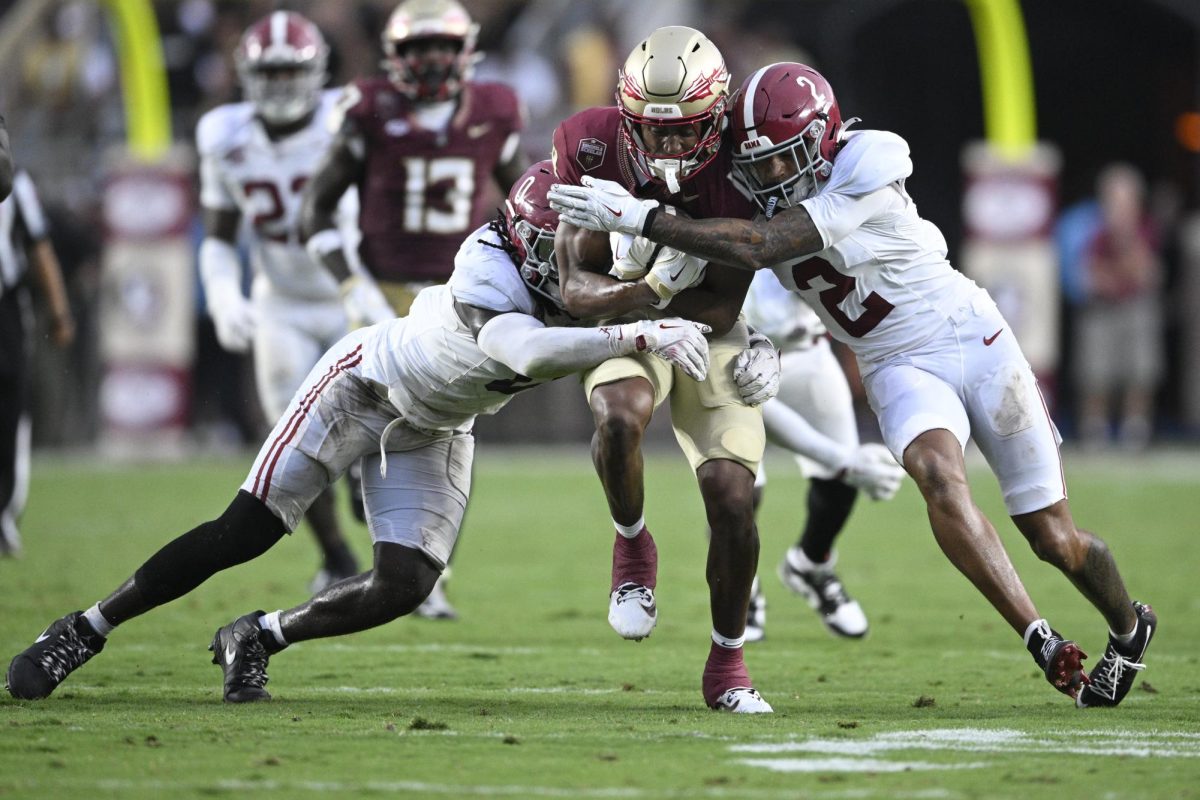
Still, no team made a louder statement than Florida State University. Entering as an unranked underdog, the Seminoles stunned preseason No. 8 Alabama 31–17 in Tallahassee. Quarterback Brock Glenn did not play due to an injury, but quarterback Tommy Castellanos made his debut for FSU, completing 9 of 14 passes for 152 yards. The upset sent shockwaves through the SEC and ACC and vaulted the Seminoles back into the national conversation. As if to prove the win was no fluke, FSU followed up with a 77–3 demolition of East Texas A&M University during week two, setting a school-record margin of victory and underscoring just how dangerous this team might be.
Up North, the University of Michigan unveiled a new talent: first-year Bryce Underwood who threw for 251 yards, the most ever by a Michigan QB in a debut, leading Michigan to a 34-17 win over the University of New Mexico. For a moment, it looked like Michigan was ready to reclaim its swagger. Then Week 2 hit.
The second weekend of the season offered both dominance and disaster. At the top, several contenders made emphatic statements: Ohio State blanked Grambling State University 70–0, University of Oregon humiliated Oklahoma State University 69–3 and University of Tennessee shattered its scoring record in a 72–17 rout against East Tennessee State University — all statements of confidence.
But if Week 2 was about dominance, it was also about college football’s trademark unpredictability. University of South Florida stunned University of Florida 18–16 with a walk-off field goal, completing back-to-back weeks of ranked upsets and launching the Bulls from anonymity into the national conversation. Penn State University cruised to a shutout yet looked uninspired on offense, while Michigan unraveled against Oklahoma University, losing 24–13 and exposing flaws that first-year brilliance alone won’t fix.
Two weeks in, the AP Top 25 has already shaken up. Ohio State leads the pack at No. 1, followed by Penn State, LSU and Oregon. Florida State’s surge into the top ten feels like the start of their surge to contender status. The wildest rise belongs to South Florida at No. 18, the season’s unlikeliest storyline. Meanwhile, preseason hopefuls like Michigan, Arizona State University, Florida, and Southern Methodist University have tumbled out entirely.
Three themes stand out: First, upsets remain September’s lifeblood. FSU over Alabama, USF over Florida and Baylor University over SMU are all proof that reputations don’t protect anyone. Second, powerhouses are flexing. Ohio State, Oregon, and Tennessee have handled lesser opponents with ruthless ease. Finally, new narratives are taking hold. From Underwood’s record-setting debut to USF’s first top-25 ranking since 2018, early September has already redrawn the season’s map.
This is only the beginning. Week 3 looms with matchups that could add even more fuel to the fire. The University of Georgia faces the University of Tennessee in an SEC clash of heavyweights. Miami hosts surging USF, which suddenly looks like the nation’s most compelling underdog. Lastly, Texas A&M visits Notre Dame in a game that could make or break both teams’ playoff aspirations.
College football thrives on unpredictability, and if the first two weeks are any indication, the only certainty is that more chaos lies ahead — exactly how September should feel.