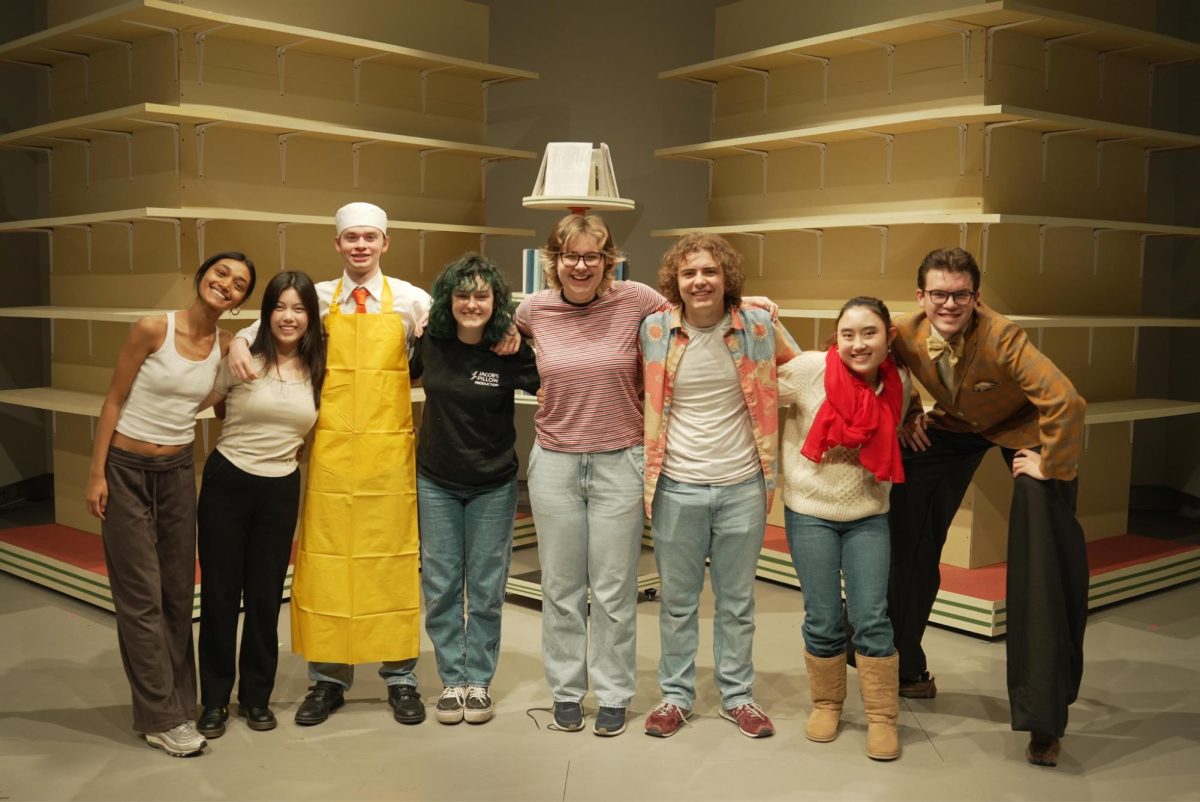
Colgate University’s Department of Theater welcomed experimental director, playwright and conceptual artist Richard Maxwell and New York City Players for a two-week residency in and around The Vault in Bernstein Hall. Maxwell’s lecture on Oct. 1 centered on his latest pursuit: robots on stage.
Maxwell shared video clips from his production “Work in Progress.” In one striking vignette, an actor stands alone on stage and describes the perils of a war-torn state. Intrigued and captivated, the audience in Bernstein Hall leaned in. However, this actor is not human at all — it is a robot.
A “Work in Progress” centers around a vague war. Maxwell seemed to omit basic principles of a production, keeping the time period and location ambiguous, aside from mentions of a mysterious place known as “the colony.” However, the plot was not the main driver of the show; in fact, Maxwell directed actors not to memorize their lines, but rather to read them off a projector while the production was occurring.
His actors noticed Maxwell’s aversion to pretending and desire to portray lifelike experiences in his work.
“He’s like, ‘Hey, I know you guys can read … I’d prefer to have you in a position of doubt and prefer to have the audience watch you parse the text live on stage,’ because that experience of them stripped down on stage, he thinks, is so much more important and it carries so much more weight than asking them to put on a performance,” senior Tanner Harmon, assistant stage manager and actor, said.
Maxwell’s troubled relationship with realism was a point drawn on in his lecture.
“I’m not interested in pretending at all,” Maxwell said.
He further shared his belief that in-depth characterization robs the audience of creating their own interpretations and drawing their own meaning from his work. Maxwell is chiefly concerned with the feelings of the audience, rather than the feelings of the actors or himself, informing the deadpan delivery.
This was reflected by the physical space of The Vault as well.
“I think [Maxwell] utilized the space very effectively because the intimacy and the stark whiteness of the whole thing was central to his ethos about truth and clarity and simplicity,” Harmon said.
The trademark affectless delivery of actors has been described as robotic, making for an exciting juxtaposition when actual robots are introduced in Maxwell’s productions. Maxwell has experimented with the idea of robots before in productions such as “Paradiso” and “The Evening,” improving upon the technology with each iteration. He most recently experimented with AI and ChatGPT along with his collaborator NYC Players Technology Designer Andrew Maxwell-Parish, who joined Maxwell for a discussion toward the end of the lecture.
Maxwell described a fascination with exploring the limits of robots as performers.
“One thing I’ve noticed about robots is that they make a splash when they do something new and spectacular, but I became interested in what the robot cannot do and its limits because this is where I feel empathy on the part of the viewer,” Maxwell said.
This inclination toward inadequacy goes beyond robots as well.
“I’m drawn to the actor without training,” Maxwell said. “I’ve often worked with trained actors, but remain interested in what is amateur in all of us. I think we relate to inadequacy, especially when it’s clear we are doing the best we can.”
“Work in Progress” utilized untrained actors, with two computer science students who helped to work on the robot joining the cast as performers and its subversive style explored these questions of empathy, which translated across to viewers like first-year Antonius Robello.
“As an audience member I felt like I wanted to humanize that robot in a way … This thing isn’t alive, but it’s presenting human aspects,” Robello said.
By exploring the bounds of empathy, Maxwell hopes to get at the root of human nature itself, which was evident in “Work in Progress.” Audience members contemplated the nature of mortality and humanity, engaging with the questions raised by the provoking production.
“The show really wanted to push that the beauty of us as people, you know, [is that] we’re perfect because we’re not perfect, and I feel like having a robot that’s supposed to be the epitome of a perfect thing was trying to show that even technology isn’t perfect and so we’re all just learning together,” Robello said.
Maxwell’s work helps to push the bounds of what theater and performance can be. “Work in Progress” creates a completely unique experience for the viewer, one that can be mystifying at times, but all the while mesmerizing.
“You get out of a Maxwell play what you put into it,” Harmon said. “If an Arthur Miller script is a Michelangelo painting, Maxwell’s work is a Rothko.”