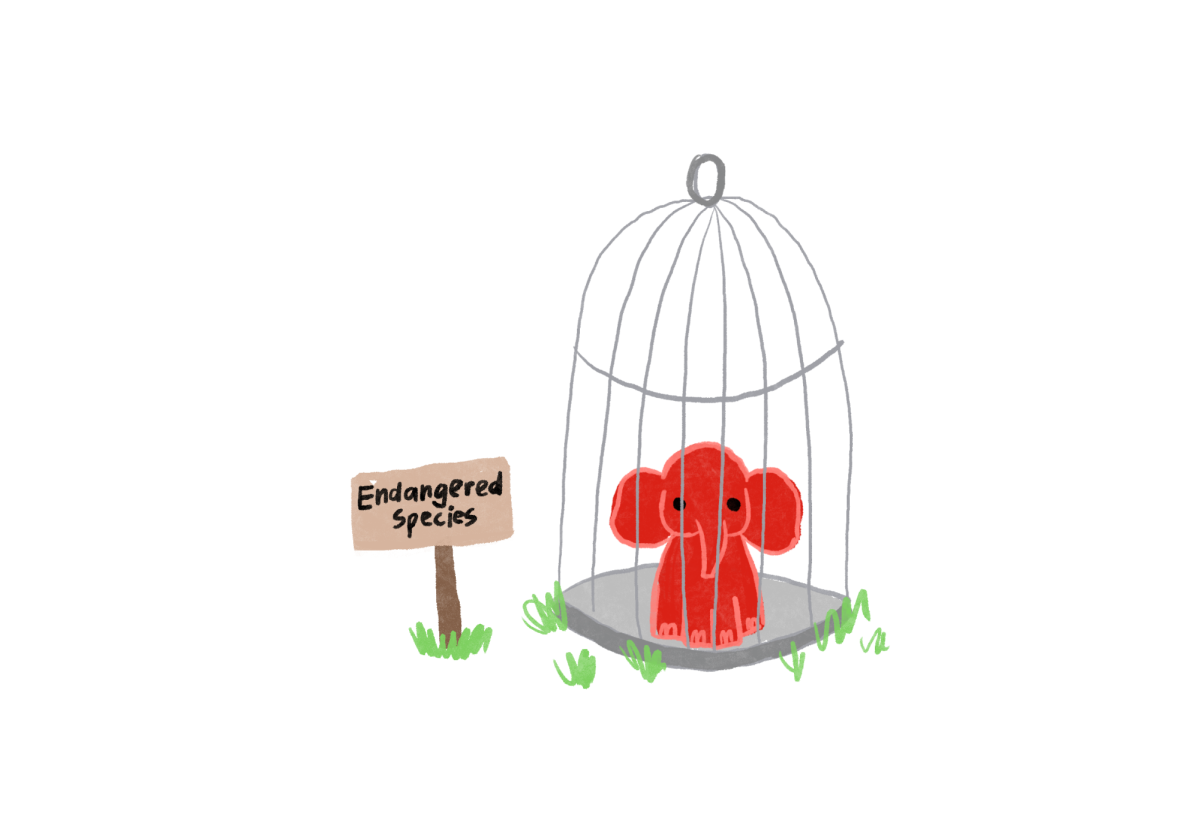
For decades, scholars thought the “campus conservative” was extinct. Occasionally, one might hear rumors: faint whispers of an economics student who dared to question the efficiency of government regulations or a political science major who muttered something about individual responsibility, but direct sightings have been rare.
Last week, however, researchers confirmed a breakthrough: A live conservative was spotted in the wild, reportedly seen exiting a seminar after cautiously suggesting that perhaps not every social issue requires a government solution. Witnesses claim that “the room fell silent.”
Now, thanks to recent field research, we can confirm that the species is still clinging to life, though in a fragile ecosystem dominated by performative tolerance. Students who champion “diversity of thought” often seem shocked to discover that thought can actually diverge.
Our team has tracked the creature’s behavior, habitat and survival strategies. What follows is a field report on one of the most endangered creatures in higher education.
Environment
The campus conservative seems to dwell in the remote, shadowy corners of the campus ecosystem. Occasional outings for political talks or late-night Frank runs have been documented, but the conservative’s stealth makes it difficult to track. Researchers have found that conservatives tend to congregate in political science and economics classes, though they remain constantly alert for potential predators.
The campus environment, a lush ecosystem of mutual affirmation and social justice, has proven to be the perfect breeding ground for left-leaning students. This supposedly “open-minded” habitat, however, is ironically inhospitable to ideological intruders.
Behavior and Communication
In response to hostility, campus conservatives have developed sophisticated methods of camouflage. Phrases such as “to play devil’s advocate…” or “I don’t like Trump, but…” have been heard echoing across campus — calls we have determined indicate the presence of a disguised campus conservative.
Additional markers include prolonged silence when conservatives are labeled “ignorant” and the strategic redirection of conversation whenever politics arise — survival mechanisms believed to help avoid social suicide. These students exhibit a visible fear response to the words “woke” and “DEI” and instinctively avoid any discussion related to transgender or identity politics.
Typical speech patterns include cautious, hedged statements, such as, “I’m not saying I agree, but…”
Conservation Efforts
Recent studies suggest that genuine conservation measures may help preserve the dwindling campus conservative population. Proposed initiatives include habitat restoration, such as fostering classrooms and discussion spaces where open disagreement is encouraged rather than punished and where professors don’t ridicule right-leaning politicians and disparage conservative thought. Structured debates, politically balanced panels and faculty-led forums could serve as protected environments where ideological diversity can safely emerge.
Efforts should also focus on promoting empathy-based dialogue rather than moral condemnation. Encouraging students to engage across ideological lines — not to convert, but to understand — may help stabilize the population. Campus organizations could play a crucial role by normalizing political difference as a form of intellectual diversity, rather than social deviance.
Ultimately, the goal is not to artificially increase the conservative population but to restore balance within the academic ecosystem. A healthy campus requires the coexistence of multiple perspectives — each challenging and grounding the other. Without such balance, intellectual life risks becoming an echo chamber, and diversity of thought may go the way of the “campus conservative” itself: a rare sight, spoken of only in theory.
Field Note: Continued observation recommended. Approach subjects gently — sudden confrontation may cause retreat into anonymity.