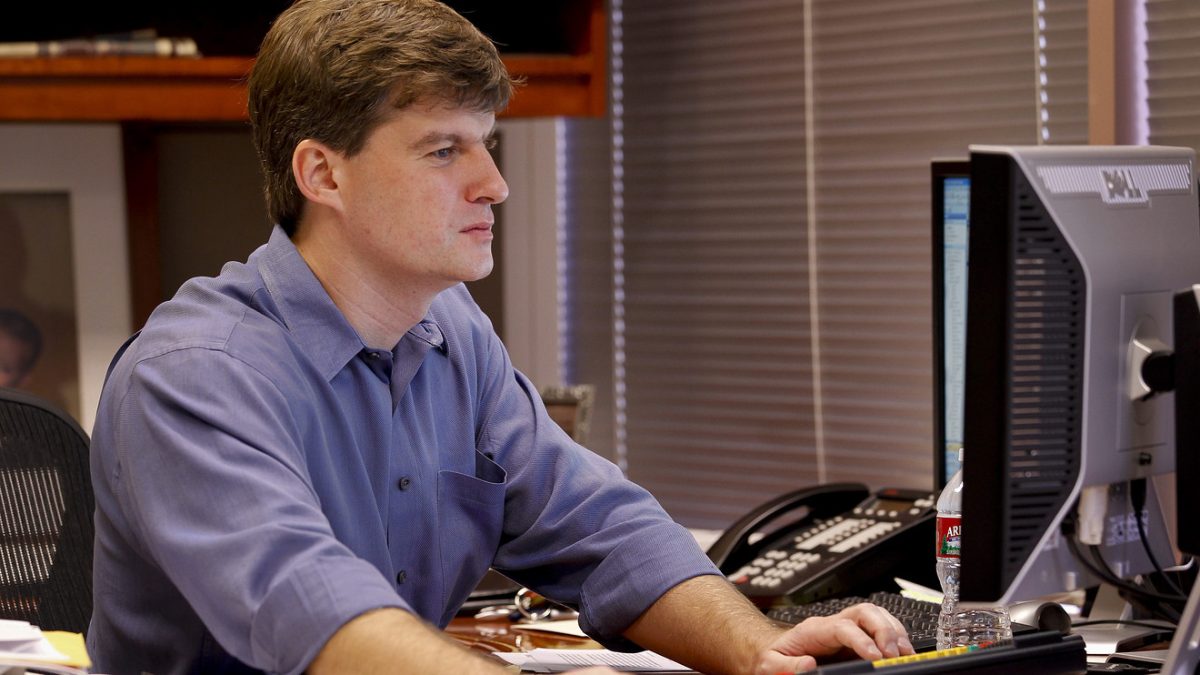
Michael Burry is a skeptic. Burry made his fortune trading stocks as a short seller, betting against the housing market before the 2008 financial crisis. Burry profited when individual stocks suffered or the entire market suffered. Burry is unlike other Wall Street investors. In 2015, Adam McKay turned Burry into Batman. In “The Big Short,” a film based on the book of the same name authored by Michael Lewis, a scrawnier Christian Bale depicted Burry’s odd mannerisms, his independence from the Wall Street elites and his eventual victory.
Companies like Hindenburg Research act as both investors and journalists, publishing investigative research on companies they believe are overvalued or committing fraud. Burry is different from other well-known investors, like Bill Ackman, who cried on CNBC at the outbreak of the COVID-19 pandemic, helping to incite market panic. In the panic, he netted his firm $2.6 billion from a $27 million bet he had made against the American economy.
Burry rose to prominence for accurately predicting the subprime mortgage crisis that drove the Great Recession. Burry recognized that the banks had gotten greedy, that they gave out bad loans to millions of Americans who would not be able to repay them and that they packaged those loans into bonds which were sold as AAA credit rating, low-risk, high-yield assets. When the system inevitably collapsed, Burry did not just profit from his trades. When the system went bust and 10 million Americans lost their homes, Burry became an icon for going against the system. This narrative of the lone truth-teller challenging corrupt elites has shaped how we understand both Burry and the crisis itself.
“The Big Short” exists somewhere in between a PSA and a conspiracy thriller. It is not a hard-nosed or bland history film in the style of “Escape From Alcatraz.” It is a deeply political Hollywood embrace of anti-government and anti-Wall Street movements. It is the celebrity validation of public fear, the moment when the little guys got it right and the powerful elites were deemed responsible for the destruction of people’s lives. From the lens of the conspiracy theorist, it was a reaffirmation that the 1% would screw over the other 99% when given the opportunity. But in real life, the “conspiracy” that drove the Great Recession was less deliberately deceitful than simply greedy.
There was no secret cabal of bankers designing entire systems to deceive the public. There was no direct control of governments or politicians, and there were no hoaxes or false flag events. The banks got greedy — they wanted more money and started breaking rules and looking past obvious warning signs and previously agreed-upon rules. That greed was catastrophic, as it destroyed the lives of millions, but was also emblematic of the real conspiracy. What people would like to ascribe to secret societies and scheming elites is more often an outcome of very human desires. We want more, we want to win, we want to break rules and exceed expectations, we want to achieve what has never been achieved before. What we would like to see as the hidden conspiracy can also be seen as a part of humanity: the same desires we all have, applied to those who can act on them. Burry got it right. He did not just see through the greed and corruption of Wall Street – he bet on it, and he won. Burry paid attention to the facts, he did his own research, he went against the mainstream narrative, he staked his career on it and he won.
The narrative of inspirational skepticism may have defined Burry in “The Big Short,” but his nihilistic philosophy extended far past the Great Recession. Burry has called his shot (in this case, short) many times since then. In 2023, he predicted a recession that never came. When his prediction went awry, Burry went silent for two years, until November 2025, when he returned to pile on to widespread fears of a bubble in the growing AI sector. Burry’s image was constructed on his intelligence, on his ability to predict what others could not see, until it was not. Burry turned from investor to celebrity, from weird yet powerful to insecure about his height and unwilling to deny his reputation as a soothsayer. What made Burry famous wasn’t tweeted out live as it was happening. He did not leverage the media to short the banks; he didn’t have an image to uphold then. Burry was wrong in 2023, and he may have been wrong this week, but his aspirations are clear. He wants more. He wants to build his legacy. He wants to remind people of who he was and who he still is.
Whether he is right this time remains to be seen. Artificial intelligence could be the next showcase of greed, another moment when wealthy elites view themselves as untouchable, but it could also be the moment when technology supersedes what was previously thought possible. Michael Burry has distinguished himself this time as a public skeptic. He is not Nostradamus, but he won’t let us forget his skepticism.