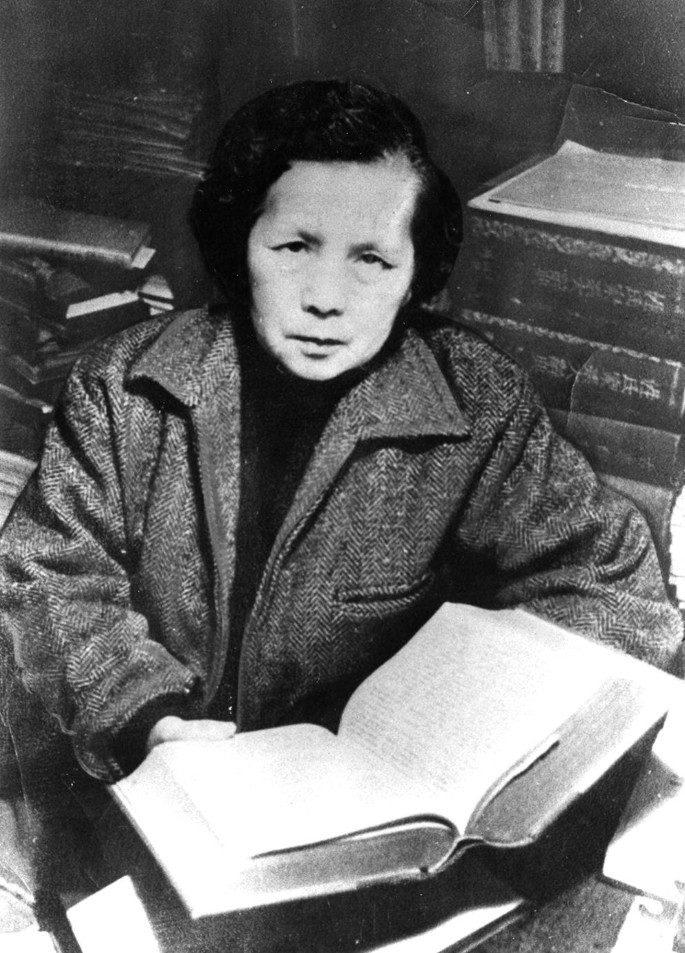
Nicholas Albertson, assistant professor of Japanese, discussed how a 1920s anarchist feminist poet diagnosed Japan’s rising imperialism during a presentation on Tuesday, Nov. 11. His presentation, “Tokyo’s Fever of Empire: A Poet’s Diagnosis in 1925,” examined the work of Takamure Itsue, whose poetry warned against anti-Korean sentiment and fascism decades before Japan’s aggressive expansion in World War II.
The presentation began with a brief overview of Japan’s history, detailing the rise of the capital, Edo — now known as Tokyo — and Japan’s gradual shift toward imperialism. Albertson described how Takamure identified an “empire fever” that swept across Japan, spurred by the Meiji Restoration. Japan’s subsequent colonization of Korea fueled anti-foreigner sentiment among the Japanese public.
“[Takamure] lamented the Japanese colonization of Korea and invasion of China while reminding readers that the imperial powers routinely denied countries like Korea a seat at the table as they jockeyed for power among themselves,” Albertson said.
Takamure’s work “Poems of a Vagabond” gives a first taste of her political insights to come, Albertson explained. Though one may typically think of landscape poems as serene or passive, Takamure uses these descriptions as metaphors to comment on the political landscape of Japan. One poem, which at face value appeared to be an aesthetic depiction of a natural landscape, is on closer inspection a dialogue between a Japanese citizen and a Korean interlocutor.
“The speaker is preoccupied with the passage of time, while her counterpart, who we presume is one of the Korean brethren of the title, is captivated by the unfamiliar flora and fauna … it encapsulates the unresolved tension in the poem by juxtaposing the two perspectives without synthesizing them,” Albertson said.
Takamure’s next work, “Tokyo Has Caught a Fever,” published in 1925, lodges more substantial critiques of Japanese imperialism and was the main focus of the presentation.
“[Takamure] sees poetry as a vehicle to liberate the universal self from the shell of bourgeois individualism into the universe,” Albertson said. “In the manner of a romantic pastoral poet, Takamure mourns what [scholar] Jonathan Bate calls a lost unity with nature, and we can see that alienation running through the landscapes of the poems.”
Takamure also uses landscapes to comment on gendered systems of oppression. She equates marriage with prostitution, relating both institutions’ economic and sexual exploitation. Her work also emphasizes maternity and sexual freedom, all as part of her feminist ideology.
While Albertson described Takamure as sympathetic toward Koreans, this sympathy was specifically aimed at the Koreans who were integrating better into Japanese society, rather than toward those working to reclaim their land. In fact, in one of her poems, Takamure describes both Korea and Japan as “weaklings.”
Despite her anti-imperialist poetry, Takamure later publicly supported Japanese expansion in East Asia.
“Like the large majority of writers in Japan, [Takamure] publicly supported Japanese aggression in East Asia, which she saw as capable of making the world a family,” Albertson said.
Albertson argued that Takamure failed to reconcile the moral and aesthetic messages of her work, ultimately making her unable to balance her roles as both prophet and poet.
The presentation led to a discussion of Takamure and Japanese poetry and history more broadly. Albertson said the conversation raised new questions for his ongoing research.
Senior Eleanor Meunier has taken classes with Albertson previously and was eager to hear about the intersection of poetry and politics.
“I really liked how [Albertson] talked a lot about the international relations that were going on at the time, and the dynamics between Japan and Korea,” Meunier said. “[Takamure] kind of took a political stance through her poetry, but maybe not as much in her personal life, which I thought was really interesting. Seeing how the arts reflect politics at any point in time is always interesting to examine.”
Meunier also enjoyed the presentation’s deep focus on a singular poet.
“It was really interesting to be able to do more of a deep dive into one specific person rather than in CORE Japan, [where] we kind of did a broad overview of poetry as a whole, instead of doing specific studies,” Meunier said.
Senior Stephanie Zuaznabar felt that the presentation left her with a lot to reflect on.
“I wonder what [Takamure] wanted to get out of this book, if she wanted to have the Korean perception shifted,” Zuaznabar said. “Obviously both sides have their own version of what happened, but I don’t know if she really planned on making it so they somehow realized that what the Japanese people did was in their best interest.”
Albertson said Takamure’s warnings about anti-foreigner sentiment remain relevant today. However, even Takamure was not consistent in her earlier anti-imperialist stances.
“Takamure failed to inoculate even herself with her admirable anti-imperialist poetry after all,” Albertson said. “But I think it is useful to examine how she critiqued narratives of Japan’s imperial modernity through poetic landscapes charged with sympathy, indignation, obligation and love.”