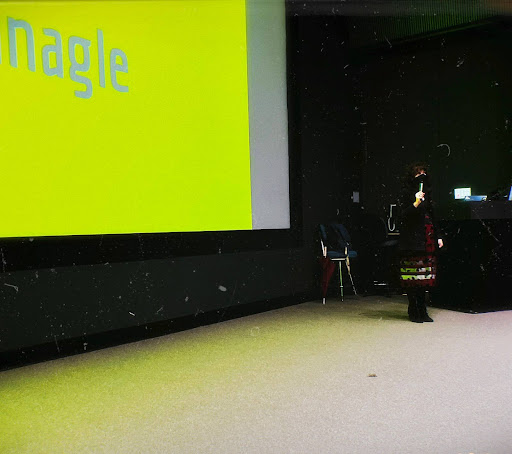
The Native American studies program hosted writer and activist Rebecca Nagle as part of Colgate University’s Anthony Aveni lecture series on Nov. 13. Nagle’s talk, titled “By The Fire We Carry: The Generations-Long Fight for Justice on Native Land,” after her debut novel of the same name, covered the cultural displacement of her community and Native Americans at large. Her journalism is nationally recognized, having earned nominations for the National Book Critics Circle Award and the Peabody Award.
A proud member of the Cherokee Nation in Oklahoma, Nagle began her presentation with a brief introduction in the Cherokee language. According to Nagle, this rarely known or spoken language exemplifies the extent to which Native American culture is obscured in our modern zeitgeist, which underlined her talk’s main topic: the lack of Native American representation in the media.
She then elucidated the magnitude of Native American erasure by chronicling a project she undertook for the Guardian newspaper during the COVID-19 pandemic, in which she examined data on how the virus impacted different demographics.
“Native Americans were placed in the category of ‘Other,’ grouped with other demographics instead of having another category,” Nagle said. “When Native Americans are left out [of data] like this, people will never know the true impact of COVID-19 had on our community.”
The exclusion of her people in COVID-19 data, Nagle explained, perpetuated a false understanding of Native Americans no longer existing in today’s popular culture and are instead only a part of a distant past.
“When I was at a conference, I introduced myself as Cherokee, and a woman came up to me and said, ‘I thought we killed all of you!’” Nagle said. “Forty percent of American adults believe that Native Americans don’t exist anymore.”
Nagle said that this issue of Native American erasure has advanced even into more current events. For example, when the Department of Homeland Security posted a picture of the painting “American Progress” by John Gast with the caption “A Heritage to be proud of, a Homeland worth Defending,” many articles dove into the purported Neo-Nazi implications of the captioning, treating it as a novel or foreign phenomenon.
Nagle explained, however, that America has always been an imperialist institution that methodically eradicated Native Americans to make space for Westward expansion.
“The Choctaw people were rounded up by gunpoint, tormented by bloodhounds and force-fed putrid meat,” Nagle said, “So, I find it interesting how the article didn’t mention Native Americans, but instead went to Nazi Germany to display how troubling that tweet was when the very painting that Homeland Security posted depicted white colonizers driving Native Americans off of their land.”
Nagle also discussed how the foundation of America as a country relied heavily on violence towards Native Americans because the military – arguably one of the most prevalent reasons as to why America gained power on the global stage – was originally created and strengthened to subdue indigenous tribes. In her Nov. 13 talk, Nagle said that the many aggressive foreign and domestic policies that we see today were modeled after the brutal practices that American settlers first used on Native Americans.
Junior Reem Numan was especially fascinated by this particular topic.
“Before coming to Nagle’s lecture, I had no idea that the injustices of Indian law have been used as legal precedent for modern-day, anti-democratic government actions, like [how] engaging in wars without formal declaration has been done [to] countless indigenous tribes,” Numan said.
To end her lecture, Nagle discussed solutions to the systemic harm that Native Americans have faced due to their continued erasure. She suggested that a dedicated Native American desk for news sites would replace popular stereotypes of her community with credible and accurate information. A greater push for a more present-day report on Native American affairs, Nagle said, might begin to reveal the truth behind the mystified past between America and Indigenous people, reminding everyone that Native American perspectives matter.
Assistant Professor of History and Native American Studies Ryan Hall commented on the lecture’s impact, echoing a similar sentiment to Nagle’s own hopes for increased Native American representation.
“I hope that the audience left the talk knowing that Native communities are alive and well in America. I hope they left the lecture thinking about the ways in which the erasure of Native people has warped the way we understand the United States and its history,” Hall said, “I also hope they think about why Native representation matters, and how both the media and popular culture’s ignorance about Native people impacts Native people today.”
In Nagle’s concluding remarks, she promoted her new podcasting project, titled “First America,” that incorporates diverse Native American perspectives back into a narrative that has actively written them out, and a collaborative anthology based on the podcast that will include writing by Native American authors.