Brehmer Theater transformed into Soviet Moscow and ancient Jerusalem over five nights this and last week as Colgate University Theater premiered “Master and Margarita” in the Dana Arts Center from Friday, Nov. 14 to Tuesday, Nov. 18. Every performance except the final showing sold out days in advance, packing the intimate space with students, faculty and staff eager to experience the ambitious production of Mikhail Bulgakov’s surrealist novel.
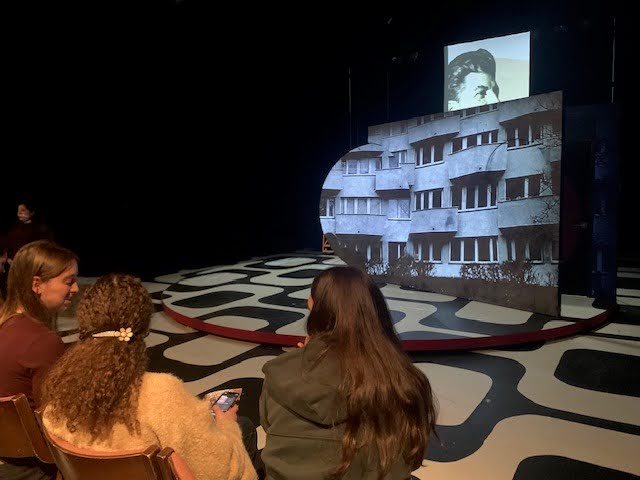
A sparse, yet intriguing set captivated the audience as they trickled to their seats, with students whispering to each other and pointing at the large screen draped downstage. The small space, made smaller by special amphitheater seating, was transformed into urban Moscow, with stone apartments projected onto the stage. The floor was painted black and white with rounded, connected rectangles, playing into an almost dreamlike environment. As the room filled, the lights seemed to grow dimmer. A sense of quiet anticipation gripped the theater. Then, the actors took the stage, and “Master and Margarita” unfolded.
First-year actor Travion Kirk commented on the unique staging.
“It doesn’t ever go dark,” Kirk said. “You’re seeing the transitions as they happen, you’ll see a scene end and the second scene begin all at once, and the stage rotates as well — it’s very interesting.”
As the narrative progressed, the blurring of time periods, settings and characters invited the audience into the scenes. The viewers had to puzzle out where the characters were taking them, both spatially and within the plot itself. There were also moments where the actors broke the fourth wall to stare directly at the audience, acknowledging their fight to understand and sometimes smirking at it.
“It’s a very audience-oriented show,” Kirk said. “The audience is basically on the stage with the actors. I wouldn’t say there’s a lot of interaction with the audience, but there can be, and there’s room to be.”
“Master and Margarita” flips between ancient Jerusalem — with Pontius Pilate’s experiences with Jesus, or Yeshua, including his decision to have Yeshua crucified and what came after that decision — and Soviet-era Moscow, Russia.
Professor Suzanne Spring, associate director of the Writing and Speaking Center, reflected on Yeshua as a frame for the entire plot.
“The only time I knew what would happen next was in the story of Pontius Pilate and Jesus/Yeshua,” Spring said. “And yet even here, I was delighted and disoriented — this was a Jesus I had never encountered before, so human, utterly confused by those who followed him, confounded by what others had written of him and his teachings.”
Sophomore Maximilian Moralishvili was similarly perplexed but found enjoyment in the production anyway.
“I was a bit lost in the plot,” Moralishvili said. “But I really liked the costumes. The devil and his posse were really cool. It did take me until the last couple scenes to realize Behemoth was supposed to be a cat, though. I was like, ‘I wonder when the cat’s gonna come in.’ The costume design was really good.”
Bold silhouettes framed by dramatic lighting and pointed, exaggerated facial expressions produced both a genuine tension and playfulness. The actors played no small part in making the show jump off the stage, so to speak, even throwing fake money directly into the seats before intermission.
“Everyone’s very in-character,” Moralishvili said. “Sometimes, since you know these people as peers, it sounds like they’re just talking in their regular voice. But these people are actually portraying their characters. I don’t recognize them at all.”
Again, Spring pointed out a specific character and actor.
“The performance of the Master took my breath away,” she said. “The actor so fully embodied and expressed love, grief, anguish and complicity all at once.”
The production extended past its technical aspects, or even the performers’ dedication to their characters and the story. With its tangled plotlines and the ease with which it slips between reality and fantasy, “Master and Margarita” truly challenged every participant: cast, crew and audience. The final product, pieced together after months of rehearsals and years of planning, required the acceptance of absurdity, bewilderment and all shades of grey.
Viewers abandoned their seats slowly at curtain call, wondering if there was more than what appeared, murmuring about devils, cats and Jesus even as they filed out of the theater. Actors, sweating but with grins on their lips, greeted them in the lobby. For five days, a philosophical, moving chaos nested in the hearts and minds of Colgate University. It is sure to linger long after the set is struck.