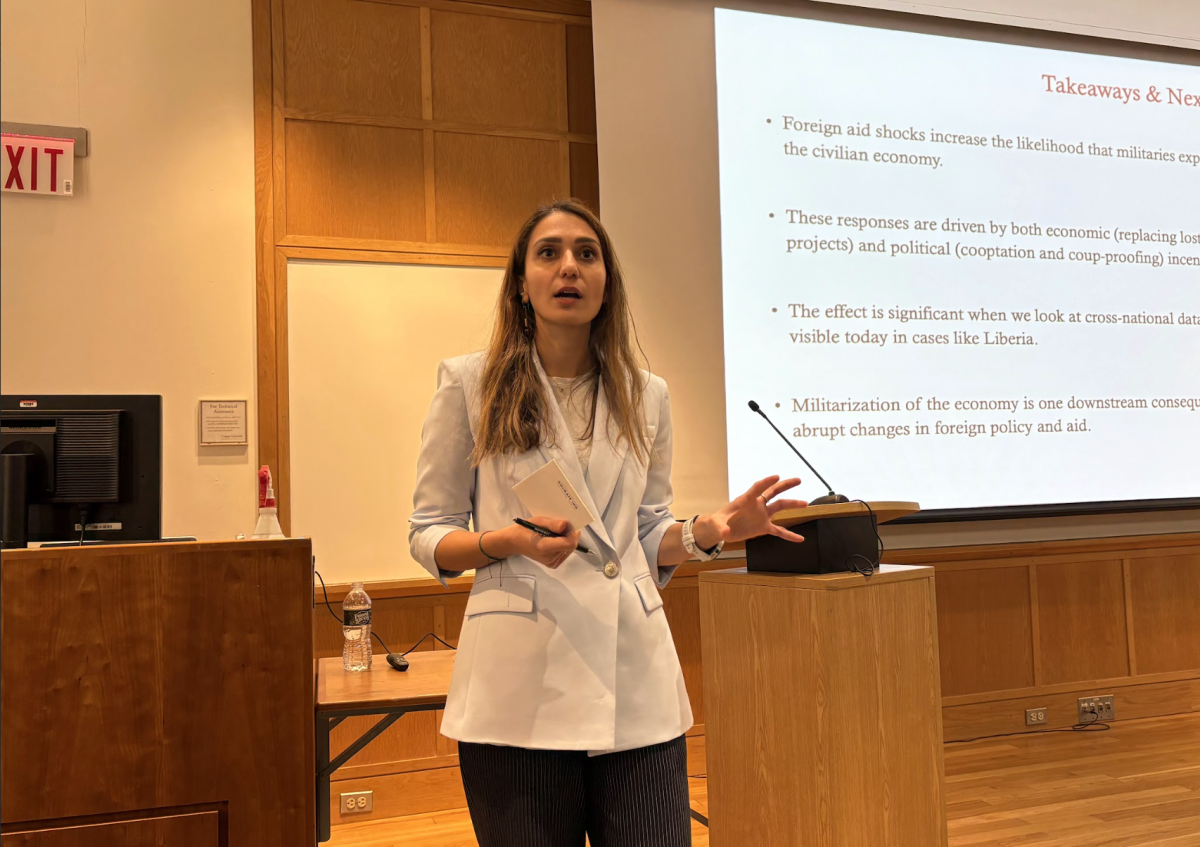
Colgate University’s Department of Political Science invited Roya Izadi, a professor at the University of Rhode Island, to speak as part of the Civil-Military Relations Speakers Series on Thursday, Dec. 4.
In addition to her role as an assistant professor of political science, Izadi serves as director of the Security Forces, Rights and Society Lab (SFRS) at the University of Rhode Island. The SFRS Lab conducts research on the role of security forces within society, focusing on empirical rights and accountability through hands-on student training and data analysis.
In her talk, Izadi discussed her research project on the militarization of civilian economies following financial shocks.
Izadi described how the military typically functions as a state’s security arm, defending against external threats. She also mentioned how, from 1950 to 2020, more than 60 countries saw their militaries assume significant economic roles.
Izadi outlined that when countries face sudden or substantial declines in foreign aid, military involvement in civilian environments becomes more attractive for recipient governments. Economically, the military can fill the gaps left by lost aid by producing goods, running farms or managing infrastructure projects. Politically, expanding the military’s role can help prevent social unrest resulting from aid cuts. Additionally, giving the military a larger role in the economy serves as compensation for potential funding shortfalls.
Assistant Professor of Political Science Danielle Lupton valued learning about these economic factors at play.
“As a scholar of civil-military relations, I had not previously considered some of the economic implications of these issues, so I really enjoyed Professor Izadi’s talk about what this landscape looks like cross-nationally,” Lupton said.
Despite the strategic incentives governments may see in expanding the military’s economic role, Izadi also discussed its significant negative implications. Economic involvement diverts state resources away from defense purposes and toward military-run private enterprises, potentially eroding combat effectiveness and resulting in avoidable and deadly outcomes.
Izadi also discussed an incident in 2020, during a confrontation between Iran and the U.S., where the Iranian military inadvertently shot down a passenger plane, killing hundreds of civilians.
“It could be that because the Iranian military is spending all these resources and attention to running over 300 enterprises from banks to hotels to oil to chemicals, it could be that they are ineffective when it comes to dealing with actual interstate crises,” Izadi said.
Izadi’s seven-year research project argues that predictable foreign aid allows governments to plan long-term, but sudden aid losses create incentives to expand military economic activity. To test this claim, she compiled cross-national data from 1960 to 2020 across 151 countries and identified a consistent positive relationship between major aid shocks and the creation of new military-run firms.
Recently, Izadi traveled to Liberia to conduct fieldwork on the country’s response following the U.S. aid freeze in February 2025. Shortly after the aid cuts, the Liberian Armed Forces (AFL) announced the creation of a military-run agriculture company. Through 19 interviews with AFL leaders, Izadi found that the AFL was chosen to run the company due to their strong organizational capacity, high public trust and cost-effectiveness.
First-year Ellie Wolk appreciated Izadi highlighting the connections between the research.
“Because Izadi made a connection between governmental institutions and civilian economies, there were things I could pull from my current knowledge on political science and international relations that definitely apply,” Wolk said.
Izadi said that she hopes to continue researching how militaries expand into civilian life when foreign aid collapses. As aid crises become more common, understanding these transformations will be essential for global politics and the future of civil-military relations.