While we commonly associate visual art with beautiful canvas paintings, swanky galleries and pristine museums, artist Stacy Levy challenges these notions of what art can be. On Nov. 19, at Colgate University, Levy detailed how she uses environmental art as a force for change.
Levy’s work centers around water, and her public art is a vehicle for exploring the natural world and fostering understanding. Levy asserts that we have constrained water from its free-flowing nature by organizing it systematically. She argues that, for the sake of the environment, we must listen to our waterways.
“What are the ways that artists can listen to water and inform people about this? In my art, I’m often trying to really look at the patterns that are happening on the site and to make these patterns much more legible,” Levy said.
Professor of Art DeWitt Godfrey introduced Levy, sharing their similarities as public artists and also citing Levy’s illustrious career.
“[Levy] has done in her career a long, sustained body of work centered on the natural world, and in particular, water,” Godfrey said. “[She works on] the ways in which we understand both the way that water is present in our lives and also the ways in which it’s been hidden by the world.”
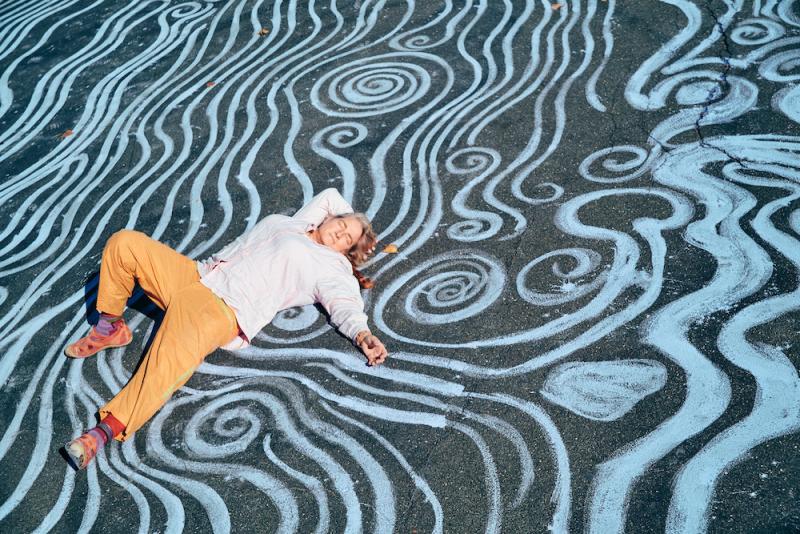
Motifs such as the meandering flow of water appear throughout Levy’s work, with the goal of mimicking its natural state.
“I know that water wants to flow freely, wants to meander over time and space. But we don’t always let it do that,” Levy said. “It doesn’t want to be straightened; it doesn’t want to be delineated into specifically wet or specifically dry. Water wants to use its own patterns. These patterns are so beautiful.”
As humans have built societies, our waterways have become covered up and dry where any given place has been drastically altered and concreted. This prompted Levy to look for what she deemed missing water.
“I think that’s a sort of native artist’s desire,” Levy said. “You see something, you get excited about it and you want other people to know about it. So I’m often looking for water that is no longer there — the missing waters of a place,” Levy said.
Levy has gone on to create both “dry” pieces — art that does not physically involve water — as well as “wet pieces” to help further her mission. Their functions have ranged from measuring the tide to creating spaces for people to explore and play in rain. All her work is public and community-based.
Levy hopes that her art will be a force for education and change. She characterizes her work as active, rather than stationary. In her lecture, she described eco-art as taking an active stance in collaborating with patterns of nature, as opposed to enviro-art. She stressed that it was time for art to address environmental issues, such as water, with a solution, rather than just pure documentation or aesthetics.
“I think it’s time for art to take on this new job of having a solution,” Levy said. “Why can’t art do some work? Artwork has ‘work’ in its name. Why can’t it go out and address things, address the world, just like engineers address the world? Why can’t it collaborate with a lot of different disciplines to become something that really not only talks about the problem, but actually does something about it?”
Levy’s assertion struck a chord with audience members, including senior Sophie Perez, who is an art major.
“I was really interested in how [Levy] views the future of eco-art as having more of a function and how art can intersect with other disciplines like environmental science to actually help the world, as opposed to just presenting the natural world in an artistic form,” Perez said.
Perez’s studio art thesis, centered around papermaking, falls under environmental art, making Levy’s insights pertinent to her own work.
“I’ve always been very interested [in] playing around with this idea of social practice art and engaging communities within my own artistic practice. So hearing from some of the ways that [Levy] has done that definitely gave me some inspiration,” Perez said. “It also made me think about how my own work might have a function in terms of not just presenting the natural world in a beautiful way but also actually intervening into some of these systems.”
Art can be a force for change, as Levy demonstrates, even if in small ways. Challenging concepts like water can help reframe how we view stewardship of the environment.
“I really want to live more closely with water and create places where water can flow in our daily lives,” Levy said. “Art is really able to make nature more legible to everyone instead of it being so mysterious. The water is watching us to see what we’re [going to] do about it.”