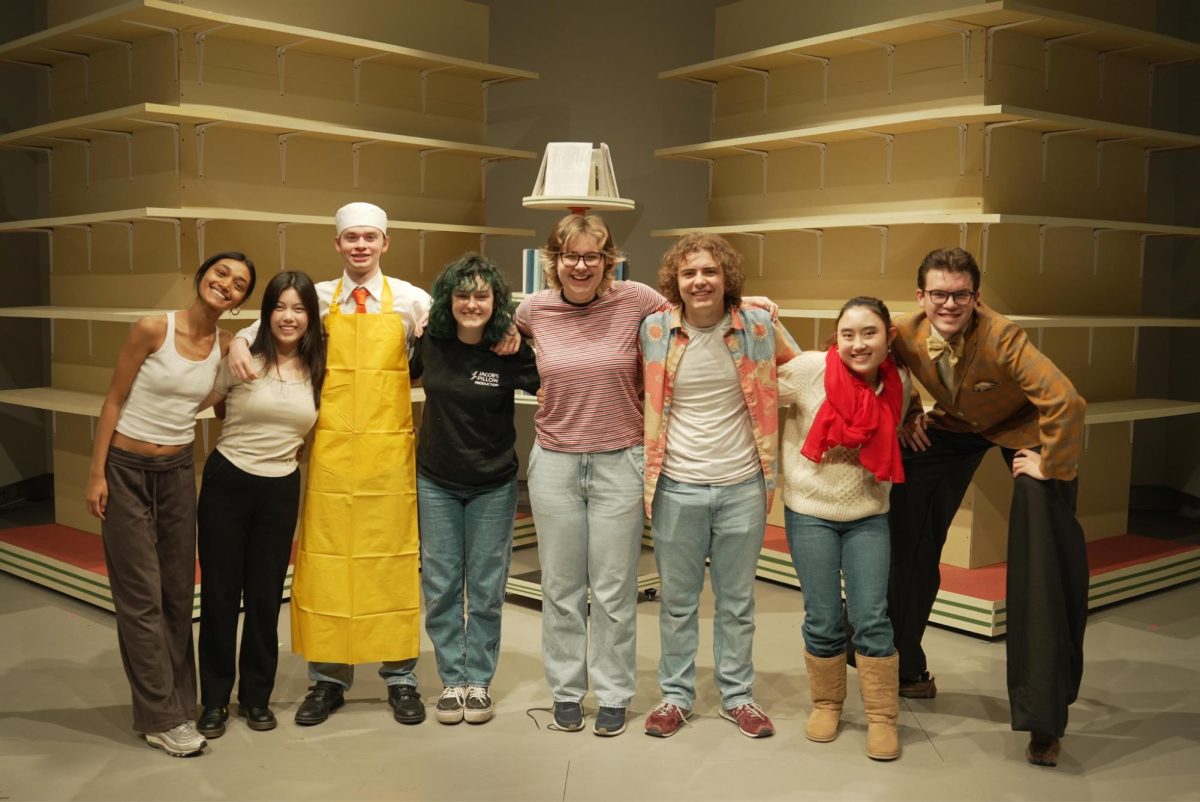
Colgate University’s senior art exhibition, entitled “IN FLUX,” explores the theme of time — past, present and future. Throughout the Clifford Art Gallery, pieces reflect issues that exist in the here and now. Some envision a world different from our own, while others examine how past traditions affect us now. The pieces in this exhibition are truly a testament to the talent within Colgate’s student body; this capstone project should be a point of pride for everyone involved in its conception and execution.
The side gallery highlights the work of senior McKenzie Broussard. Broussard’s contribution is an immersive experience titled “DISCRETION.” Broussard’s interrogation of contemporary society calls out the reliance on artificial intelligence (AI) and the need to delve deeper into the issues that define our society. In this piece, various political commentary are shrouded in the darkness of the room and the participant can use a flashlight to examine various issues of race and discrimination, creating an experience which artfully encapsulates the conscious effort it takes to uncover the truth.
“In a dark room such as this, the viewer alone holds the agency to uncover darkness and bring new things to light — at their own discretion,” Broussard said.
In the main room, several powerful exhibits are displayed. First is a work by senior Abby Pierce, which displays several distortions of the same image to create a truly haunting effect.
“Memories of pain arise in me in overwhelming and unimaginable ways,” Pierce wrote. “Photography renders a space where my memories can exist in tangible form, able to be excavated and investigated. As the intrusive memories emerge, I create physical mimicries through a process of repetitive printing. Again and again, the same image is born, externalized and moldable.”
Pierce’s powerful anecdote perfectly describes the blurred vision of the prints displayed.
Next, is work of senior Lindsay Hess. Hess’ foremothers have been practicing the fiber arts, such as crochet, for generations. Hess’ exhibit tracks her progress in connecting with her heritage through beautifully intricate and delicate weaves. Hess’ exhibit is incredibly nostalgic and captivates with its sense of reverence and humanity.
Also examining heritage, senior Luciana Schinella’s “Quiet Inheritance” is a series of three paintings, each one inspired by a photograph of a member of her family.
“By translating these moments into paint, I’m tracing a lineage of both deliberate and unconscious ways of being that shape the culture of a family,” Schinella wrote. “Returning to each image day after day became its own ritual. One that enabled me to observe how ordinary gestures, as well as practiced traditions, become a site of shared familial memory.”
Schinella’s works were colorful and felt imbued with a great sense of joy and care. These feelings radiate from the dead canvas and impart a sense of great vitality and vibrance.
“The Fragile Champions” is a display imagined and realized by Grace Reilly. Reilly’s display comments on the high expectations and stress modern society places on student athletes, both mentally and physically.
“Athletes suffer through countless injuries throughout their careers, and the narrative quickly becomes how to get them back on the field and how the team will still succeed,” Reilly wrote. “There is a lack of attention and necessary analysis of the athletes’ physical health and how they will be impacted by these injuries for a lifetime… They endure unimaginable pain and physical stress on their bodies [because of] the pressure of institutions and society for them to perform.”
Reilly’s exhibit is meant to portray a hospital room with various X-rays. The X-rays show a plethora of injuries, with images of championship rings appearing in the X-rays. Though the exhibit is rather obvious and simplistic in approach, the message certainly hits home and raises internal reflection: how much do I participate in the dehumanization of my favorite athletes just because I want my team to win?
Senior Ellie Stokes’s entry is an architectural envisioning of how buildings would look if humanity had to leave Earth’s surface upon it becoming uninhabitable. The first model imagines cylindrical buildings layered on top of each other to create a dense network of underground dwellings. The second model envisions interplanetary habitation in more angular and sprawling forms. This entry poignantly highlights how the conditions of our environment define what we envision when we think of “home.”
Highlighting a similar theme, “The Third Parent, Your Home” is senior Frida Laux’s physical manifestation of a theory concerning the importance of heritage and real materials in home building.
“My work argues for a return to honoring real materials that carry both a history and the weight of future care requirements,” Laux said. “The piece positions the home not as a site of diminishment but as an active, vital force: a place where partnership, creativity and family life can be nurtured, sustained and reimagined.”
This piece immerses the viewer in a collage where various materials and designs for beautiful homes are presented. This exhibit, though offbeat, continues a prevailing theme in this exhibition — a concern for time and heritage.
The next two exhibits both emphasize the inherent beauty of natural scenery without embellishment or exaggeration. Senior Rylie Berwanger’s “Heat, Pressure, Time” takes a look at the natural processes of rocks. Similarly, Sophie Perez’s display uses recycled paper and cardboard, used paper towels, plant matter and natural dyes to create a beautiful model forest, which shows a beauty in the contrast between decomposition and rebirth.
“While making the work,” Perez wrote, “I have immersed myself in a process that is slow and regenerative, mirroring eco-centric rhythms as a kind of intervention into anthropocentric notions of time, progress and production.”
Seniors Shaelee DeCarolis and Daisy Helm both use oil on canvas to create their highly interesting and colorful scenes, while sharing thematic similarities with the work of senior Eloise Sampson. “The Color of Memory” by DeCarolis does exactly what its title evokes by exploring the intricacy and the overwhelming rush of recalling emotional memories.
“The very nature of a memory is elusive,” DeCarolis said. “My work captures the experience of being completely lost, even overwhelmed, by a memory.”
Helm takes the poem “Nothing Gold Can Stay” as inspiration for her sensational and bright works. The poem posits that the greatest things in life eventually, unavoidably, fade. Helm thus takes scenes from her memory to better understand the fading nature of experience. Sampson’s work, “A Bird’s Song,” explores the vague and convoluted feeling of loss, with memory and imagination as mediums for this feeling.
“Ambiguous loss is a loss in which grief may feel unjustified or nonsensical,” wrote Sampson. “‘A Bird’s Song’ counters his narrative. My tapestry began as an exploration into the fantastical worlds I imagined as a child.”
The final entry in the exhibition belongs to senior Paxton Hilgendorff, entitled “Husk.” Hilgendorff uses an old car grille, muffler pipes and other metallic materials to create a heap of metal that beautifully shows the destructive and warping powers of time.
“Husk attempts to understand nature and natural processes,” wrote Hilgendorff.
This exhibit is a thoughtful display with a great variety of mediums, palettes, themes and philosophies. It is difficult when creating pieces of art to balance impulses and direction, especially when working in conjunction with others to put on a cohesive exhibition. Despite this, each piece is done with a distinct vision in mind that ripples across the other ideas and themes explored in other entries, while remaining unique and distinct. This exhibition is a worthy conclusion to all of the work that the contributing student artists have put into their courses and work throughout their time at Colgate.