


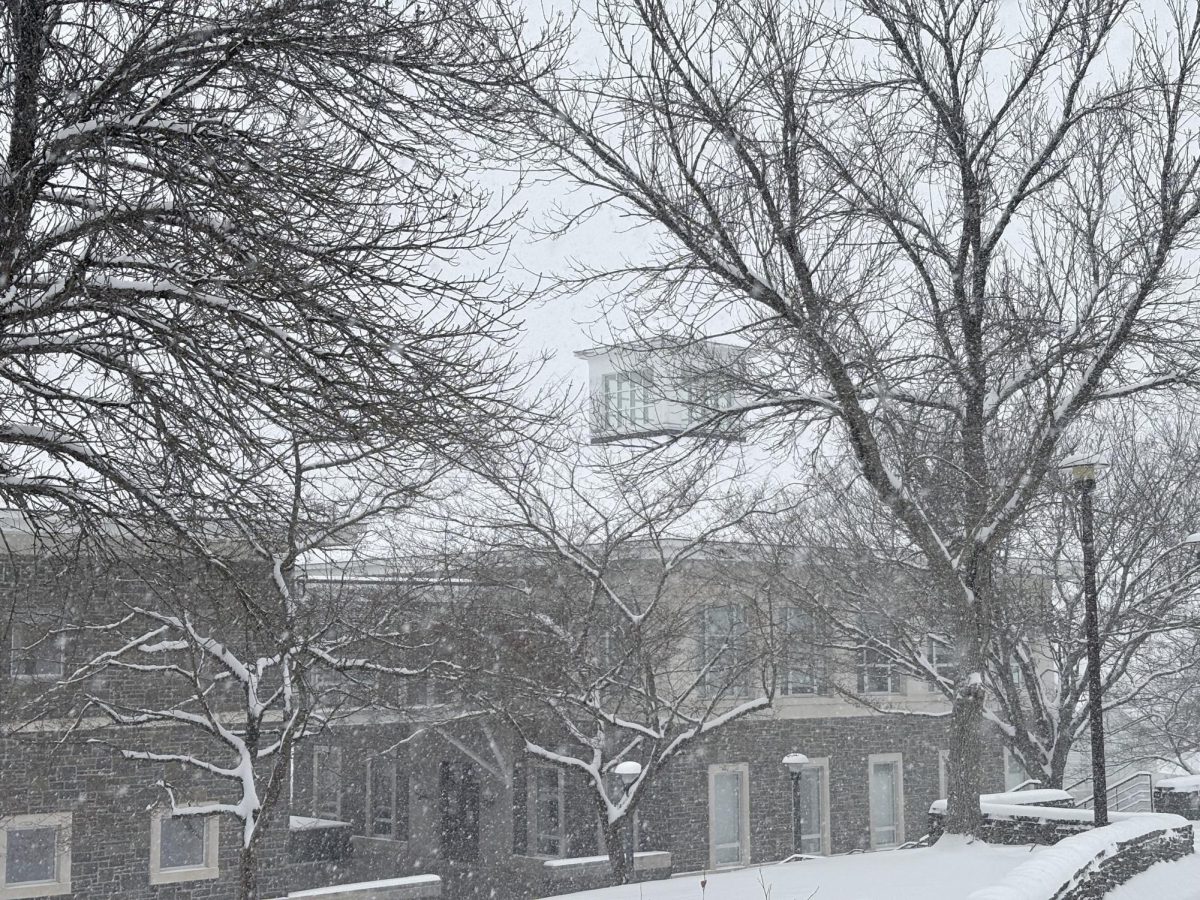
For the second year in a row, Colgate University canceled classes due to winter weather, marking a notable shift for an institution that went nearly two decades without a snow day while school was in session. A nationwide snowstorm hit campus and surrounding roads, prompting administrators to suspend in-person classes amid hazardous conditions on Monday, Jan. 26. The decision follows a similar closure last winter, which was the first weather-related full closure (not including closures when classes were not in session) since 2008.
While heavy snowfall may seem counterintuitive in the context of global warming, Professor of Geography Adam Burnett explained that individual snow events still fit within broader climate trends.
“The long-term temperature record is showing warming, which one might associate with less snow,” Burnett said. “Even with warming, there will still be periods of cold capable of generating snow. The snow we have experienced this season does not surprise me.”
Burnett noted that although snowfall is expected to decline overall as warming continues, cold air outbreaks will still occur.
“However, as long as there are opportunities to bring cold air to N.Y. from the high latitudes, we will continue to see snow,” Burnett said. “[This includes] snow from low pressure systems like we had on Jan. 26 and lake effect snow from Lake Ontario.”
Burnett also pointed to ongoing research on jet streams, suggesting that these patterns may persist.
“Some research suggests that climate change might make the jet dip south more often, bringing cold outbreaks to our region,”Burnett said. “Therefore, we can expect some cold even in the face of global warming.”
The storm brought an estimated 16 to 18 inches of snow to the Hamilton area, accompanied by strong winds and windchills as low as -25° Fahrenheit (-32° Celsius). Colgate students received a weather advisory conveying that extended time outside risks frostbite, and the low temperatures would persist through the weekend. Roads around campus remained difficult to navigate throughout the morning as snowfall and blaring winds continued.
When asked how climate change may affect winter weather in the Northeast in the coming decades, Burnett emphasized uncertainty.
“We will continue to have some winters that are cold and snowy and other winters that are warm and less snowy,” Burnett said. “[However,] over the next 50 years models suggest we will trend to less cold and less snowy winters.”
While long-term climate trends shape expectations about winter weather, Colgate students experience these shifts tangibly through decisions such as cancelling classes. Sophomore Daniel Montan expressed ambivalence about the recent closure of campus.
“It was great to have the day to catch up on sleep in my warm blankets, but I was actually excited to go to class after preparing for a while the night before. This was the second full closure in my two years at Colgate, which is apparently not the norm,” Montan said. “But I think it was for the best, as I know some friends who had trouble driving around in the immense snow and cold.”
According to Director of Environmental Health and Safety Mary Williams, decisions to close the university follow an established protocol.
“Decisions to close the University are made by the Senior Vice President for Finance and Administration and the Provost and Dean of Faculty in consultation with other University executives and the Weather Decision Group,” Williams said.
She further explained that staff closely monitor conditions and carefully deliberate during meetings.
“Employees are continually monitoring the weather and engaging with our partners at the National Weather Service,” Williams said. “The Weather Decision Group meets when a weather event looks like it could be significant enough to change our operating status.”
Williams said the group considers multiple factors, including severity, timing, road conditions and travel safety.
“Decisions to close or delay are taken very seriously,” Williams said, citing the Emergency Closing Policy. “The University will make every effort to provide essential services to residential students and campers, even in cases of extreme adverse weather or other emergencies. Therefore, the University will almost always remain open.”
Williams further elaborated on whether two snow days in two years reflect a changing precedent.
“The same process has been in place as long as I’ve been working in Environmental Health and Safety — 14 years,” Williams said. “In that time, we have had about one day per winter when we were closed with essential personnel only.”
As climate variability and safety concerns continue to intersect and are considered by Colgate, the Jan. 26, 2026, and Feb. 17, 2025, snow days may highlight a shift in attitude toward extreme weather moving forward.





John golden • Feb 6, 2026 at 2:08 pm
Thanks for the informative Snow article in the MAROON NEWS.
I am smiling or smirking! Back in the day…1962-1966.. I cannot remember one “ snow day of closed classes.
And back then it snowed – a lot- from Thanksgiving to as late as each May.
Each morning, we would wake up to huge snow banks next to the paths from our dorms and Greek houses to the classrooms up the Hill.
There were no steps down to the Student Union just a macadam pathway covered with some snow. Adventuresome Residents up the hill would ride lunch trays down the hill for breakfast or lunch.But most of us settle for coffee and toast in the very small Coop, then under East Hall.
Perhaps Colgate closes down now as so many employees and faculty live outside of Hamilton. In our time most faculty lived locally and of good shape could walk up the hill with students living downtown or on the Row.
My first two years we ended the first semester at the end of January. So we were on campus ,save Christmas break, through the entire winter. Then the last two years we had Jan Plan. A great idea sorely missed.
I was off campus Fall early winter of junior yr in damp dreary( but most exciting) London. We wore coats and scarfs in some of our classrooms! Great time!
Enjoy the snow. It is part of the Colgate tradition.
John golden
‘66 H’07
…and bring back Maroon! I am not sure what that color is now masquerading for team wear and signage. My friends think the C on my half zip is for the Cubs or even Cornell! .