Brian Stark, assistant professor of music, launched the three-day showcase “Bug Music,” which integrates music with the scientific study of insects, on Saturday, Feb. 1. Colgate University’s liberal arts curriculum is dedicated to fostering an interdisciplinary experience for students, which emphasizes critical thinking, communication and diverse perspectives. This project incorporates the same cross-disciplinary approach, offering a new perspective on the true “nature” of music.
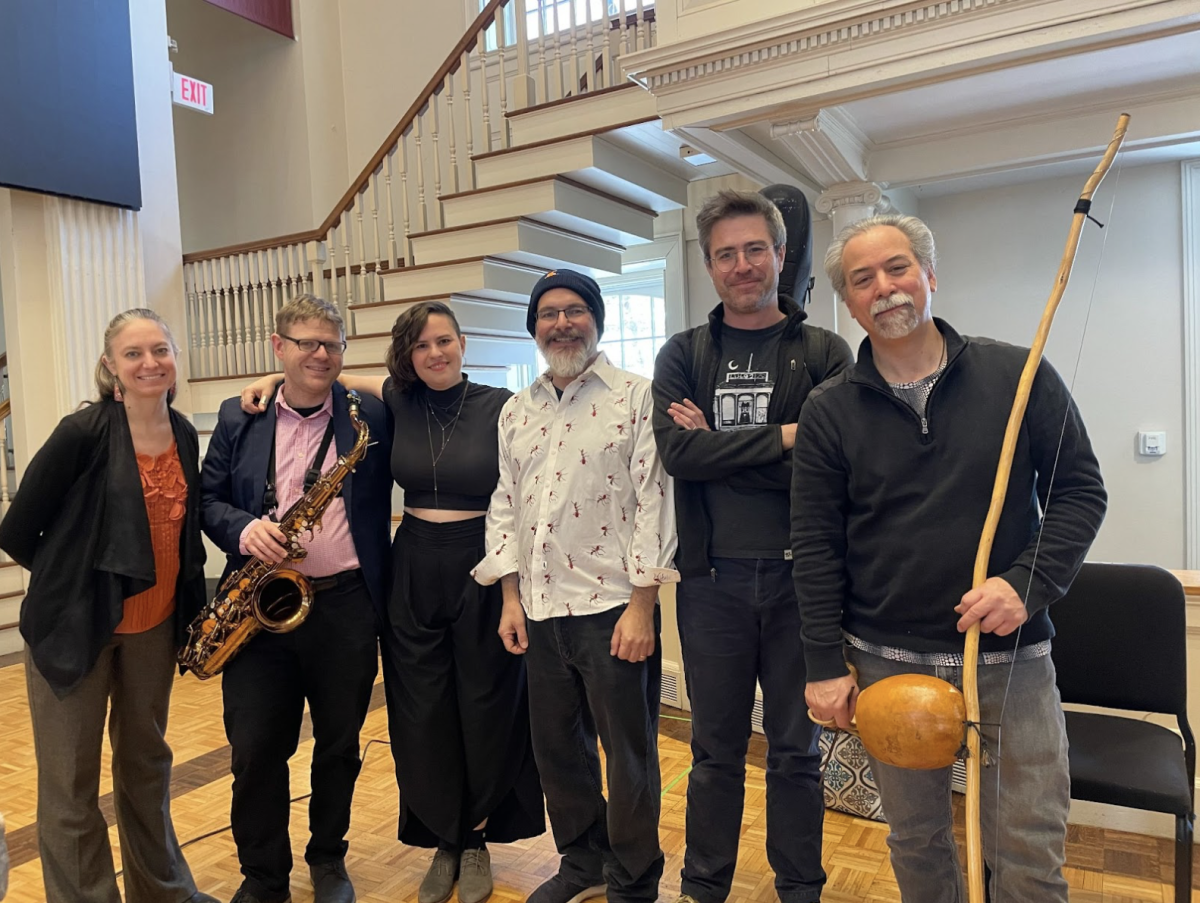
Stark organized “Bug Music” alongside Adam Larison, an instructor of music at the University of Illinois Springfield; Jason Finkelman, assistant professor of global arts at the University of Illinois Urbana-Champaign; Andy Suarez, professor of entomology at the University of Illinois Urbana-Champaign; and Jesse Stark, founding member of Hamilton Village Quartet.
Suarez headed the scientific aspect of the showcase, informed by his research about ants.
“I became fascinated with the way organisms communicate with one another, particularly when we’re talking about different species, forming mutualisms that are very important for the architecture of nature,” Suarez said.
Stark explained how Suarez’s research informed the creation of Bug Music.
“Communicating not by sounds you hear, but by vibrations in the air,” Stark said. “That was interesting. The way Andy talked about it was evocative, and I thought, ‘We can make music about this.’”
Their first event on Feb. 1 at the Colgate Memorial Chapel included a lecture by Suarez backed by an instrumental improvisation. They attempted to musically tie insects and humans together, drawing comparisons between ways of communication and understanding.
“It was my first time doing something like this, so I was trying to do a lot of listening and responding,” Stark said. “I was trying to fit into the texture and look at the pictures to see if there were any concepts that inspired me to play any particular sounds. When [Suarez] talked about vibrations, I tried to hit my instrument a little more or scrape it.”
Alongside traditional musical techniques, Finkelman continued collaborating with Suarez’s work by sonifying treehoppers and katydids. They used the produced sounds as a sample for electronic music to integrate into the improvisational number. They also invited the audience to lend their own voices to the performance.
“I had a recording of katydids, night sounds, crickets and so forth,” Finkelman said. “We proceeded with having the audience make the ‘ss-ss-ss’ sounds to create a late summer, early autumn night, which we blended the electronic sound into. The incredible part was how some audience members continued creating the sound, so we entered and came out of the piece with audience participation.”
On Feb. 2 and Feb. 3, “Bug Music” spread to classrooms. The group visited a variety of classes, including Invertebrate Zoology, Neurology, Jazz Theory and an Animal Behavior lab, to further show students how music and science can meld together. There, they gave a short version of the lecture and improvisation performance, followed by a dialogue.
“One thing that happens in this collaborative environment is that it helps us think about the science, the ecology and our place here,” Finkelman said. “It excites our imaginations in ways traditional science might not. I think this practice can lead to [new] pathways of understanding.”
During the next event, a jam session in Case-Geyer Library, students had the opportunity to do just that. Without a word from Brian Stark, Larison, Finkelman, Suarez or Jesse Stark, the students who filtered in with their instruments simply started to play. They all had unique sounds to bring, yet followed each other’s cues, the music ebbing and flowing disjointedly in a way that sounded entirely natural. There was no leader to follow, but rather a continual test of focus where players paid attention to the complex web of sounds.
Flutists blew hot air into their instruments while a guitarist plucked thin, shrill sounds from his strings. At one point, the room filled with a high-pitched caterwaul of instruments all fighting for a resounding crescendo. Vibrations pressed against the musicians’ feet, mimicking the communicative vibrations of the ants Suarez studied. Laughter and murmurs of voices filled the air as well, contributing to the music in conjunction with traditional instruments and bug noises.
The last event occurred at Chapel House. Similar to the jam session, the participants collaborated without ever needing to speak, though with more instruments in the fray. The space was also larger, allowing players more freedom.
Some simply sat and listened. Movement and sound were always present, whether that included people walking with their instruments, hands patting drums or the swaying of stationary cellists and guitarists. They had the opportunity to play or not, to move or not and to be in or out of view of the others. The free atmosphere led to a powerful collaboration. The environment allowed participants to indulge in reflection and meditation.
Throughout the night, the instrumentalists created an appropriate ambience alongside the bug sounds, maintaining the insectile aspect that the program promised. After some time, all of the brass instruments drifted to one side of the room, while the strings ended up on the other, with a flutist roaming the middle. The music eventually quieted so that only the voices of the participants could be heard.
“I would rather have one student connect with the project than have a room of 700 people who just watch and leave and never think about it again,” Stark said. “I feel like we’re off to a good start. What I’m really hoping we do is have [students] think about the arts and how it can inform scientific studies.”