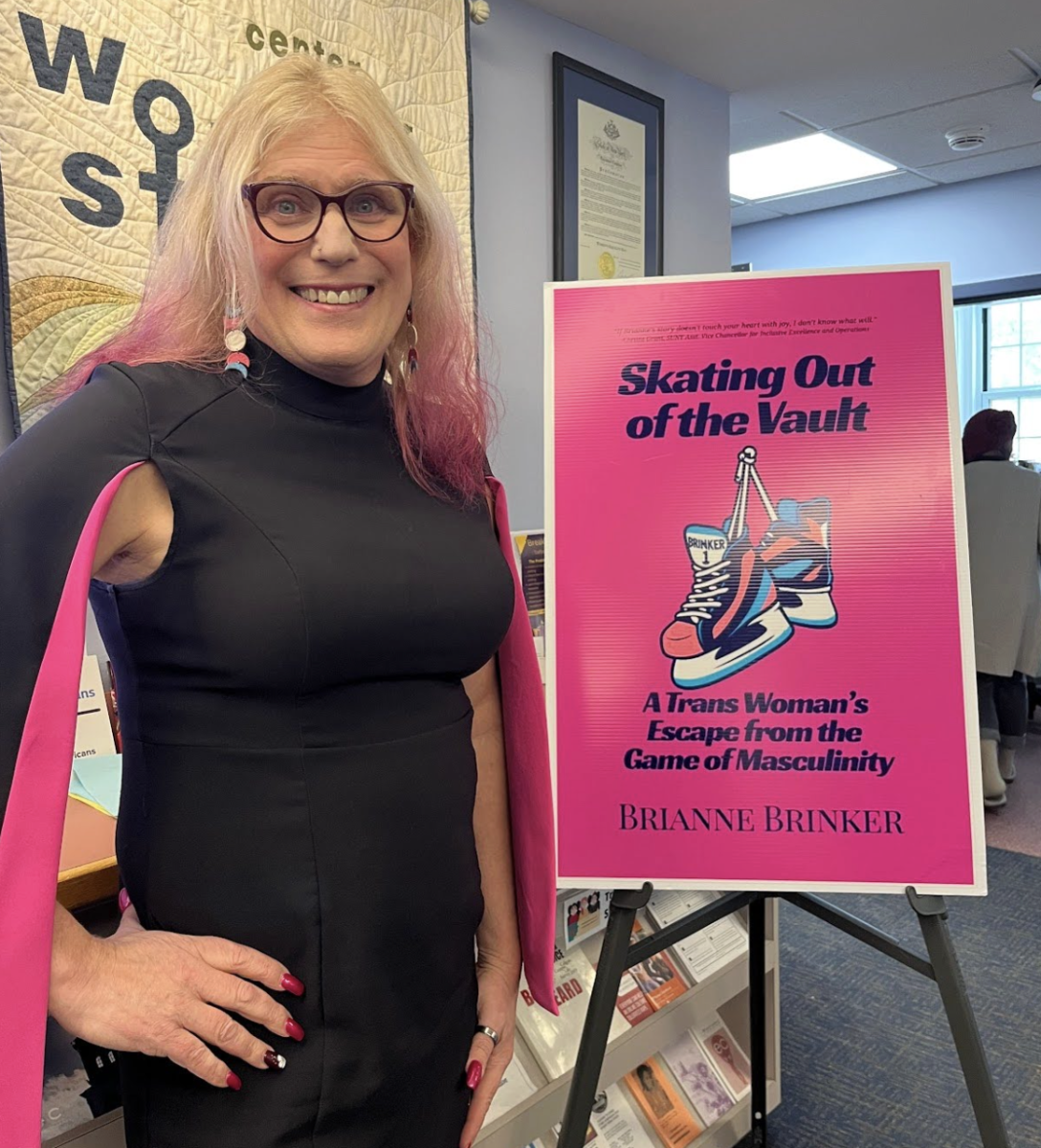
Former NCAA Division I men’s ice hockey goalie coach Brianne Brinker spoke at Colgate University’s Center for Women’s Studies Brown Bag series on Tuesday, Feb. 2. Brinker’s talk, titled “A Trans Woman’s Escape from the Game of Masculinity,” after her debut novel “Skating Out of the Vault,” described her journey to find and accept her identity as a transgender woman. Brinker is the current assistant athletic director for facilities at Union College and a longtime hockey player.
Brinker began the Brown Bag with an anecdote about watching “Superman,” which turned into her earliest conceptions of gender norms.
“I wanted to be tough like Superman,” Brinker said. “But I also saw myself in Lois Lane … I wanted to be that pretty girl.”
Brinker described how, from a young age, she realized she could not reveal her internal conflicts to anyone, as it would protect her from scrutiny and hatred. She dove deep into hockey, a traditionally masculine sport, becoming a star player well into her elementary school and high school years. Even after graduating from Kent State University and landing a job as a college hockey coach, Brinker continued to struggle to reconcile the social pressure to maintain her tough, manly hockey goalie persona with her increasingly enigmatic gender identity.
Brinker chronicled how she often went on recruiting trips for her job, and she would secretly frequent LGBTQ+ bars that hosted drag shows. She thought that seeing drag queens would help her make sense of her identity. At one of these shows, Brinker met a drag queen named Valerie, another trans woman, who quickly became her friend.
Brinker confessed she did not want to be seen hanging out with Valerie, so she made them go to different parts of town where she was sure no one would recognize her.
“I’m pissed at myself that I didn’t want to be caught with someone like Valerie,” Brinker said. “She was everything I wanted to be.”
After some time away from the bar, Brinker returned, only to discover many portraits of Valerie displayed across the walls. Initially believing she had walked into a birthday celebration, Brinker soon learned from others that the bar was hosting a memorial. She was devastated by this realization.
“I learned that Valerie was shot by her boyfriend, who didn’t want to be caught dating a trans woman. I didn’t want to try to be a trans woman after knowing about the violence Valerie faced. I was scared,” Brinker said.
Brinker recounted her life afterward as being normal. She had a loving wife, two beautiful children and the traditional family that she had been primed to need as a man.
A pivotal moment in her gender identity journey was when Laverne Cox, a notable trans actress, came to Union College — where Brinker was already working — for a keynote address. Brinker told her wife that she was just going to watch the basketball tournaments, but she instead rode her bike to the university’s chapel, where Cox was going to speak. Ultimately, she did not attend, instead sneaking around to the side of the chapel.
“It’s hilarious how I was okay with creepily peeping at Laverne Cox from outside rather than just going in,” Brinker said.
Brinker soon realized that she wanted to further explore her gender identity. She listed many of the safe spaces she found on her journey: coffee shops, gay bars and a thrift shop that allowed her to store her feminine clothing in their storage units so she did not have to bring them home. However, Brinker only began prioritizing the need to understand herself when her wife was diagnosed with terminal cancer.
“I couldn’t take care of my wife the way she deserved if I didn’t know who I was,” Brinker said.
Brinker described coming out to her wife as trans while they watched the film “Bohemian Rhapsody.” She explained how they spent three hours in the kitchen just talking. With her family’s support, Brinker then found the courage to come out to her administrative team and to Union College as a whole.
“[My team] helped me share my coming-out letter to the community,” Brinker said. “I was bombarded with congratulatory messages within minutes.”
Brinker told Brown Bag attendees that while many people describe their coming-out journey as “coming out of the closet,” she considered her journey to be escaping a vault locked from the outside. She needed external forces of support to encourage her to reclaim her femininity. From her women’s hockey team, where students loved sharing fashion tips with her, to little girls who waved at her whenever she drove her Zamboni ice resurfacer at the rink, Brinker was grateful for the dozens of community members who stood by her side.
Brinker ended the Brown Bag with a reminder about the importance of trans visibility and advocacy.
“I want to talk to anyone about transgender rights,” Brinker said. “Which is why I’m so grateful for the opportunity to come to Colgate and share my story.”
Senior Johnny Capulin resonated with Brinker’s dedication to caring for herself by accepting her gender identity.
“Oftentimes, we might push our own identities and close off our hearts because, in the moment, it may seem easier to ignore it than embrace it,” Capulin said. “Brianne’s story is a reminder that embracing yourself might in fact help out your community more than you think.”
Lyosha Gorshkov, director of LGBTQ+ Initiatives, appreciated how Brinker’s emphasis on community support during her journey empowers people to be empathetic towards others’ stories.
“I believe that Brianne’s story resonates with quite a lot of our community members regardless of their identity,” Gorshkov said. “We need to hear it, and we need to learn how to be more accepting and supportive of our neighbors.”