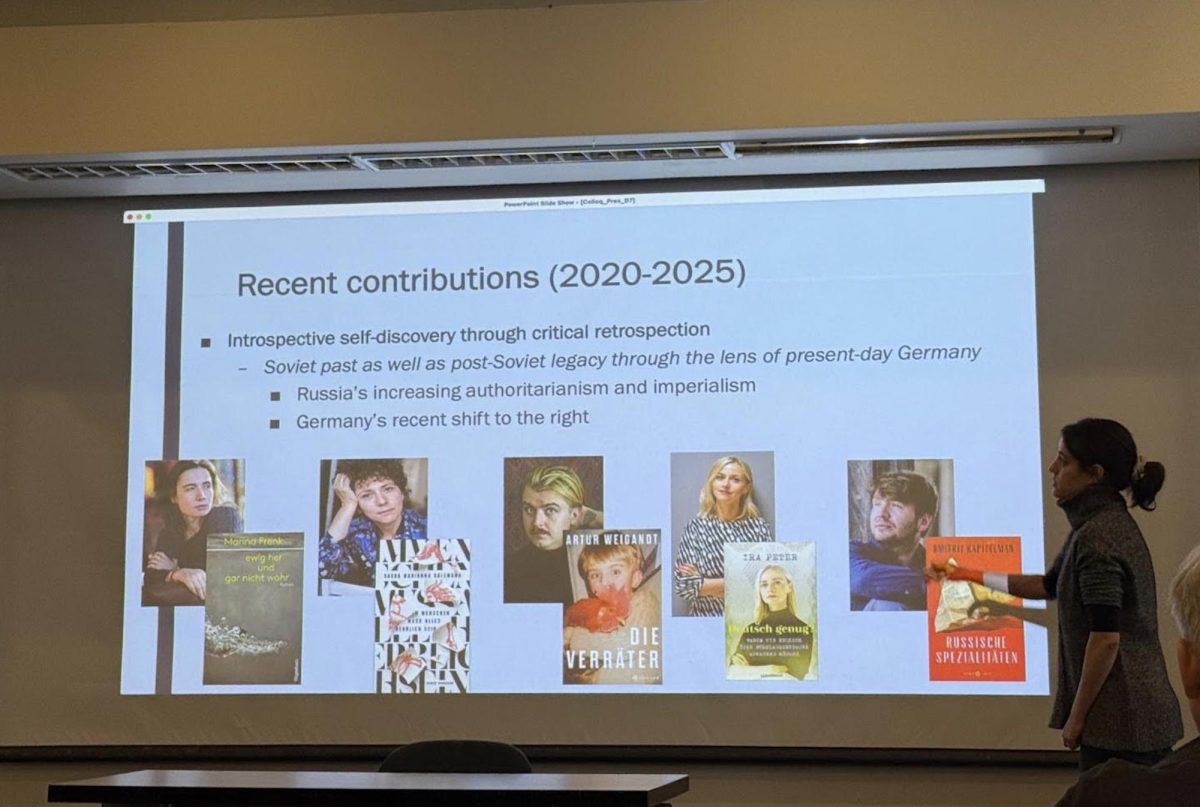
Colgate University Assistant Professor of German Irina Kogan unveiled her new nonfiction book to faculty members and students on Tuesday, Feb. 10. Under the working title of “Accessing the Soviet Past Through German-Language Literature,” her research centers on the emergence of German-speaking authors who are critically evaluating their Soviet pasts in response to Russia’s authoritarian and imperial conquests in Ukraine. Her book will deal with the intersections of past and current issues, such as the Cold War, the Nazi regime and the current war in Ukraine, as well as acknowledge their intersectionality.
Kogan graduated from Northwestern University with a B.A. in Comparative Literature and Philosophy with a minor in French. After spending a year as a teaching assistant in Austria, she received a master’s degree in Comparative Literature and a Ph.D. in Dramatic Language and Literature, both from Yale University.
Claire Baldwin, the department chair of German, introduced Kogan and complimented her skills as a linguist and scholar.
“Kogan is an impressive linguist, and her literary sensitivity to both Russian and German poetry, as well as her own trans-cultural expertise, make her a talented guide,” Baldwin said.
While introducing Kogan’s topic, Baldwin commented on the effects of migration to Germany on the relationships between Ukraine, Germany and Russia.
“Migration to Germany from the former Soviet States since 1990, and particularly since the start of the war of Russian aggression in Ukraine in 2022, has shifted the relationships and the self-understanding of those relationships between Ukraine, Germany and Russia, and those whose identities have been forged in the interstices, cultures, languages and histories,” Baldwin said.
At the beginning of her presentation, Kogan referenced Sasha Marianna Salzmann’s essay “The Great Hunger and the Long Silence,” which addressed the gaps in Ukrainian history, such as the genocide in the 1930s. Additionally, she was fascinated by accounts of migration from Russia to Germany.
Following this, she moved on to the controversy surrounding the term “post-Soviet.” According to Kogan, the term extends a Soviet framing and ignores the other cultures that the Soviet Union erased or suppressed. She said she will continue to use the term while understanding and acknowledging its problematic implications.
Next, Kogan covered the specifics of post-Soviet migration to Germany — the focus of her research. As of 2019, 3.5 million people in Germany were from the former Soviet Union. About 2.7 million of these people had their own direct experience of migration. The three most common countries are the Russian Federation, Kazakhstan and Ukraine.
Immigrants from these countries have been especially prominent in German media because they tend to vote for right-wing parties, such as Alternative for Germany (Alternativ für Deutschland), Germany’s far-right political party founded in 2013. She highlighted this because of the negative visibility that it brings to this group of people, as well as reinforcing stereotypes that post-Soviet migrants are comfortable with authoritarianism due to their roots.
Additionally, Kogan referenced the tension between negative and positive stereotypes of post-Soviet migrants. Jewish migrants are perceived as part of the educated class, but face antisemitism. Russo-German resettlers are viewed as “hard-working” Germans but are also rejected as “too German.” Anti-Slavic prejudices are still alive in Germany today, forcing re-settlers to “perform” their German identity.
Kogan then mentioned the concept of Gedächtnistheater, or “memory theater,” which highlights the binary opposition between migrants and German society. She emphasized Jewish people in Germany as having to perform for normalization after World War II, despite many being from the Soviet Union. Kogan also discussed the erasure of culture, as often Sovietization was actually “Russification.” This reality meant that many attempts to create a Soviet identity ultimately rejected the amalgamation of other identities in the Soviet Union.
When discussing post-migration society, Kogan stressed pluralism.
“I think of theories of post-migration, for example, that have become increasingly popular, where scholars, sociologists, anthropologists think about how to stop thinking just purely in terms of migration, purely in terms of the host society, the binary host society and migrants, but how to think of a more plural society, where people are not categorized on the basis of who was born here and who came here,” Kogan said.
First-year Sofia Golab attended the lecture and expressed appreciation for the presentation on how the past bleeds into modernity.
“I really enjoyed how the presentation used resources from right after communism fell, as in writers from that era, while also including modern writers, demonstrating how it’s an ongoing process of learning to live in the post-Soviet world,” Golab said.