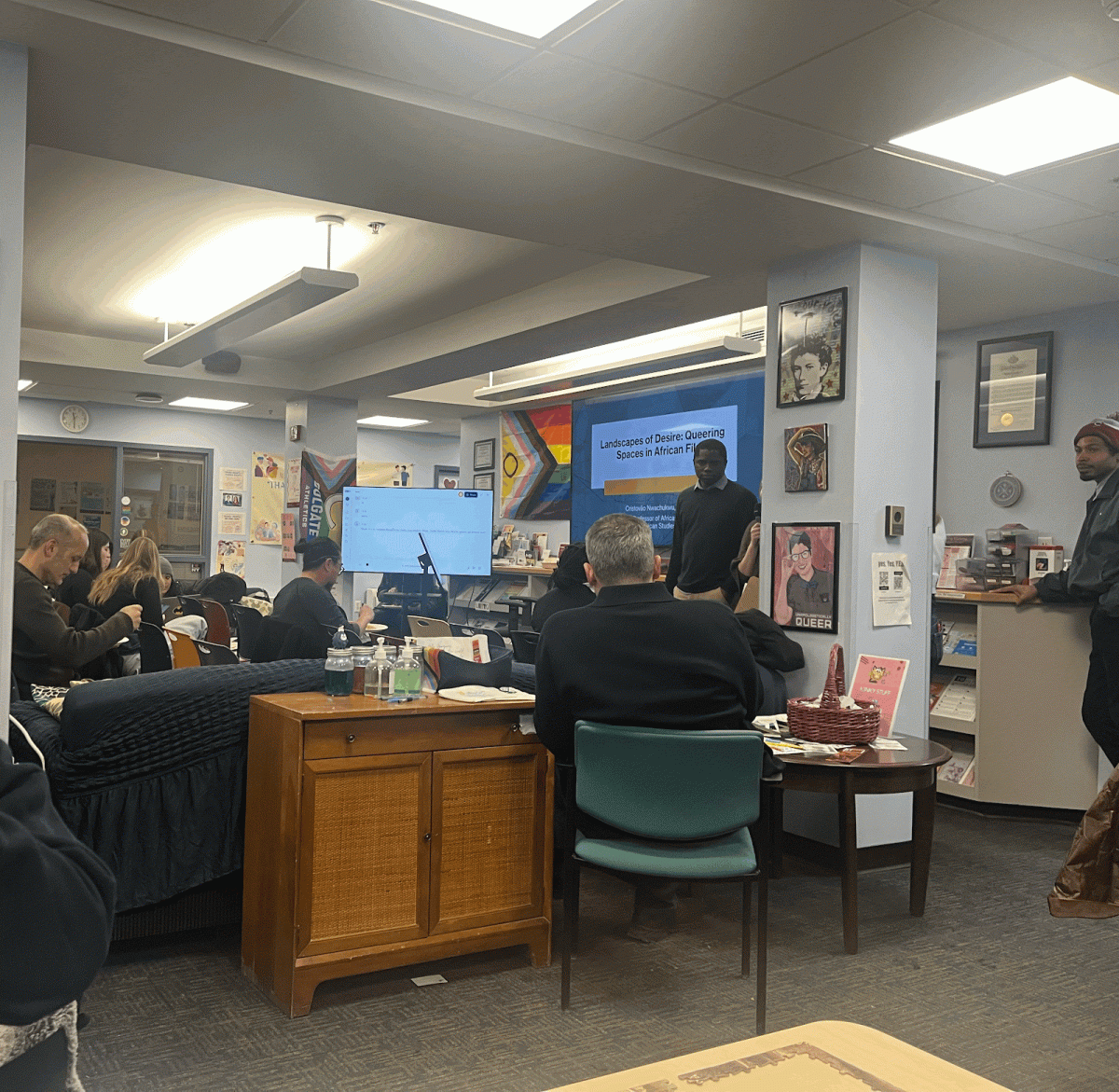
The Center for Women’s Studies hosted the brown bag event “Landscapes of Desire: Queering Spaces in African Film” on Feb. 10. Assistant Professor of Africana and Latin American Studies Cristovão Nwachukwu led the discussion on how the representation of spaces in film can empower or stifle queer desire. The talk engaged with queer African studies theory, pushing students to consider and confront normative social structures.
The lecture focused on the drama film “Dakan” (1997) by Mohamed Camara, which tells the story of two young men struggling to pursue a relationship as their family and broader heteronormative structures try to keep them apart.
Nwachukwu described how private and public spaces showcase the tension between desire and heteronormativity. The film’s cinematography and lighting help communicate both conformity and confrontation.
Shadows in the film reveal who is permitted to fully express themselves and inhabit the light. Manga is cast in the dark, while his mother stands in the light, attempting to control his identity. Nwachukwu also called attention to the symbolism of the balcony’s balustrade, which frames the characters as if confined within a self-imposed prison.
“I wanted to focus a lot on the aesthetic features of the film, because yes, the plot is important, the things that Camara explores in this film are important, but also there’s a lot of aesthetic, formalistic prowess that he showcases throughout the film, especially how he deals with queerness and how the characters relate to different spaces,” Nwachukwu said.
Nwachukwu defined queerness as anything out of the heteronormative order. As Nwachukwu explained, normative social relations are not natural but imposed. For instance, colonization, Christianity and Western academia played a role in creating African anti-homosexuality laws. Nwachukwu argued that films like “Dakan” can reinvent how we think about queerness and desire, especially in an African context.
“Stella Nyanzi, a major scholar in queer African studies, says that scholars in queer African studies have to reclaim Africanness, both the diversities and reinsert queerness, as Camara did in his film, really showcasing that queerness has always existed in African societies” Nwachukwu said.
Seniors Salem Sokpoli and Zemira Meade resonated with how the lecture created a space to dive into and discuss taboo subject matter.
“The topic piqued my interest primarily because talking about anything that’s not heteronormative is kind of seen as a taboo topic that’s not spoken about freely, and the fact that a professor is talking about this in an academic space is the reason why I’m here,” Meade said.
A former student of Nwachukwu, Sokpoli found the connection between queerness and space fascinating.
“I found it really interesting how he talked about how queer people ‘queer’ public spaces or they kind of ‘queer’ the binaries between public and private, in and out, and those are very much set on a rigid binary,” Sokpoli said.
Meade appreciated how the lecture touched on the intersection of queerness with other marginalized identities.
“I don’t think I’ve taken a class that spoke about queerness, so this is my first introduction hearing a professor outright speak about queerness, which is kind of sad because it’s our final semester,” Meade said. “But I’m glad that there’s a professor that openly talks about it, and not only talking about queerness but talking about queerness amongst marginalized communities, like [people of color] communities, because not only is queerness being stigmatized, but it’s even more stigmatized when it’s in some sort of POC community.”
The Center for Women’s Studies held a film screening of “Dakan” the night before the lecture, which Sokpoli attended.
“It was really beautiful, and I personally really like West African cinema, and I’m trying to expand more into that because that’s not mainstream. So it was a good exposure to that and it was scenic. It was just beautiful,” Sokpoli said.
The ending of “Dakan” conveys an uncertain future, but also emphasizes queer freedom.
“It’s not going to be a clear cut, happy ending. It’s going to be somewhat ambiguous because they’re going to run away from the family, they’re going to have to create their own spaces,” Nwachukwu said. “This idea of queering is here because what exactly is going to happen to us? Are we going to find a space where we are going to be openly in love with another, going to find a space where we can project our desire?”