At Colgate University, the number 13 is impossible to ignore. What many people consider unlucky has instead become one of the most recognizable and quietly celebrated features of campus life. For students, the number appears everywhere, in both obvious and unexpectedly subtle ways, shaping Colgate’s traditions, identity and everyday experience.
Colgate’s connection to 13 begins with its founding story. In 1817, 13 men gathered in Hamilton, N.Y., to establish what would become the university. Their founding constitution consisted of 13 articles and each member contributed 13 dollars and offered 13 prayers to support the new educational society. This combination of symbolism and ritual laid the foundation for a tradition that still defines Colgate even more than two centuries later.
Though the institution evolved over time, undergoing name changes and expanding academically, the mythology surrounding 13 remained intact. Rather than fading into historical trivia, the number gradually embedded itself into the culture and physical landscape of campus.
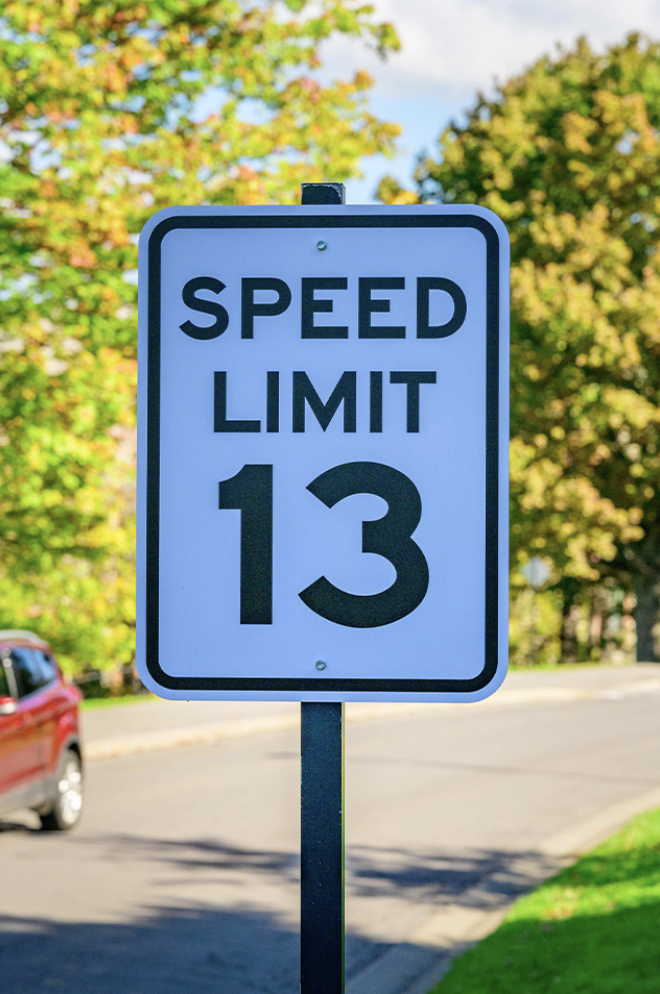
Today, students encounter Colgate’s lucky number in countless ways. One of the most noticeable appears on the roads surrounding upper campus, where drivers navigate under the distinctive 13 mile-per-hour speed limit signs.
First-year Charlie Marsala shared his aspect with this wholesome addition to the campus.
“The 13 mile-per-hour speed limit signs were definitely unexpected on my first visit, but I found them to be a fun addition to campus,” Marsala said.
For many students, moments like these transform the tradition from abstract history into lived experience. Marsala also described the number less as superstition and more as shared campus character.
“I think it’s something quirky about Colgate that brings people together and instills a sense of unity amongst the student body and faculty,” Marsala said.
For first-year student Sarah Chirchick, the tradition stands out as a visible expression of school pride.
“One of my favorite 13 traditions on campus is having every Friday the 13th be Colgate Day because I think it’s a good way to foster school pride,” Chirchick said.
Colgate’s attachment to 13 extends beyond signage. The university’s official address, 13 Oak Dr., serves as a constant reminder of the tradition, quietly reinforcing the number’s presence in even the most administrative details of campus life.
Even Colgate’s zip code participates in the pattern. The sequence 13346 begins with 13, while the remaining digits (3 + 4 + 6) sum to 13 — a numerical coincidence that students often enjoy pointing out.
While some references to 13 are easy to spot, others are woven subtly into campus architecture. Inside Alumni Hall, students moving between floors encounter a quiet nod to tradition: thirteen stairs separating each level. The design transforms a routine part of student life — climbing stairs between classes or meetings — into an understated connection to Colgate’s history. Chirchick also pointed to this feature as a more unique aspect on campus.
“I think it’s a funny thing to have exactly 13 steps between each floor,” Chirchick said.
Together, these details illustrate how 13 has become less of a novelty and more of a shared experience. The number appears not only in symbols and stories, but also in the everyday rhythms of campus life.
Perhaps the most iconic embodiment of Colgate’s lucky number is the Colgate Thirteen, the university’s long-standing all-male a cappella group. Named in honor of the tradition, the ensemble represents continuity, performance and school spirit.
First-year student Michael Darville, a member of the Colgate Thirteen, emphasized the sense of community within the group.
“It’s a really amazing community to be in, and all of my brothers in the Thirteen are my friends for life,” Darville said.
For generations of students and alumni, the group serves as a living reminder that Colgate’s identity is shaped as much by tradition as by academics.
What began in 1817 as 13 men drafting 13 articles, contributing 13 dollars and offering 13 prayers has evolved into something far larger. The number now lives in road signs, staircases, mailing addresses and student traditions as a quiet but persistent thread connecting Colgate’s past and present.
At Colgate, 13 is not simply a number.
It is a tradition students walk past, drive by and climb through every single day.