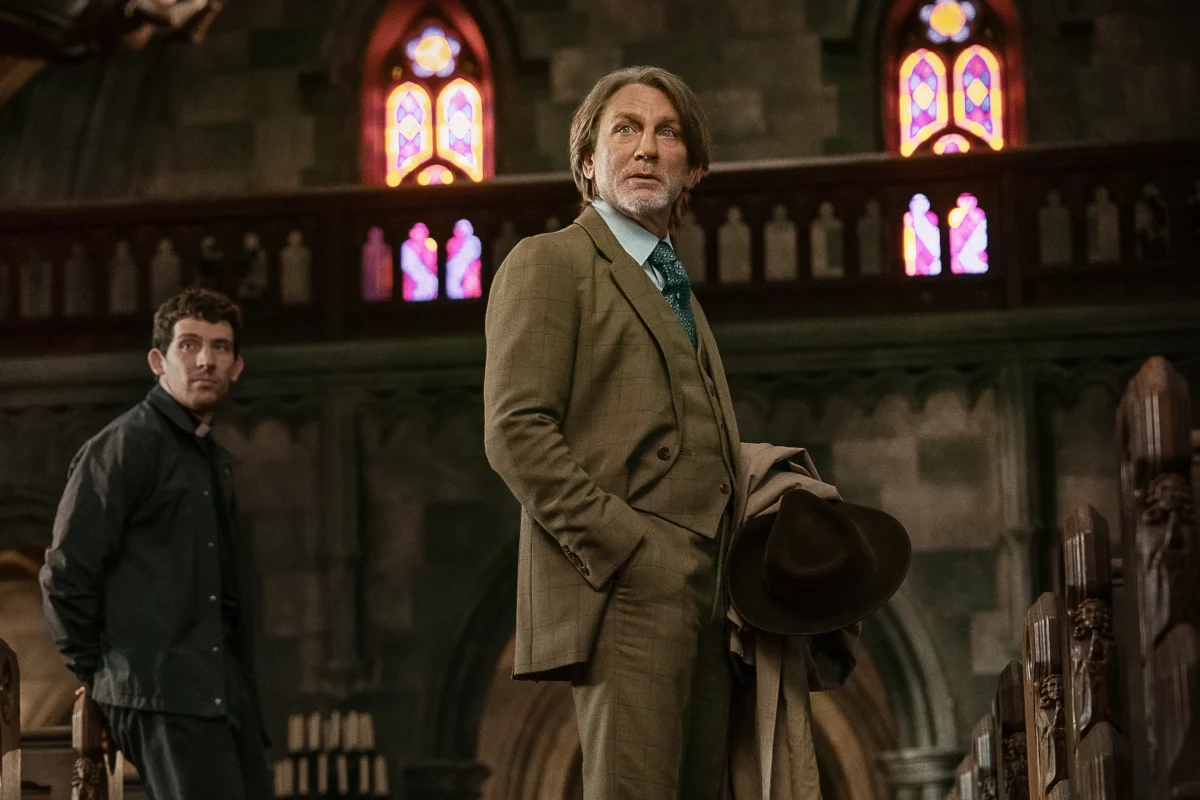
The third installment in Rian Johnson’s “Knives Out” series of films was released on Netflix on Nov. 26, 2025. “Wake Up Dead Man: A Knives Out Mystery” featured a similarly star-studded cast to its predecessors, as well as minor public attention. Besides taking a break to create one of the worst Star Wars films ever made, director Rian Johnson has consistently directed noir movies since 2005.
His debut film “Brick” exists as what might truly be referred to as cinematic lightning in a bottle. Within the first act of the film, it appears to be something of a weird high school power fantasy, which few would take seriously until eventually unfolding into a high-stakes noir that is hard to look away from. The film is visually impressive, too, meshing that student film identity with many ideas that work so beautifully in the context of the narrative. To describe the film’s many virtues is difficult; it is a blockbuster and a cult classic, a fervent thriller and a shock to the system.
Contrasting the burning originality of “Brick” to Johnson’s boilerplate “Knives Out” series, it is difficult to understand how these films are made by the same director. To give a comprehensive view of the serial films, an example of its holistic misgivings can be viewed in an analysis of his latest film, “Wake Up Dead Man: A Knives Out Mystery”; it is important, and maybe easier, to analyze the symptoms to understand the larger disease.
Similar to its predecessors, “Wake Up Dead Man” is a whodunit noir with detective Benoit Blanc, played by Daniel Craig, at its center, attempting to solve the complex murder of overzealous preacher Jefferson Wicks, played by Josh Brolin, in a small American town. Across the wide range of characters typical in a murder mystery, few stand out despite the fortune it cost to fund the casting for this movie. All the characters seem to have some sort of motivation for the murder, yet the back of the viewer’s mind is constantly prodded with the reality that there is only one salient suspect, who, even if unsuspected by the audience, is generally unremarkable in terms of the dull, low-stakes plot.
Perspective is also very strange throughout the film. It is customary in a noir to give the viewer the limited perspective of detective Blanc or his sidekick Jud, an associate pastor and the main suspect for the murder of Wicks. However, similar to the previous “Knives Out” films, the viewer is also removed from the perspective of our two main characters, making the film an overall third-person narrative.
It is true of most drama films, but especially the noir, that the plot should unfold with each step leading to the next — this should be unpredictable, but inevitable. The use of the third person in the film, however, only hides certain plot points and revelations from the audience until the editor decides to reveal them. The predecessor to “Wake Up Dead Man,” “Glass Onion,” had this problem of third person in spades, which, depending on how much is hidden from you by the editor and cinematographer, makes the spectacle of the film seem analogous to someone telling you to close your eyes as they perform part of a basic magic trick.
The plot, therefore, feels less like an unfolding series of events that you experience alongside a character and more like a planned spectacle that must be shown to you in a certain way in order to reach the specific murder mystery conclusion the scriptwriter had in mind.
The film suffers from a certain visual mediocrity as well. There are some nice shots here and there, reflecting certain characters and plot points, yet with a budget of $210 million, it is ultimately underwhelming. This is especially true considering that it has half the visual innovativeness of “Brick,” which was filmed on a budget of less than half a million dollars.
The film, once again, is very similar to its prequels and is also thematically bankrupt. All of the “Knives Out” movies appear to be on the brink of saying something about money, power or religion, but never actually do. It is admittedly difficult to bake a theme into a story that is so narratively complex, but what is most infuriating is that they almost claim some bona fide semblance of a message without actually saying anything.
The release of “Wake Up Dead Man” represents another step in mediocrity for Netflix-produced movies as well as for the career of director Rian Johnson. As he continues to estrange himself from his previous impassioned and creative filmmaking, he leaves us with weak sauce as he counts the zeros on his paycheck from Netflix.