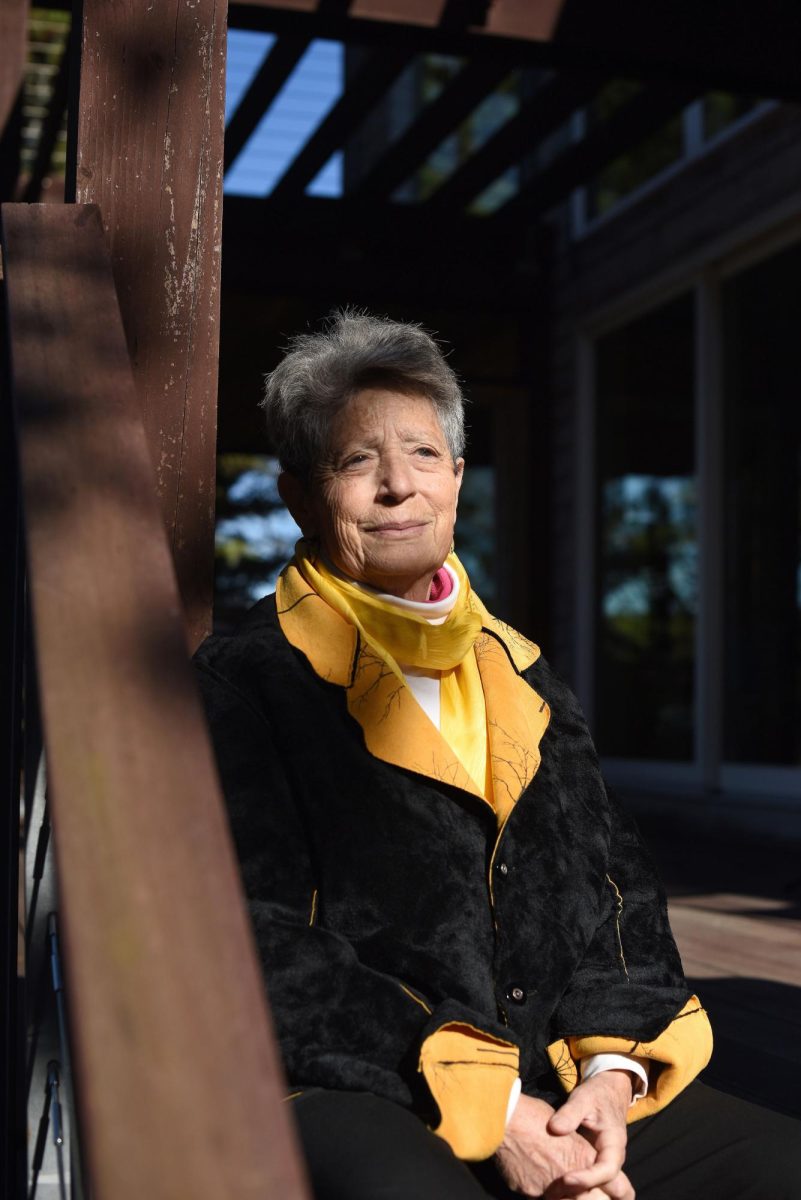
The Center for Women’s Studies, LGBTQ+ Initiatives and Robert H.N. Ho Mind, Brain, and Behavior Initiatives hosted an interactive lunch conversation with Dr. Anne Fausto-Sterling on Wednesday, Feb. 18. Fausto-Sterling, who is the founder and former director of the Science & Technology Studies Program and a Nancy Duke Lewis Professor Emerita of Biology and Gender Studies at Brown University, spoke about her expertise in the intersection between biology, gender and feminism.
Fausto-Sterling has been a pivotal figure in the creation of women’s and gender studies programs across the nation, dedicating her career to reframing gender as a less dichotomous subject.
Fausto-Sterling began the conversation by acknowledging that the field of women and gender studies was modeled after scholarship on race and ethnic relations, both of which focus on the liberation of marginalized communities. She emphasized the importance of these topics in academia, a field historically dominated by white men.
According to Fausto-Sterling, it was those same white men who fervently resisted her and her colleagues’ goal of integrating women and gender studies in Brown University’s curriculum.
“We were all junior female faculty who would develop our own courses about women’s studies. Male professors would laugh at us and say, ‘this isn’t serious history,’” Fausto-Sterling said.
Fausto-Sterling felt a need to bridge the gap between biology and gender to show dissenters of women’s studies that gender did, in fact, play a pertinent role in science. She admitted that her passion for an unconventional research topic led her to miss out on promotions and income increases, but she continued to advocate for the intersection of gender and science.
Fausto-Sterling eventually received tenure, giving her the right platform to expand her network of like-minded academics.
“Our interest group utilized mini-grants for literature, materials and pizza for our meetings,” Fausto-Sterling said. “We developed a common language while studying together so we could take the right steps in exposing our community to a new field of scholarship.”
Colgate University Assistant Professor of LGBTQ+ Studies Lindsay Toman, who served as the moderator for Wednesday’s lunch conversation, asked Fausto-Sterling to explain how she has clarified the lapse in focus on gender in science. Fasuto-Sterling answered Toman’s question by defining the word “gendersex,” a term she coined to describe the intricate feedback between biological sex and a social gender construct.
“Not a lot of people wanted to use the word ‘gendersex,’ because, traditionally, social impacts on sex weren’t recognized as relevant factors,” Fausto-Sterling said.
Fausto-Sterling then credited her parents for raising her to be an activist. Her mother and father were both part of their regional NAACP chapter and had extensive experience fighting for the rights of disadvantaged communities.
Fausto-Sterling noted how her home environment continuously pushed her to acknowledge the oppression of women, which she noted is growing increasingly more prevalent today. She shed light on President Donald Trump’s Executive Order 14168, “Defending Women From Gender Ideology Extremism and Restoring Biological Truth to the Federal Government,” and implored her audience to challenge the narrative the current administration is trying to push.
“Removing gender from the discussion will eventually evolve into [people] dissolving women and gender studies. This is the first stage of genocide,” Fausto-Sterling said.
When asked to name what specific actions people can take to protect women and gender scholarship in universities targeted by anti-diversity policies, Fausto-Sterling underscored the importance of cross-campus communication, lobbying to higher management about the necessity of gender studies and recognizing the broader context of social reform movements.
“Look at how people are suppressing medical care for trans youth, look at the [U.S. Immigration and Customs Enforcement] protests and think about how that liberation correlates with gender studies,” she said. “Look around and think to yourselves, ‘what is the Colgate health system doing?’”
Fausto-Sterling ended the luncheon by highlighting her recent academic pursuits – new research and book publications – which embody these initiatives and represent her larger goal of moving science towards a more “process-oriented theory,” in which gender is embedded in a nature-and-nurture process.
As Toman thanked Fausto-Sterling for coming to Colgate to educate the community about the nuances in women and gender studies, she reflected on how Fausto-Sterling has affected her academic and professional career.
“From graduate school to my own class at Colgate, ‘Gay’s Anatomy,’ [Fausto-Sterling] has been foundational in reframing how I teach gender theory. I want to provide my students with perspectives that I didn’t even encounter in my undergraduate education,” Toman said.
First-year Kriti Dhakal considered how educators who encourage interdisciplinary education, like Fausto-Sterling, can shape the opinions and perspectives of a whole generation of students.
“I felt really inspired by her talk, especially when she talked about how the boundaries between biology and society are imaginary,” Dhakal said. “I really appreciated hearing that.”