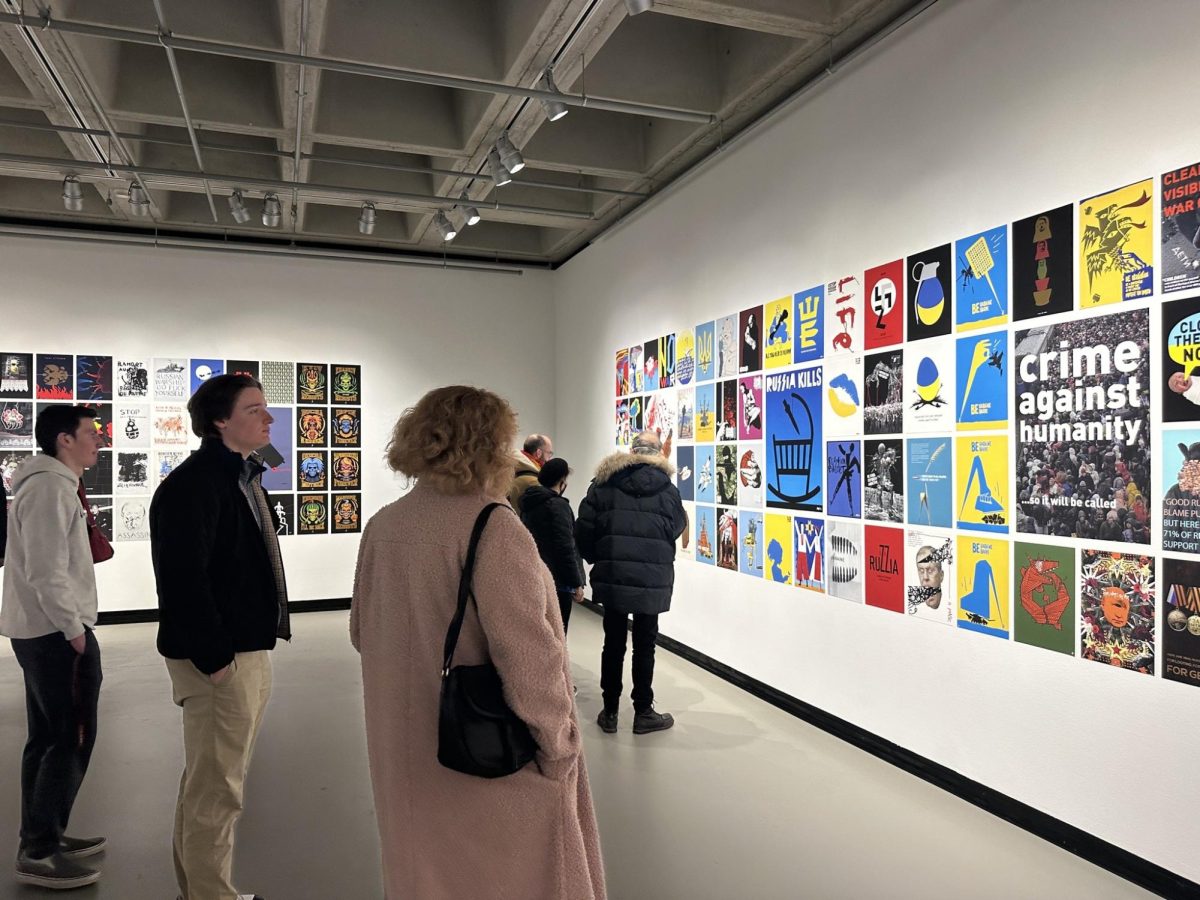
Colgate University opened the historic exhibition “Ukraine Wartime Posters, 2022–2025: The Way of Resistance,” in Little Hall’s Clifford Gallery with a lecture-discussion from guest curator Olena Speranska on Wednesday, Feb. 25.
The largest graphic artwork show ever displayed in the United States, the exhibit features 309 graphic works by 42 contemporary artists from Ukraine, Poland and France. Each piece is an artistic expression of civic life during wartime. The opening marks the fourth anniversary of Russia’s full-scale invasion of Ukraine on Feb. 24, 2022.
Speranska, the curator of the two-month-long display, is vice president of the Contemporary Art Research Union, director of the Art Residencies program with BIRUCHIY Contemporary Art Project and founder of the U.S.-based Ukrainian Contemporary Art Platform.
The exhibition coordinator, Associate Professor of Art History and Co-Director of the Kraynak Institute for the Study of Freedom and Western Traditions Carolyn Guile, first met Speranska in January 2024.
“Our guest is very active in the Ukrainian contemporary art circles, and her work has received wide recognition both at home and internationally. She is an extremely impressive person, whose knowledge, curatorial skill and determination are behind the work you see today,” Guile said. “I decided immediately upon meeting her that we at Colgate must bring her to campus — we must stage an exhibition of this powerful material.”
Before Speranska’s lecture, “The Power of the Image: Trauma, Art and Counter-Propaganda,” Guile turned the stage over to the 2022 Nobel Peace Prize Winner and Ukrainian human rights lawyer, Oleksandra Matviichuk. Matviichuk, through a pre-recorded video, explained the importance of Speranska’s work.
“Let’s make it clear, if Ukrainians stop resisting, Russia will occupy the whole country. We will cease to exist,” Matviichuk said. “The basis of our existence is our dignity, not victimhood, and dignity is action. We are not hostages of circumstances. We are participants of the historical process, and dignity provides us a chance to continue our fight, even in unbearable conditions.”
The lecture began with the question, “What is art about?” as Speranska took the audience through prominent works of art throughout history, including those of notable Ukrainian artists.
“The main thing of art is actually remembrance, a fixation of history. With one single piece of art, we can research our past, understand our present and await the evolution of human society in the future,” Speranska said.
Speranska then shared her own experience of loss and trauma over the course of the war. Russian forces attacked her home city of Irpin, on the outskirts of Kyiv, in the opening days of the full-scale invasion and destroyed nearly 70% of the region.
“It’s not just about everything that we have lost. We also lost the long story of why I am standing here right now, and why I have the right to support the Ukrainian artists and why I have the right to speak about Ukrainian history,” Speranska said.
Returning to the art sphere, she extensively referenced her work at the BIRUCHIY Contemporary Art Project Art Laboratory, discussing the livelihoods of herself and her artistic peers and crafting various art installations with unparalleled creative freedom.
“I just want to show you the level of freedom we had. It was absolutely another piece of land [that felt like we had] our own government and own territory at this time, and it was a real tragedy that we lost it,” Speranska said.
The lecture cited data from the Ukrainian Ministry of Culture, reporting that more than 2,000 cultural institutions have been damaged and hundreds destroyed, including approximately 120 museums and galleries, 784 libraries and 39 theatres, cinemas and philanthropic halls.
Citing these attacks on Ukrainians, Speranska shifted the discussion into the final phase of her talk: the importance of working with counter-propaganda. Speranska detailed the initial few days in hiding after her family’s home had been attacked, searching online for any consolation for what she had lost. Instead, she encountered an incredible influx of artwork.
“The only tools [artists] had were iPads, personal laptops and iPhones, and they started to create images — lots of them, flooding the internet. And I started to collect them,” Speranska said.
After fleeing the region, Speranska began to use these wartime posters to participate in rallies in New York City, N.Y., and Washington while also curating exhibitions of the works worldwide, from Colorado Springs, Colo., to Ogaki, Japan.
“[These posters were] the next step, the next really powerful step, of spreading the word,” Speranska said. “Yes, we can clearly declare that Russia is a terrorist state, which is why we must work with counter-propaganda and spread the word — spread the truth — of what is really going on.”
Speranka concluded with a presentation of her eponymous book. First published in 2023, the work features a curated collection of 453 total graphic works.
Following the lecture, attendees gathered in the Golden Auditorium lobby to enjoy catered refreshments and witness the official opening of the installation.
“Ukraine Wartime Posters, 2022–2025: The Way of Resistance,” will be on display in Clifford Gallery for viewing until May 1, 2026.