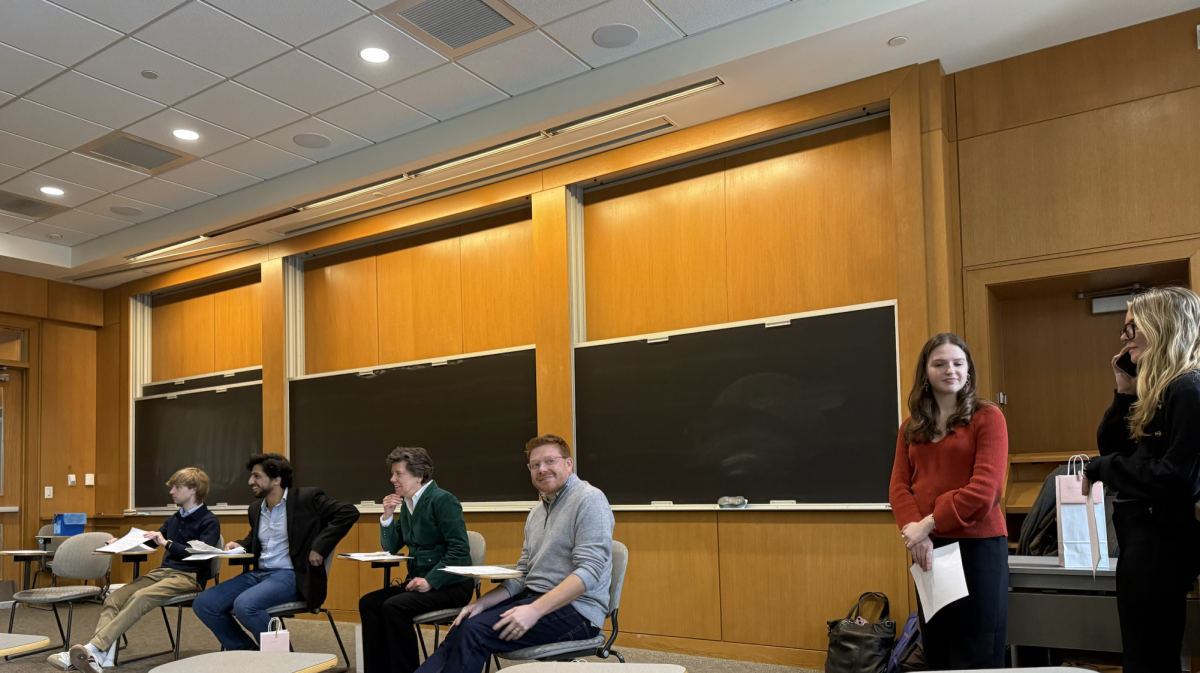
The Colgate University Writing and Speaking Center (WSC) hosted a dialogue of faculty, current students and an alumnus about their thoughts on the impact of generative artificial intelligence (AI) in education on Thursday, Feb. 26. Seniors Sophia Boyd and Abby Call, both peer writing consultants at the WSC, organized and moderated the panel intending to restore trust between students and faculty amid concerns that AI tools are replacing traditional writing support. Since the WSC has experienced fewer student appointments this semester, the panel aimed to address how AI is changing academic work and what role human feedback and collaboration still play in the learning process.
The talk featured five central panelists, including Professor of Philosophy Aaron Wolf, whose work covers the ethics of artificial intelligence. Wolf is a founding member of the new Data Studies minor at Colgate.
During the panel, Wolf focused on the benefits he believes generative AI offers in an educational context.
“The benefits of AI for academics and learning are just beginning to reveal themselves in the last couple of months,” Wolf said. “The benefits are largely going overlooked and under-appreciated.”
Wolf mentioned that some AI tools for learning help students think independently, rather than answer questions for them.
“There is also a new AI tool called PingPong that won’t answer the whole prompt for you, but guides the user to an answer,” Wolf said. “I have been working on developing my own tool that uses system prompting to guide users to an answer rather than simply providing one.”
Wolf also noted he has limited direct experience observing how students currently use generative AI, but said that when he has introduced AI tools in class, they have helped students engage with complex material earlier in their academic careers.
“I’ve shown students how chat tools can be used to begin something like a literature search,” Wolf said. “Students are able to grasp more complicated concepts and have more complex conversations than they otherwise might.”
Professor of English and Rebecca S. Chopp Chair in the Humanities Constance Harsh also participated in the panel. She described generative AI as an important yet complex issue, particularly in writing-based disciplines. While she acknowledged that AI can be useful in certain academic contexts, she expressed concern about its role in English courses.
“In English, we really value reading and form as much as content,” Harsh said. “AI can convey information, but it can’t replicate the experience of reading and struggling through a text.”
Sophomore Ethan Nichols, a student of Harsh’s, said he came away from his English classes with a similar sentiment.
“[Generative AI’s] convenience is undeniable … However, that convenience comes at a cost,” Nichols said. “Writing is not simply about producing a finished product; it is a process of thinking. Developing a thesis, struggling through revisions and refining unclear ideas are all essential parts of strengthening critical thinking skills.”
The two faculty panelists discussed how generative AI has changed their classroom experiences, particularly in how they understand student work and learning. Rather than creating entirely new challenges, some panelists said AI has intensified existing concerns around engagement, assessment and academic honesty.
Wolf said that while he does not have extensive direct insight into how students currently use AI, he believes the technology has amplified longstanding issues in higher education.
“I don’t think AI is a new problem,” Wolf said. “It has made an existing problem much more acute.”
Wolf explained that in response, he has focused on increasing transparency in grading and clearly separating the quality of work from the grade itself, which he said can help motivate students to focus on learning rather than performance.
Harsh echoed these concerns. She said faculty must clearly communicate why assignments exist and what skills they are meant to develop.
“Simply telling students not to use AI isn’t enough,” Harsh said. “Students need to understand what the learning goals are and why using AI would undermine them. But just because I tell my students something does not mean it will automatically be believed.”
Ultimately, the panelists concluded students often rely too heavily on the tool because of its convenience in obtaining a correct answer when they believe they know the process. Still, practice is an important aspect of learning. If used thoughtfully, AI can support learning without hindering the growth of critical thinking skills and patience in the face of struggle.
The conversation concluded by bringing up the issue of restoring trust in the classroom between faculty and students. Harsh said that when generative AI first emerged, much of the faculty response centered on identifying whether students were cheating. She explained that moving beyond detection and instead focusing on learning goals allows academic integrity to be maintained more effectively.
“I know it is not always the case, but if we can facilitate more conversations between faculty and students about why they are here and what they can accomplish, we can get to the idea of what students really want and how we faculty can guide them there,” Harsh said.
The event concluded with an open session for conversation between the attendees and panelists over refreshments, emphasizing the need for continued dialogue between faculty and students in relation to AI space as the technology becomes more ingrained in academic spaces.