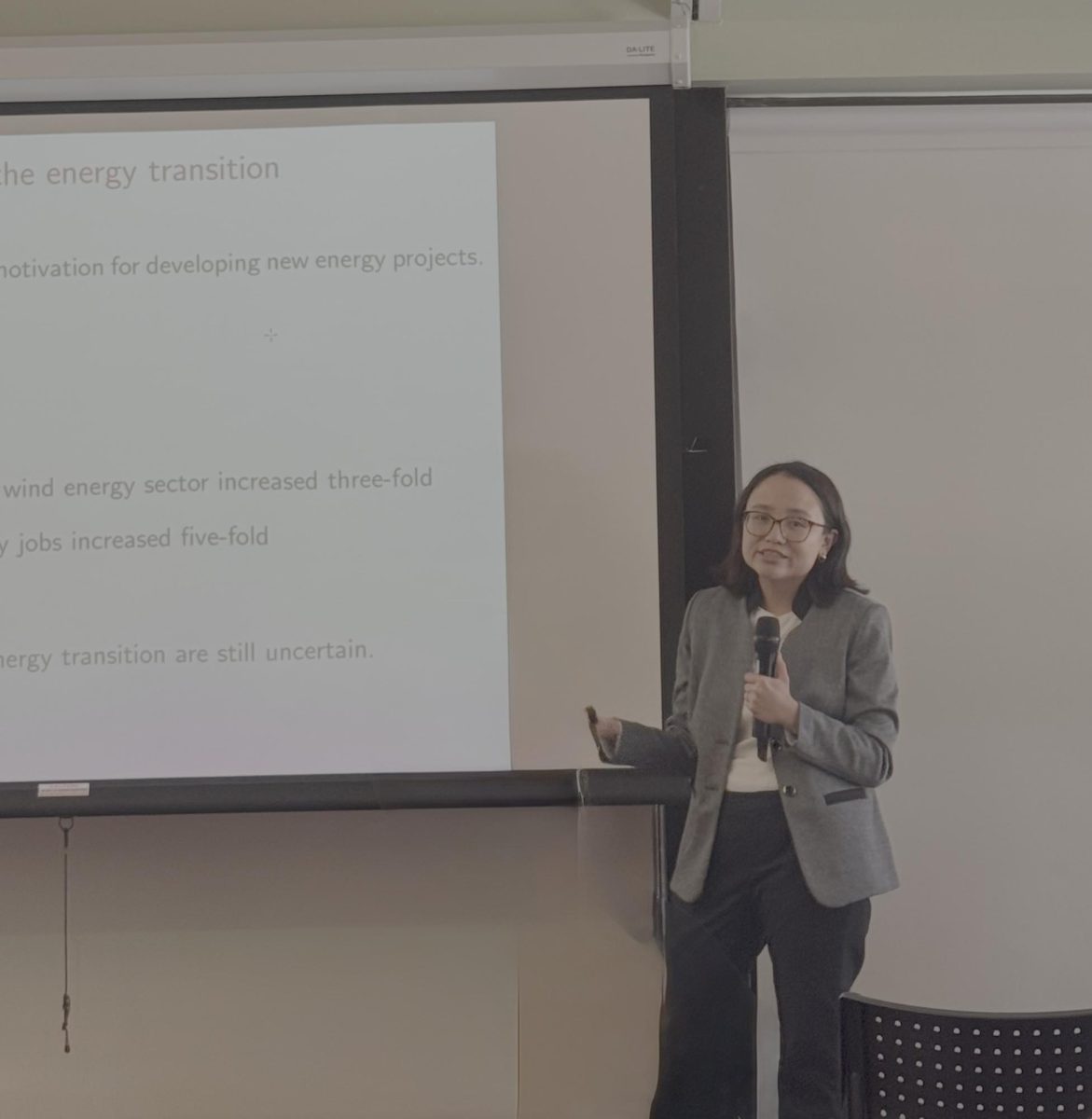
Colgate University’s ALANA Cultural Center hosted Dr. Danae Hernandez-Cortes for a guest lecture co-sponsored by the Environmental Studies and Economics departments on Friday, Feb. 27. An assistant professor at Arizona State University and faculty research fellow at the National Bureau of Economic Research, Hernandez-Cortes delivered a talk titled, “Causes to Solutions: Advancing Equity in Energy and Environmental Policy.” Her talk was mainly concerned with the effects of a carbon-neutral economy on racial and economic inequalities if policymakers fail to address existing injustices.
As states from California to Illinois to New York roll out ambitious clean energy programs, Hernandez-Cortes said that, when thinking of environmental issues like carbon neutrality, what matters is more than merely doing so, but doing so justly. To transition to a carbon-neutral economy, she told the audience, we must first understand how energy policies interact with the underlying socioeconomic disparities that shape who gets to breathe clean air and who doesn’t.
While Hernandez-Cortes acknowledged the contribution of legislation like the Clean Air Act to environmental protection, she noted that the burden of pollution has never been shared equally. Hernandez-Cortes presented data from California to illustrate how Black and Hispanic communities consistently face higher concentrations of PM2.5, one of the most dangerous airborne pollutants, than white populations. She added that poverty levels and exposure to pollution track closely across the entire state.
While overall pollution levels have declined since the 1960s, the gap in exposure between Black and white populations has declined much less. Moreover, Hernandez-Cortes noted, there is very little data on what these disparities looked like before 1960, meaning the full historical scope of environmental inequality remains poorly understood.
Hernandez-Cortes hopes that her ongoing research will shed light on this and fill in some blanks. In a study tracing U.S. power plant siting from 1910 to 2020, Hernandez-Cortes and her team found that power plants were not initially disproportionately sited near minority communities. But after more infrastructure went up, the share of Black residents living in surrounding areas increased significantly. Her explanation pointed to the growing public awareness of pollution after 1960. As its harms became more widely known, land values near industrial sites dropped, pushing lower-income and minority families into those areas.
Most environmental research has focused on factories and power plants, but Hernandez-Cortes argued that other pollution sources, such as wildfires, agriculture and water scarcity, are increasingly important, especially in regions that are essential to a transition to clean energy. One site of interest for Hernandez-Cortes was the Salton Sea area in southern California. The region sits atop one of the world’s most significant lithium deposits, making it useful to the battery and electric vehicle industries. Yet it has an asthma rate more than twice the California average, itself already among the highest in the nation.
Hernandez-Cortes’s research found that as water levels in the Salton Sea dropped after 2005, disadvantaged communities nearby experienced a sharper rise in pollution concentrations. Ultimately, this pollutant build-up at the bottom of the lake leads to direct health consequences for communities that have long lacked the political power to demand relief.
In the Phoenix, Ariz. area, Hernandez-Cortes’s research highlights a different issue: cumulative exposure. South Phoenix communities face elevated levels of toxic air pollutants, high PM2.5 concentrations and extreme heat all at once, and all disproportionately concentrated among minority residents.
Hernandez-Cortes and her team are also developing new methods to measure cumulative disparities. Findings show that while many parts of the country saw improvement between 2000 and 2020, pollution in parts of the southwest has worsened due to rising temperatures. Furthermore, the pollution concentration faced by Black and Hispanic populations is still higher than that faced by white populations.
Hernandez-Cortes also used an analysis of California’s cap-and-trade program to show how well-designed climate policy can actually reduce environmental disparities. Before the program, pollution exposure gaps between communities were widening. After implementation, those gaps began to close because the policy targeted the facilities emitting the most pollution, which are concentrated next to minority communities.
Later in the talk, Hernandez-Cortes distinguished between three dimensions of environmental justice: distributional justice, who is harmed or helped; procedural justice, who has a voice in decisions; and recognition justice, whose history and experience are acknowledged. Most research and policy focus mainly on the first; the other two are more often ignored.
“We’ve seen a lot of active policy in order to mitigate impacts, but sometimes the policies that aim at decreasing those emissions may have some unintended consequences,” Hernandez-Cortes said.
To handle this, her team organized five community workshops in Phoenix, funded through an Environmental Protection Agency (EPA) grant, gathering over 400 residents to discuss transportation, air quality and what decarbonization would look like in their neighborhoods. Their input, discussed in these very workshops, helped shape the policy scenarios her team then modeled, simulating how different plans would affect pollution levels across communities (based on race, income, poverty status and so on) before bringing back the findings to the same communities.
“Who has access to talk about these issues? Who has access to design these policies? That matters,” Hernandez-Cortes said. “Community engagement could allow us to address some of these disparities while also looking at some of the issues of a procedural imbalance.”
Sophomore Aynsley Zamore, an environmental biology major, explained how the talk overlapped with one of her current classes.
“I’m taking an environmental policy class right now, so hearing [Hernandez-Cortes] break down how communities in south Phoenix are dealing with toxic pollution, bad air quality and extreme heat all at the same time was interesting,” Zamore said. “[It] really brought the environmental justice piece of what we’ve been studying.”
Senior Joycelyn Brobbey, a double major in environmental studies and sociology, said the lecture raised questions about the current political moment.
“One thing I couldn’t help but think about was how the repeal of the ‘endangerment finding’ from the Trump administration would impact how states can legislate on things like air pollution, and how that would affect low-income communities in the future,” Brobbey said.
The EPA’s “endangerment finding” (its official determination that greenhouse gases threaten public health) is the legal foundation for a lot of the federal government’s power to regulate air pollution. If that determination is reversed, it could undermine the very policies that Hernandez-Cortes’s research found effective at reducing environmental inequality. States would be left to fill the gap, and vulnerable communities would lose protections.
In light of unstable environmental circumstances, Hernandez-Cortes offered that, while decarbonization may seem like a clean-cut positive solution, it is not automatically a force for justice without consciousness of the communities that are disproportionately affected.
Hernandez-Cortes identified three major takeaways: measuring environmental disparities is really important, climate change policy for pollution industries can reduce disparities if it is designed to acknowledge them and there can be equity tradeoffs from the carbonization policy.
“Community engagement could allow us to estimate some of these disparities while also closing some of the issues of a procedural imbalance,” Hernandez-Cortes said. “Understanding how these policies interact with existing environmental disparities is really important, especially to try to avoid increasing historical injustices.”