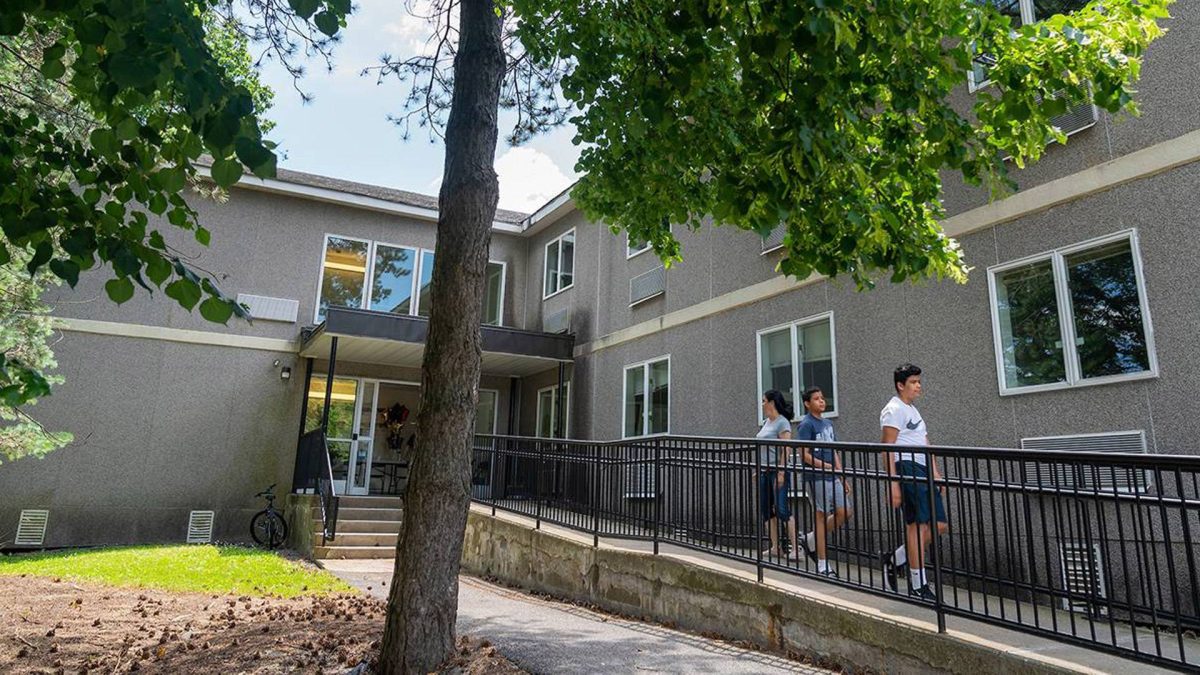
Colgate University plans to demolish Gate House and replace it with new housing as part of a broader residential life overhaul, President Brian W. Casey announced in his annual President’s Report released in early March.
The annual report detailed the developments made on campus in the previous year. For the first time, the publication contained a Stewardship Report, discussing the progress of the Third-Century Plan over the past seven years. The Third-Century Plan, launched in 2019, is Colgate’s comprehensive campaign to enhance academics, residential life, financial aid and campus infrastructure through major fundraising and strategic development. The President’s Report provided updates on completed campus projects and the next areas of expansion, with a focus on residential life and expanding financial aid.
Casey identified three priorities for the coming years: continuing the fundraising campaign’s momentum, expanding financial aid and building on recent investments in arts and innovation.
“Should the campaign keep going as well as it’s going? What’s the next push of financial aid? Those feel like the two things that feel most immediate,” Casey said.
The University has already expanded access through the Colgate Commitment, which provides tuition-free, no-loan aid for families with incomes up to $175,000.
Casey also pointed to recent developments like Bernstein Hall as groundwork for future arts initiatives.
“We built Bernstein, we’ve started thinking more about arts, creativity and innovation — what’s the next step for that?” Casey said.
One of the projects most relevant to student life on campus is the update to residential life. Long-discussed projects such as the removal of the first-year dorm Gate House are slated to begin soon. Casey also hoped to replace the dorm at 113 Broad St. and shared how they are ensuring sufficient housing during this transition period. The University plans to build entirely new residential housing near the current 113 Broad St. location first. Once that housing is complete, students currently in Gate House and 113 Broad St. will move into the new buildings, allowing both older structures to be demolished.
“The fastest way to replace Gate House and 113 is actually to start building around where 113 is right now,” Casey said. “If we start building a community down there to eventually replace 113 itself, but also replace Gate House, does that open up the possibility of having the first-years live on a quad up on the hill and then sophomores live as a community on the southern edge of Whitnall?”
The University has not yet set a specific timeline for the Gate House replacement, but preliminary planning is underway. The shift of sophomores to Middle Campus involves not only a change in living space but an expansion of community. The Third-Century plan accounted for not only the extra housing but also building new facilities for those living farther from up-the-hill amenities.
“Were we to move, say, 800 sophomores down toward where 113 is — does that call on us to make investments in James C. Colgate, Donovan’s Pub? Does that need to be bigger? Probably,” Casey said.
Besides upcoming residential campus projects, Casey also shared updates on the other facets of the Third-Century Plan. Projects like the Carey Center will begin construction soon. Offices located in the Facilities building nearby have been relocated, and ground will break on the new building in May during Alumni Weekend. The President’s Report called the Carey Center “[Colgate’s] largest single investment at more than $100 million,” adding that it “will redefine athletics and student life for generations.”
Additionally, a new apartment complex at 18-22 Utica St. designed to provide affordable housing for faculty and staff is nearing completion, with many of the 41 units already under lease.
“As of June, 32 of them could be occupied. We wanted to hold some back, waiting for the next hiring season. We also made a promise to the hospital and the school district that some apartments would be held for them,” Casey said. “We have such a need for reasonable housing for staff.”
The President’s Report and the attached Stewardship Report provided a comprehensive overview of the four pillars of the Third-Century Plan, each representing a different facet of campus life, from student recruitment to physical infrastructure. The first pillar aimed to attract outstanding students, faculty and staff through financial initiatives such as the Colgate Commitment or endowed chair positions.
The second pillar focused on strengthening the University’s academic enterprise, centering on the four institutes — the Lampert Institute for Civic and Global Affairs, Kraynak Institute for the Study of Freedom and Western Traditions, Picker Interdisciplinary Science Institute and the Upstate Institute. It also included the development of new ventures, such as the Colgate Union.
The third pillar centered on enriching the student experience, including residential life and student-athlete experiences. Casey emphasized that residential life improvements — part of the third pillar — would be among the most visible changes in coming years.
Finally, the fourth pillar examines improvements to campus and the environment, including developments both at the University and in the village.
In the coming months and years, students, alumni and faculty can expect to see massive progress in these four pillars.