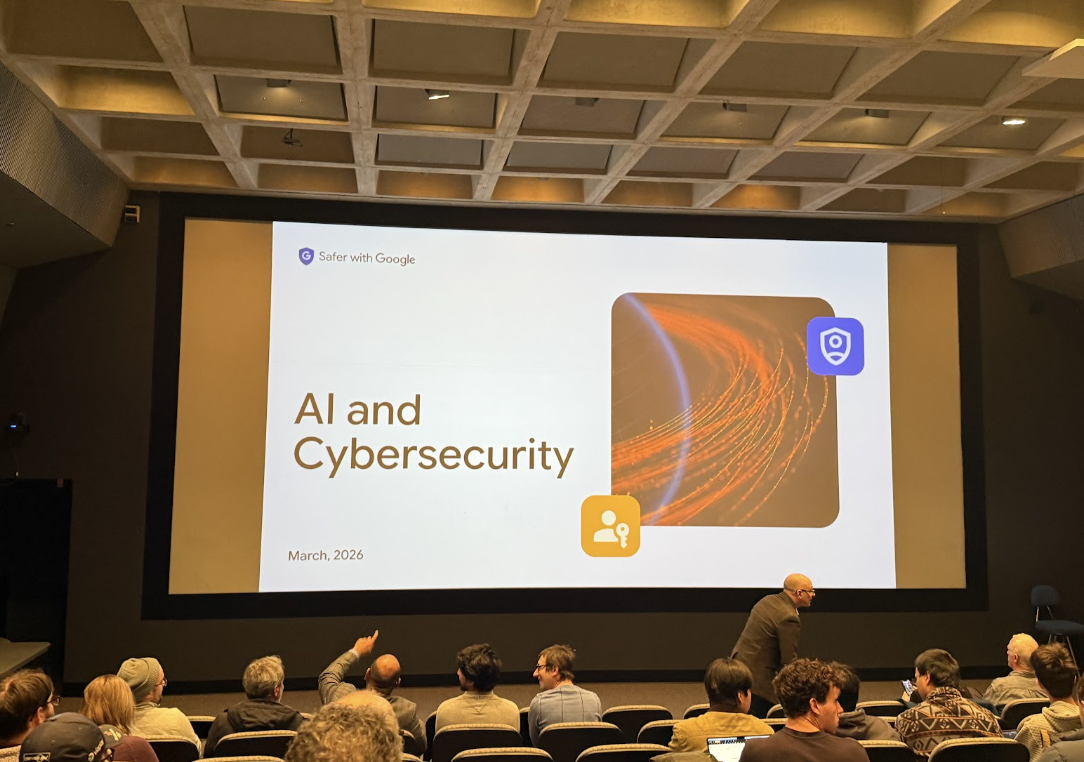
Colgate University’s Lampert Institute for Civic and Global Affairs hosted Royal Hansen, the current Vice President of Security at Google, on Wednesday, Mar. 4. The presentation titled “AI and Cybersecurity,” which was held in the Golden Auditorium, covered essential issues such as generative artificial intelligence (AI), programming, the natural environment and future pathways for scientific innovation.
Hansen’s role at Google encompasses various roles, but most importantly, he is responsible for driving the company’s information security strategy for the technical infrastructure that serves billions of users. He received a Bachelor of Arts in computer science from Yale University and began his career as a software developer. Hansen opened the presentation by expressing his excitement at visiting Colgate, a liberal arts institution. He discussed the intersection of natural language and AI, and the role of the humanities in this process. Hansen recounts being one of the only computer science majors at a humanities-dominated Yale, but stressed the importance of both fields in carving the path towards the future.
First-year Katherine Koenning appreciated Hansen’s connection between computer science and a Colgate education.
“I really liked his conversation on security and how that intersects with the liberal arts and technology, all converging,” Koenning said. “And, I thought it was interesting how he said that as liberal arts students we should be the ones having conversations about technology and the ethics of it.”
Hansen segued into explaining the famous Google paper “The Data Center as a Computer,” which provided the fundamentals for AI down the line. This novel concept, developed by his friend at Google, yielded valuable insights into high-level computer development. However, it also sparked Hansen’s curiosity about the natural world’s potential to interpret complex data phenomena.
“Turns out, [the writer of the paper] was also a wildlife photographer and really into this sort of natural world,” Hansen said. “And little by little, we realized that we were living in a world where the only thing as complex as a data center and all the data and networking that goes behind the Google services for two or three billion people was the natural world. And we began to wonder: ‘what are these lessons from the natural world that help us deal with the complexity of our digital world?’”
Next, he discussed the inherent “wildness” of the digital world and Richard Danzey’s article using nature as an analogy for the internet. The article titled “Surviving on a Diet of Poisoned Fruit: Reducing the National Security Risks of America’s Cyber Dependencies” addressed the internet as both an unstable place full of discrepancies and misinformation, as well as a massive place for cultural growth. According to Hansen, it is the job of humans to adapt to this new ecosystem and further humanity’s interests.
Hansen also discussed the place of biology in his field of research. He explained how the structure of amino acids relates to AI research and development. For example, if you take 20 amino acids and run them through specific constraints using AI, an outcome will be produced in accordance with the laws of physics, Hansen explained. And then, if you allow the system to just iterate and iterate, it will keep improving itself until it can solve this problem, creating models of several hundred thousand proteins. This solves scientific problems that otherwise would have taken humanity hundreds or even thousands of years to solve.
Hansen continued to stress the importance of constraints in AI development. According to Hansen, the power of AI lies in the use of constraints, but not an infinite number of them. Essentially, he argued that by giving an AI constraints and letting it run wild within them, it creates the fastest possible feedback loop, with the shortest development and correction times.
He connected this concept to the emergence of Waymo Cars, an autonomous driver ride-hailing service. Waymo Cars are a safer alternative to regular cars because their sensors respond faster than human reflexes, allowing them to adjust more quickly in emergency situations. Similarly, AI offers a better opportunity because its feedback loops respond more quickly than human perception would.
Next, he addressed the future implications of AI. He explained the “Red Queen Hypothesis,” another allusion to the natural environment, in which a garter snake and a rough-skinned newt are locked into an evolutionary battle, with the newt’s poison evolving at the same pace as the garter snake’s resistance. This symbolizes a race towards evolution, where the loser will go extinct. He connected this to the concept of AI as being a positive force towards humanity’s future, one that we must adapt to.
Finally, Hansen talked about AI as the driving force towards scientific innovation. He argued that what we associate with generative AI, like chatbots, will be obsolete in a couple of years. Instead, the medical and scientific implementations of AI will live on. AI will be able to implement laws and fundamentally change democracy. However, he articulated that AI is a tool for the people because it is accessible to everyone, and therefore, the true innovation will come from the people themselves.
Senior Abby Call recounted meeting Hansen before his talk and her initial take on his presentation.
“I was able to meet with Mr. Hansen, actually, before this, so we had a conversation earlier, and his exploration of both philosophical ideas and biology being built into the conversation really struck me,” Call said. “But I do think there is something to be said about saying that all of these things instead of actively building that into the company. So, I still think that’s something that needs to be considered.”