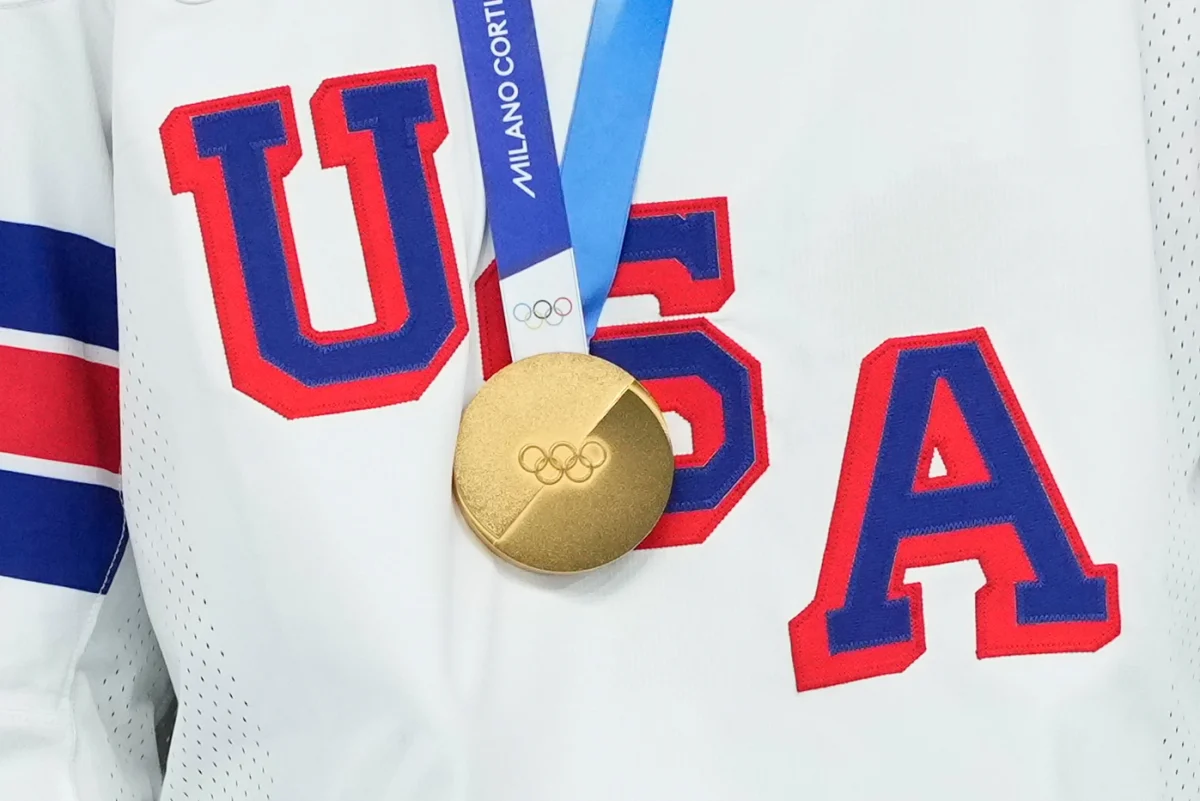
The 2026 Winter Olympics were hugely successful for American hockey. For the first time in history, both the men’s and women’s teams took home the gold medal in the same Olympics. The two teams accomplished the feat in similar fashion, with the women taking down arch-rival Canada 2-1 in overtime before the men did the same to our northern neighbors in equally dramatic fashion, securing a 2-1 overtime win.
Despite puck drop for the men’s game coming in the early hours of Sunday morning, NBC’s live coverage of the event still averaged over 18 million viewers, with viewership peaking during overtime as 26 million sets of eyes tuned in on the grudge match for gold. According to Nielsen, the game was the most-watched sporting event in American history to start before 9 A.M. Eastern Time. The women’s game was also a ratings success, peaking at 7.7 million viewers, making it the most-watched women’s hockey game of all time.
The twin victories in Milan should have been American hockey’s moment in the sun. Instead, the controversies that followed in the days after the men’s final cast an unfortunate shadow on what was supposed to be a watershed moment for hockey in this country.
Videos from the locker room following the men’s win made waves as they began to leak out on social media Sunday afternoon. In the most viral clip, many members of the team were seen huddled around a phone on a call with President Trump as he congratulated them on their accomplishment. This was not too controversial or surprising — until Trump made a distasteful comment about the women’s team that was followed by laughs from some of the players. The joke, perceived by many as sexist and dismissive, magnified the already-sensitive narrative surrounding women’s sports in America.
The relationship between sports and politics has perhaps never been as pronounced as it is now. For decades, it was customary for victorious sports teams to visit the White House some time after their title to be celebrated by the president, regardless of the Commander-in-Chief’s political affiliation. Times have changed. Since Trump first took office in 2017, various teams or athletes have chosen not to visit the White House. The change reflects the growing politicization of the sports world in the social media age, as sports are becoming more and more often a platform for political expression.
As a result, the men’s team’s ensuing visit to Washington, with the additional context of the inappropriate joke, became a particularly controversial one. Some defended the team, noting that interacting with the president is not unusual for athletes representing the United States. However, it would be ignorant to deny that the current political environment makes celebrating with the President and other members of his Cabinet a more politically charged act than it has been in the past.
This is especially the case because there has never been an administration that latches on to sports as a vehicle of American exceptionalism quite like the current one. For starters, FBI Director William H. Webster wasn’t in the locker room spraying champagne with the men’s team following their miraculous upset over the Soviets in 1980. Compare him to the current FBI Director, Kash Patel, who partook in the locker room celebration with evident gusto. Regardless, the men’s team found themselves caught in a difficult situation.
Luckily, it seems as though relations between the men’s and women’s teams remain strong. Members of both teams appeared on SNL and even poked fun at Trump’s sexist comment. Captain Hilary Knight acknowledged the joke as “distasteful and unfortunate,” but added that she felt “a genuine level of support and respect” between the men and women. The incident, while unfortunately putting a damper on what was otherwise an incredible moment for American sports, shows the political realities of the current moment. The episode ultimately serves as a reminder of the role sports now occupy in American life, where even the most celebratory victories can quickly become part of a larger political conversation.