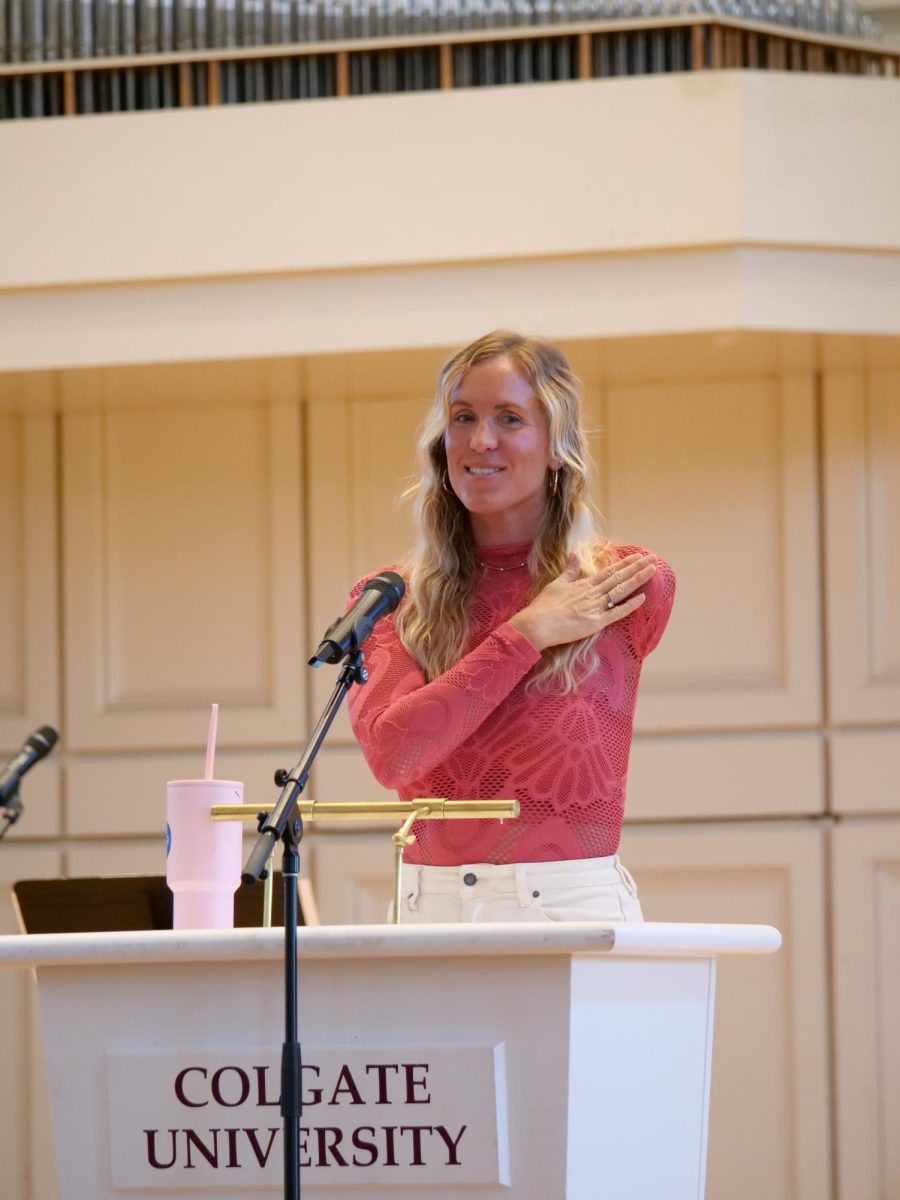
At the age of 13, Bethany Hamilton was lying on her surfboard in the waters off of Kaua’i, Hawai’i, when a 14-foot tiger shark attacked her, taking her left arm and, it seemed, her future in surfing. Just one month after the attack, Hamilton was back in the water. Within two years, she had claimed her first national surfing title. By age 17, she had turned professional, and she hasn’t stopped competing since. Hamilton also became a writer and speaker whose story was notably adapted into the 2011 feature film “Soul Surfer.” Following the traditional order of worship, Hamilton shared her story of resilience and imparted some wisdom with members of the Colgate community during a service at the Memorial Chapel on Sunday, March 8.
Hamilton reflected on her attack and how it has informed her life.
“I never imagined losing my arm to a shark, and then having this wild, just different life … I never thought it was going to happen. But seeing how I was able to adapt … it’s so much more than me,” Hamilton said. “Most people would see this as such a horrible thing, but I see all the meaning that God has brought out of it, and it’s just incredible how we can turn things that we don’t understand into good.”
Rather than dwelling on what she lost, Hamilton told the audience she has spent her life developing what she calls an adaptive approach, which is a framework built on several core principles that anyone can apply.
Hamilton focuses first on appreciation. When she woke up in the hospital after the attack, she was quite aware of how close she had come to dying.
“I remember being in the hospital thinking I lost 60% of my blood … getting to the hospital, it was a really long distance, and not only that, but our medical is sub-par, it’s a very small town,” Hamilton said. “It was just a miracle that I survived.”
That instinct — to look for what is good rather than mourn what is gone — has stayed with Hamilton.
“Instead of focusing on what’s not going right, you’re focusing on how good and beautiful things are right in your life,” Hamilton said. “You’re looking for the good.”
Hamilton was candid that gratitude doesn’t always come easy, but emphasized the science behind gratitude, noting how it changes the chemistry in your brain and supports overall health and well-being.
“God calls me to be grateful in all circumstances. Not just when life is going good and easy — and I’ll be the first to admit that’s very challenging.”
First-year Madeleine Callahan shared her thoughts on Hamilton’s talk.
“I really liked the appreciation approach. In a world where there’s a lot of suffering and comparing, taking a moment to pause and be grateful for the things you have in life and what you can control is super good for your own mindset and morals,” Callahan said. “Because I am a Catholic myself, I really enjoyed her own stories with God and felt like I could relate to them.”
Hamilton continued by explaining the value of staying directed. In times of chaos, it is easy to lose your way.
“When those chaotic moments hit, you can lose your purpose … because once again you’re focusing on the negative,” Hamilton said.
She further urged the audience to resist distractions, particularly on social media.
“[Social media] will only steal you from your action, purpose and joy,” Hamilton said.
For Hamilton, her direction has long been rooted in faith.
“I ride my emotions, or I ride my passions … and research says passion is a good thing,” Hamilton said. “But I think God is a better thing.”
Next, Hamilton insisted on the importance of building community for oneself, as no one endures hardship well alone.
“We need to have people that we can share and enjoy life with,” Hamilton said. “We truly are built for connection and closeness. We need to do life together.”
She encouraged avoiding isolation, urging people not just to “muster through on our own, leaving everyone else behind,” but more so to lean in and let others lean on them. Hamilton spoke highly of her mother, whose unwavering familial commitment she deeply admired. Hamilton turned to the audience and suggested they be more intentional about engaging with the people they love.
The next point Hamilton discussed was perseverance.
“I think the opposite of perseverance is to give up. And when you persevere, you don’t just do it for yourself. When a father perseveres through hardship, his children see it and are strengthened by it. Our society needs that strength,” Hamilton said. “ When you step up in a hard situation, you bring light to those around you.”
According to Hamilton, giving up is not an option — but perseverance has to be paired with humility. She challenged the audience to never stop learning.
“Being teachable took such a young age in surfing and inserted so much into my life,” Hamilton said. “I challenge you to be teachable and to not stifle yourself by ignoring the older, wiser or more established individuals in your life.”
First-year Margot Boyd explained her takeaways from Hamilton’s talk, notably how it extended beyond religious frameworks to convey life lessons.
“I loved Bethany’s talk, particularly her lessons on how to productively respond to stressful and potentially life-altering situations,” Boyd said. “I thought that her advice on finding joy in the face of adversity through the A.D.A.P.T. acronym — Appreciation, Direction, Associates, Perseverance and Teachable — expanded beyond being purely religious and provided a framework for staying positive and dedicated to one’s goals in the midst of hardship.”
Throughout the evening, Hamilton returned to her Christian faith as the source of her strength. She acknowledged that religion is often judged by the imperfection of its followers.
“Christians are imperfect,” Hamilton said. “Your faith is not in people, your faith is in God, who is perfect. People are imperfect. Christians still sin and do wrong. But God is the one who does right.”
Hamilton spoke of this peace that has accompanied her even in her darkest seasons, something she said she can’t fully explain, but something only God could bring. She closed on that note, inviting the audience to look beyond imperfect people as a reason to dismiss faith, but instead to look to God directly.
“That is when we are able to persevere in the darkest hour,” Hamilton said.
Today, Hamilton is married and raising four children, whom she calls her greatest joy. Her story has inspired a major motion picture, a documentary, a foundation running retreats for young people and amputees and a career as a global speaker. She remains an active surf competitor.
“It’s just been so cool to see,” Hamilton said. “Something so awful, and [God] takes those things and sharpens us. Sometimes the purpose is simply to bring us back: hey, what actually matters? Help me up. Help me persevere.”