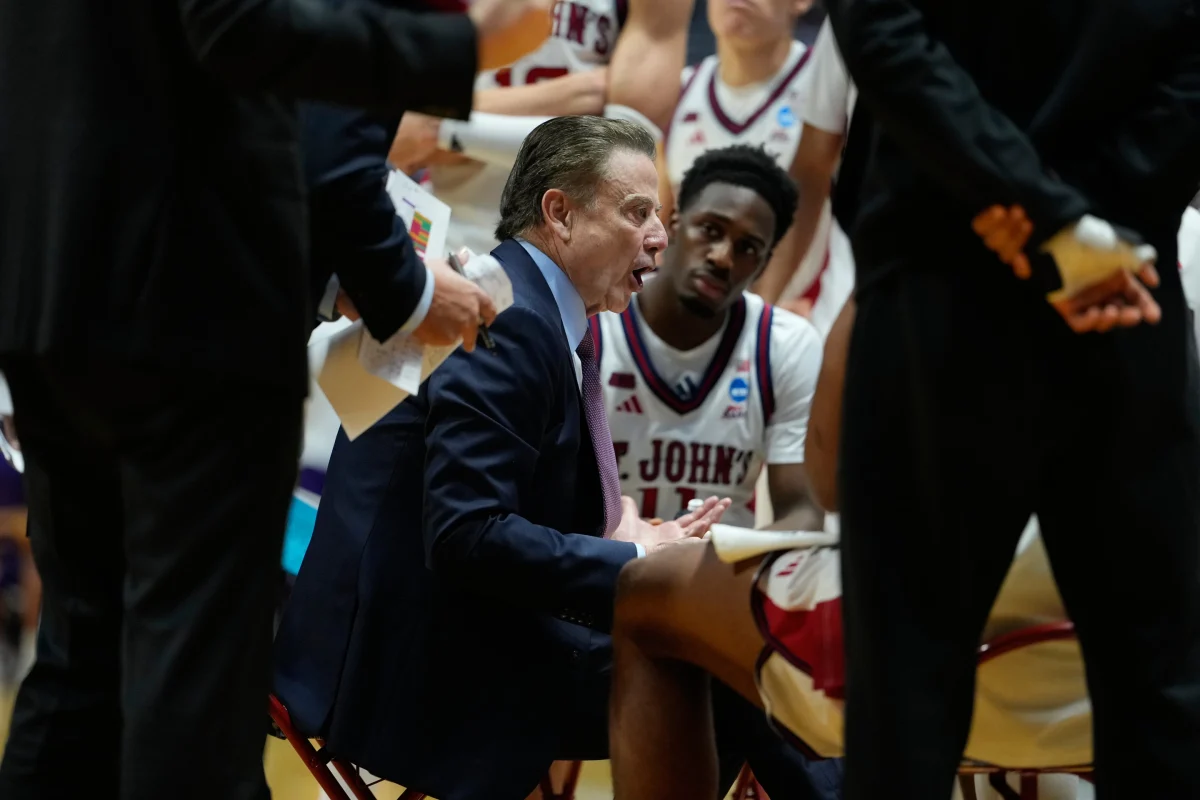
After leading St. John’s University to the Sweet 16 in this year’s NCAA Tournament, one thing has become clear about coach Rick Pitino: he knows how to win. Pitino has amassed 915 victories as a head coach in college basketball, in a career that started 50 years ago at the University of Hawai’i, where he took over as interim head coach in 1976.
Despite an 80-75 loss to Duke that ended this year’s tournament run for St. John’s, Pitino’s success is undeniable. The Red Storm’s appearance in the Sweet 16 was their first since 1999.
They won back-to-back Big East regular-season titles and Big East Tournament titles with Pitino at the helm. Perhaps most surprisingly, in an era where offense has become a priority, St. John’s did all that despite ranking outside the top 150 in the nation in field goal percentage and three-point percentage. Pitino coaches this St. John’s program to win on the defensive end, as they rank 10th in the country in defensive rating according to college basketball statistics website KenPom.
In the second round against the University of Kansas, St. John’s held a 14-point advantage with eight minutes to play in the second half. The lead was thanks in large part to their stifling defense, as Kansas managed only 16 points in the first 12 minutes of the half. But the Jayhawks stormed back and tied the game at 65 when Darryn Peterson made a pair of free throws with 13 seconds left. St. John’s looked to be in trouble, as the game appeared poised to go to overtime, and Kansas would have all the momentum after their late rally. But Red Storm guard Dylan Darling had other ideas. He slashed to the rim on the final play and flipped a shot off the backboard that bounced in, sending his teammates into a frenzy and St. John’s to the Sweet 16.
However, Pitino wasn’t even the one who called the game-winning play. In his postgame press conference, Pitino said it was Darling who suggested running the play that would get him to the basket. On the surface, this isn’t particularly extraordinary; confident players call their own number in close-game situations all the time. But Darling had been scoreless in the game, missing all four of his shots from the field. Pitino knew Darling had had a poor night shooting, and even though he was surprised that Darling would suggest running the final play for himself, Pitino recognized Darling’s confidence and let him take the shot.
Great coaches know what their players are capable of, even on bad nights. They know who they can trust to take the last shot. If Darling missed and St. John’s had gone on to lose the game, the conversation would be different. Why would Pitino let Darling, of all people, shoot the last shot of regulation? But a coach being clear that he trusts his players can sometimes be all the motivation and confidence a player needs. That’s what Pitino gave Darling, and Darling didn’t disappoint.
Pitino is, without a doubt, an incredible coach, but does he deserve to be in conversation with the greatest college coaches of all time? He largely has the numbers to be in the conversation. He won a national championship with the University of Kentucky back in 1996 and another with the University of Louisville in 2013. However, his title with Louisville was later vacated due to a recruiting scandal, and with it, 123 wins across four of his seasons with the Cardinals were also vacated. Officially, Pitino only has 792 career wins, which drops him from third to 15th on the list of coaches with the most career Division 1 men’s basketball wins. He probably won’t ever be able to touch the likes of Mike Krzyzewski, who had five titles at Duke, or Roy Williams, who had three at North Carolina. But Pitino has had success at multiple schools; St. John’s is the fourth different program he has led to the Sweet 16, after Providence College, Kentucky and Louisville. He has been to the Sweet 16 at least once in each of the last five decades. And at age 73, he has had the privilege of seeing his son, Richard Pitino, grow up and become a college coach as well.
The fact that players are able to get paid for name, image and likeness (NIL) generally makes team construction in college basketball more difficult. Players will bolt for the transfer portal if they get offered more money or more playing time. Pitino’s son said that his dad doesn’t worry about roster turnover and players leaving the same way that other coaches do. The younger Pitino also praised his father for putting together back-to-back successful seasons despite the year-to-year turnover on college basketball rosters brought about by NIL.
Rick Pitino’s trust in his players, his sustained success at multiple schools, his coaching record and his adaptability to new dynamics in college basketball all point to his legendary status. While other coaches his age might contemplate retirement, Pitino continues to take the court with an all-business expression and win games. When the time comes that he does decide to retire, everyone in the world of college basketball can remember him as a winner.