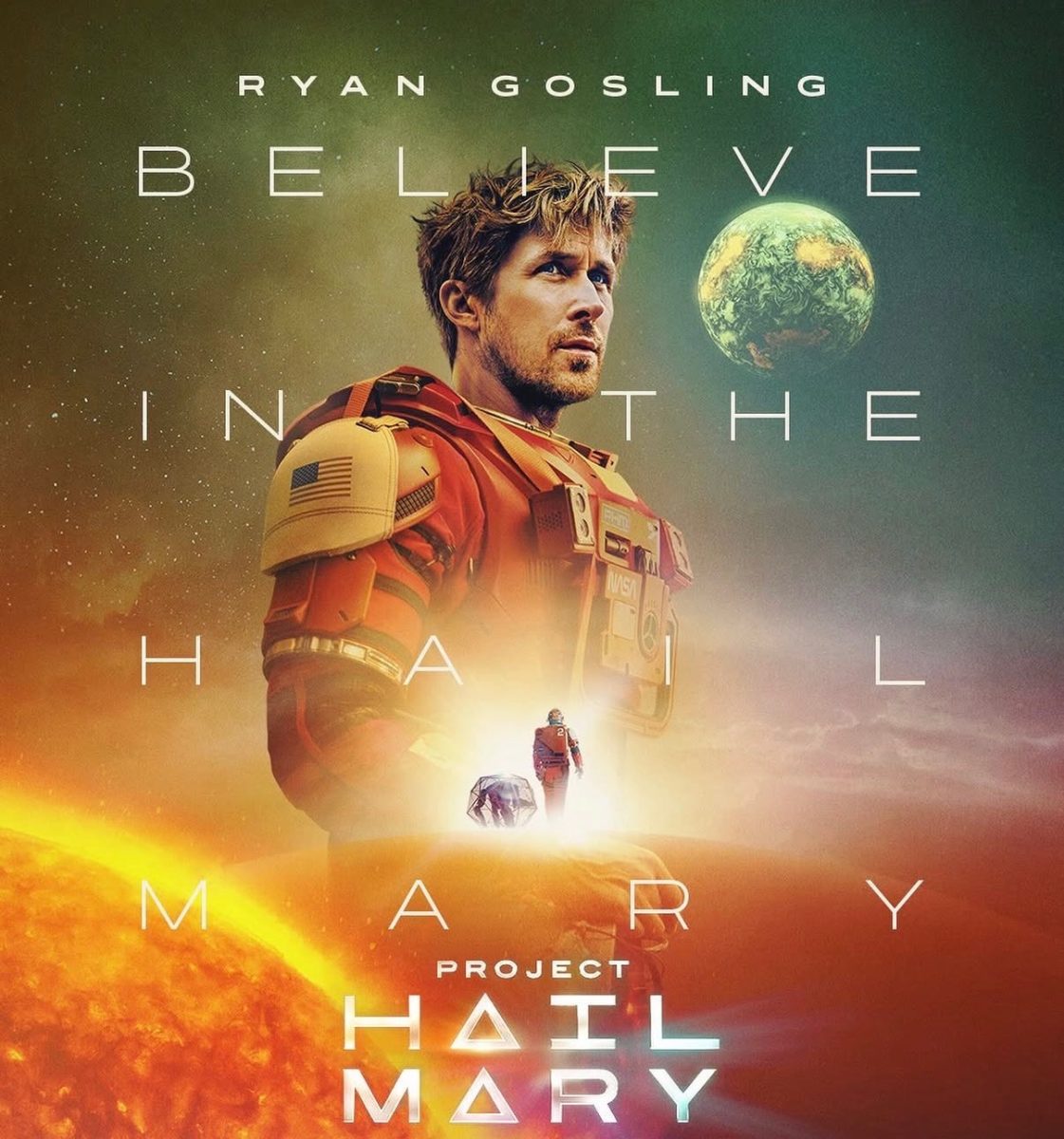
After a slew of recent postmodernist films that only confuse and bore, the release of “Project Hail Mary” earlier this March saw the beautiful execution of a somewhat simple idea. Considering the amount of pretentiousness that cinemas have been exposed to in the last year, one would be forgiven for expecting a confusingly low-concept narrative with a visual style that’s especially hard to follow (an ample description of “High Life”).
Project Hail Mary is anything but pretentious, yet, at the same time, not vehemently redundant in its American-ness. The disaster-space plot of the movie is not entirely original. However, while the idea of sending people out on a last-ditch effort to space has been done before, the film sets itself apart in many ways.
The first aspect that sets it apart is the editing. Typically, the sci-fi genre adopts a linear style of storytelling to cope with numerous narrative pieces. However, in “Project Hail Mary,” the film is able to balance a non-linear script with a narrative that is very involved. In the script, the disaster scenario presented never amounts to the total despondency in dialogue that is so prevalent among other, outer-space films. Instead, it maintains realistic, good humor from likable characters.
Performances shine through as well. Lead actor Ryan Gosling has always had an eye for good scripts and his presence adds a lot of gravitas to “Project Hail Mary.” The near one-man show that is this movie certainly marks somewhat of a crux in Gosling’s career, as well. His performance as Dr. Grace, the unlikely school teacher turned savior of humanity, works especially well and shows a real fruition of all of his previous semi-comedic roles. Even by himself, Gosling shines as a comedic actor.
The film often employs physical comedy with only one or two characters (one of which isn’t even human), to an extremely effective degree — it squeezes out gags from otherwise monotonous scenarios. With the inclusion of the alien, Rocky, whom Grace meets and names along the way, the comedy is effective and always forwards the relationship between the two characters.
The effects are amazing for a movie that apparently never used green screens or major CGI graphics. Even the alien in the film was the work of advanced puppeteering, giving the entire experience a more grounded and realistic visual style, with no shots being bogged down by the appearance of poor CGI or effects. You would think that without the use of those modern techniques, the plot itself would be minimalistic and boring.
However, there are still many impressive action scenes and views of the cosmos. Even the zero gravity parts utilized only a series of suspension and stunt rigs. There is a good breadth of shots reflecting all parts of the narrative arc of Grace’s journey, as well as his relationship with Rocky. The results are visuals that are consistently pleasing, if not impactful.
Impactful is exactly what the film is. By the end of the non-linear plot, flashing back between Grace’s space odyssey and what led him there, we are left with a complete narrative arc of an apparent nobody who relinquishes his own reluctance to self-sacrifice. Having a simple yet effective character arc and narrative structure, “Project Hail Mary” in many ways makes a break from its cluttered postmodernist contemporaries with a story that is, ironically, both down-to-earth and human. Compared to other cosmic epics, it makes a break and stands out when it seemed like there was nothing new under the sun.