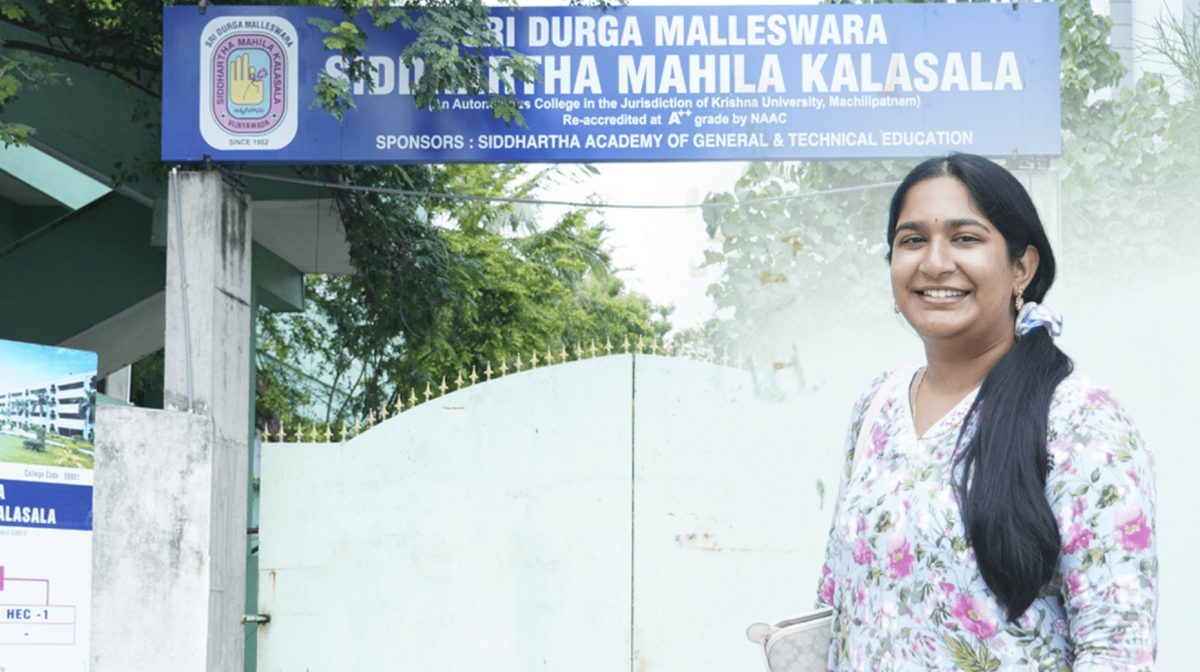
Senior Harshitha Talasila has been selected as a Thomas J. Watson Fellow, an award that grants graduating students $40,000 to support a year of independent global exploration.
The Watson Fellowship selects only 40 students from across the country and provides them with the opportunity to travel to more than 71 countries while pursuing passion projects ranging from local theater to rural healthcare.
Assistant Director of National Fellowship Advising Meghan Niedt spoke to what distinguishes the Watson Fellowship from other opportunities.
“Unlike many postgraduate fellowships, it allows fellows the freedom to follow their curiosity across the globe, immersing themselves in a self-designed project without the constraints of formal academic or professional outcomes,” Niedt said.
At an early age, Talasila moved from Vijayawada, India, to Hopewell Junction, N.Y. This experience moving between India and the United States largely shaped her intellectual interest and fellowship focus.
“Everything from language to fashion to food has shaped how I approach two halves of the same identity,” Talasila said. “It’s given me great appreciation for both cultures and a greater perspective on how different cultures address similar issues.”
As an environmental and peace and conflict studies double major, Talasila has distinguished herself through her work in the classroom and in research. In a course taught by Associate Professor of Peace and Conflict Studies Jacob Mundy, Talasila explored geo-spatial differences in patterns of mass famine in colonial India under British imperialism. Using archival and geospatial data, Talasila brought together her interests in conflict studies and the environment.
“Harshitha is one of those rare students where, as an instructor, you just let their imagination run wild and try to feed it with helpful ideas, scholarship to consider and research approaches that might work,” Mundy said. “You can see from her Watson project that she’s thinking about things in new and innovative ways, and I have to say that is all her doing.”
During her time in India, Talasila observed how rivers are deeply intertwined with religious stories and rituals, reflecting the country’s predominantly Hindu population. In contrast, rivers in the U.S. are largely managed for economic purposes, with dams and power plants built to maximize their utility.
“I had lived in and visited India and saw how the Krishna River, Ganga River and many others were being treated, and was able to compare it to how the Hudson River was being managed,” Talasila said. “I did not see similar rituals as closely associated when I moved to the United States; it was a difference that was pretty striking.”
Talasila will spend her Watson year journeying to Canada, Peru, Germany, Oman, Malaysia and Singapore. She will visit rivers including the Yukon, Amazon, Rhine, Danube, Wadi Shab and Johor. There, she will learn how communities balance environmental conservation with economic development.
In the summer of 2025, Talasila embarked on the Projects for Peace fellowship, working with a nonprofit in Vijayawada to share information with university students about drugs, abuse and other mental health concerns that are often stigmatized in Indian society. Talasila appreciates that the hands-on experience allowed her to immerse herself in a different work culture and further develop her Telugu skills, a Dravidian language.
Since first stepping onto campus, Talasila has acted as a leader at Colgate University. Talasila currently serves as president of the Student Government Association, vice president of the Hindu Student Association and peer advisor in the Office of Entrepreneurship and Innovation. In addition, Talasila served as a Sustainability Representative in her first year, inspiring her to pursue environmentalism and eventually become a sustainability intern.
She believes that Colgate’s opportunities across a range of sectors have led her to discover her passions.
“I think Colgate’s resources have not only fostered interest, but longevity in my involvement in various spaces, because of all the people who believed in me and helped me grow along the way,” Talasila said.
As Talasila prepares to embark on her year of travel and discovery, she hopes to deepen her understanding of how rivers shape both ecosystems and communities around the world.
“I don’t think there will be any other point in my life where I will have one year to spend alongside communities and rivers, learning from the people and environment around me,” Talasila said.