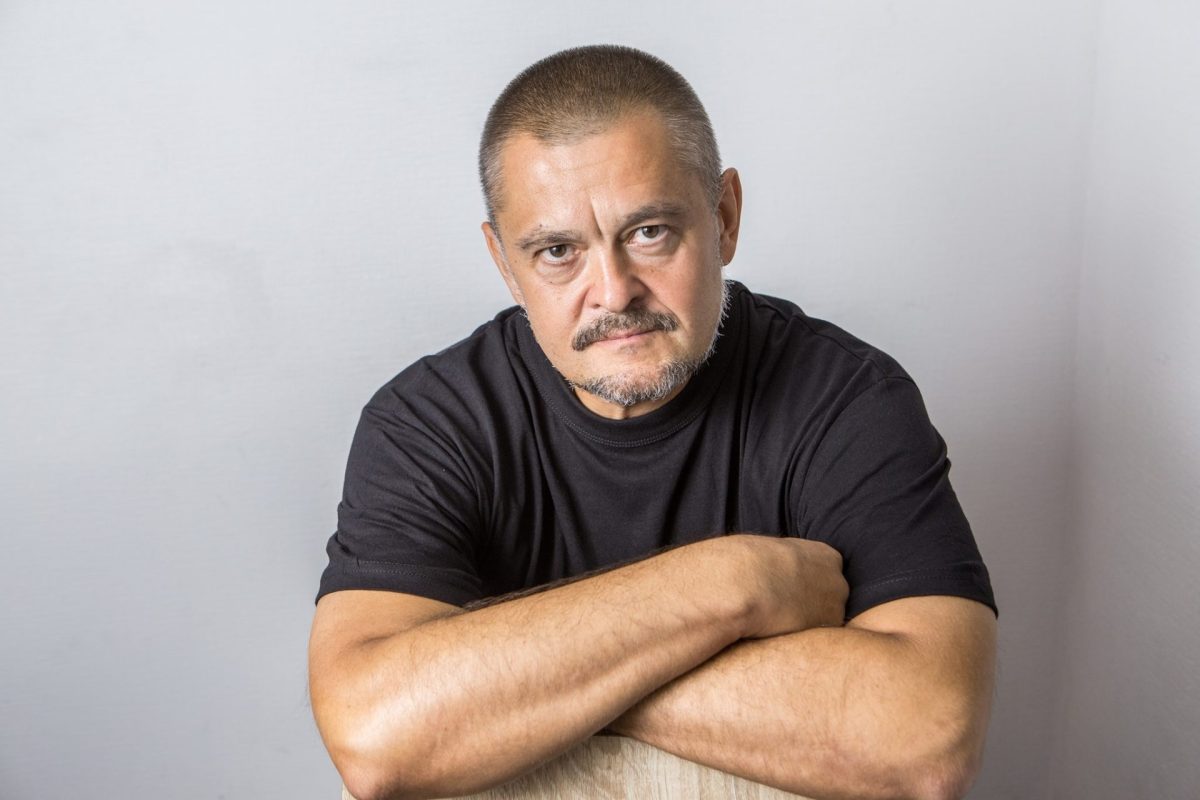
Colgate University hosted Ukrainian writer, poet, translator and film critic Volodymyr Rafeyenko for a conversation on language, identity and the human experience on Thursday, April 9. The event included a public reading from his most recent play, “Signals of Being.”
Senior Lecturer in University Studies Aleksandr Sklyar emphasized that the event was intended as a discussion.
“I would like to stress that this is not a guest lecture in which our guest will lecture to you all. This is a conversation, a conversation between you all, between our intellectual community here at Colgate and a current very important Ukrainian writer,” Sklyar said.
Rafeyenko introduced “Signals of Being,” a translated play about the early days of Russia’s full-scale invasion of Ukraine in 2022. Rafeyenko spoke in Ukrainian with the help of a translator. The play was read first in its original Ukrainian and then in English.
Rafeyenko’s experience during Russia’s invasion and occupation motivated him to write the play.
“In late March 2022, my wife and I were taken out of the occupied territories by volunteers. It was a long and rather dangerous process, first and foremost for the volunteers themselves, but at last we reached the free Ukrainian territories,” Rafeyenko said. “It was hard to believe that we had survived. It was then that I realized that I had to write about what I had seen.”
The play is set in February 2022 in a rural area outside Kyiv and features a mix of physical, unseen and imaginary characters, such as a crow-headed human who can predict the future and warns people to flee.
Rafeyenko resonated with drama as the best way to capture his experience, describing the play as autobiographical.
“Only the dramatic form could actually convey this reality. In other narrative forms, there is a narrator, someone who is retelling the story, and I was not a narrator. I could only watch and try to not cry, so it’s like witnessing.”
After Russia invaded Ukrainian Crimea in 2014 and then launched its full-scale invasion in 2022, Rafeyenko decided to stop using Russian. Despite initially not knowing the language, Rafeyenko now speaks and writes in Ukrainian. He spoke of the difficulty of this switch.
“I spoke Ukrainian worse than I spoke English, and the worst part was that Ukrainian-speaking friends who could witness how hard it was for me, they would say, ‘It’s ok, you can speak Russian,’” Rafeyenko said. “That’s when I decided to be radical about it and decided that I would just forbid myself to write in Russian entirely and that I would write [Signals of Being]. In the process of writing this, that’s how I learned to learn a foreign language — to try to write a literary piece.”
The current regime in Russia sometimes references the need to save the Russian-speaking population on Ukrainian territory. This attempt to give legitimacy to the invasion spurred protest. Rafeyenko considered learning Ukrainian to be an act of defiance, a tangible way to demonstrate his support. However, Rafeyenko clarified that Russia’s actions, not the Russian language, were the problem.
Rafeyenko also discussed the relationship between language and identity, arguing that language shapes a country’s identity, or a “self-birth” that helps to connect and unite citizens. Language can also shift one’s own identity and mental processes.
“There is this moment when language actually enters you and starts structuring you. Your memory works differently. You suddenly remember things from the past which you didn’t remember otherwise, because human beings are a language animal, a verbal animal,” Rafeyenko said.
When writing and reflecting on “Signals of Being,” Rafeyenko commented on ontology and Socratic philosophy, adding a fascinating dimension to his work.
First-year Annabelle King said Rafeyenko’s insight on the war and language made Russia’s invasion of Ukraine feel more immediate.
“I’ve never talked to someone in person or heard from someone in person who had lived through these things because the invasion in Ukraine is on a different side of the world, obviously. I think that having the chance to hear from someone that experienced that is so different, versus seeing things on the news, and I think that just felt very important,” King said.
The event not only spoke to the power of art and language to harness and create identity, but also served as a reminder of the ongoing terrors facing people in conflict-ridden areas.
“Please remember that there is a war. Do whatever you can. You can just say even some few kind words, or even if you cannot say them, you can think them,” Rafeyenko said. “Sometimes kindness, which we can feel within us, is stronger than weapons.”