


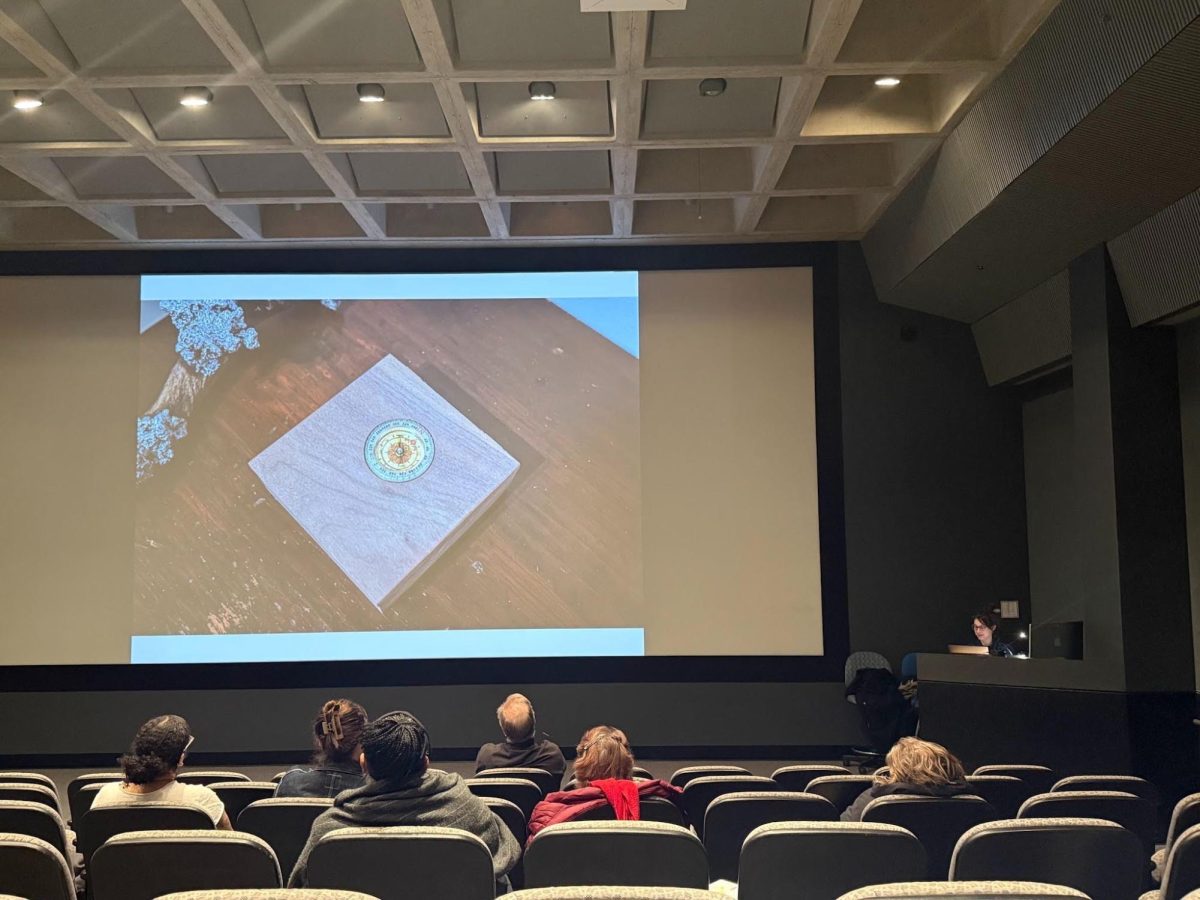
As part of the Art Lecture Series organized by Colgate University’s department of art, Lecturer in Art Jennifer Leibowitz shared her fascination with optical illusions that inspire her artistically with her audience in Golden Auditorium on Wednesday, April 8. Leibowitz’s interest in illusions stems from her childhood curiosity about nature and the unknown, where she grew up learning about the science behind those urban legends that captivated her as a child. After pursuing a Bachelor of Arts from Emerson College, she studied art and engineering at Portland Community College, and most recently received a Master of Fine Arts from the School of the Art Institute of Chicago.
Leibowitz is interested in the way myth and science interact with each other. Her art reflects the role of science in mythology and explores the mission of science to explain the unknown. In her lecture, she shared a curated collection of her art pieces, including “Compass from Afar” and “Last Train to Babylon.”
“Compass From Afar” is inspired by the myth that a compass needle will spin continuously at the North Pole. In reality, the needle would try to point directly downward if it weren’t restricted by its horizontal design. Like many, Leibowitz heard of this myth when she was a child and only discovered the scientific truth when she grew up. She created “Compass From Afar” by integrating an artificial magnetic field housed within the compass that makes the needles spin as the myth would suggest.
“Last Train to Babylon” is a series of giant pine lumber arches that converge to form a dome-like structure. While the structure resembles the shape and architecture of an ornate cathedral or church, its wooden arches are meant to mimic the tunnels you would find in a train station. Leibowitz was inspired by the resemblance of train station tunnels to the architecture found in churches.
“Last Train to Babylon” is a tribute to transition, which represents her early life moving around the country with her friends and finding employment through odd jobs. Eventually, she chose to move to Chicago, and it was there that she first experimented with woodworking in the early days of the COVID-19 pandemic.
“This was my tribute to the train station and the tunnels and just trying to make a decision,” Leibowitz said.
Professor DeWitt Godfrey, chair of the departments of art, music and theater at Colgate, spoke about “Last Train to Babylon” in his comments on the lecture.
“It’s also a metaphor for the fact that there are many different interests and many different exits,” Godfrey said. “I particularly like the way she kind of kept transforming it, continuing the idea of the journey is such an interesting little mini road.”
As time passed, Leibowitz experimented more with her woodworking skills and took the modular pieces of “Last Train to Babylon” to build something new. She recycled the pine lumber and transformed it into “Passage” and “Ascending Scales.” “Passage” is a handmade boat that Leibowitz released into Lake Michigan. “Ascending Scales” is a seven-foot-tall piano with stairs that take inspiration from church organs.
Senior Pryce Pitchford, an attendee and one of Leibowitz’s woodworking students, found her thought process inspiring.
“I thought it was really unique to see her process in deciding what to make, and then how she actually went about making those projects,” Pitchford said. “I thought it was really cool to see the difference between the woodwork and the metalwork.”
Leibowitz’s reflection and vulnerability brought comfort to attendees who have felt unsure about their own paths. Her commitment to her art was evident, as she was willing to tear down a structure that meant so much to her and give it a new identity and shape through transformation. Leibowitz showed how science, mythos and art can come together and showed how this intersection is instrumental to her journey.




Sean O’Brien • Apr 19, 2026 at 1:49 pm
THAT’S MY BROTHER!!