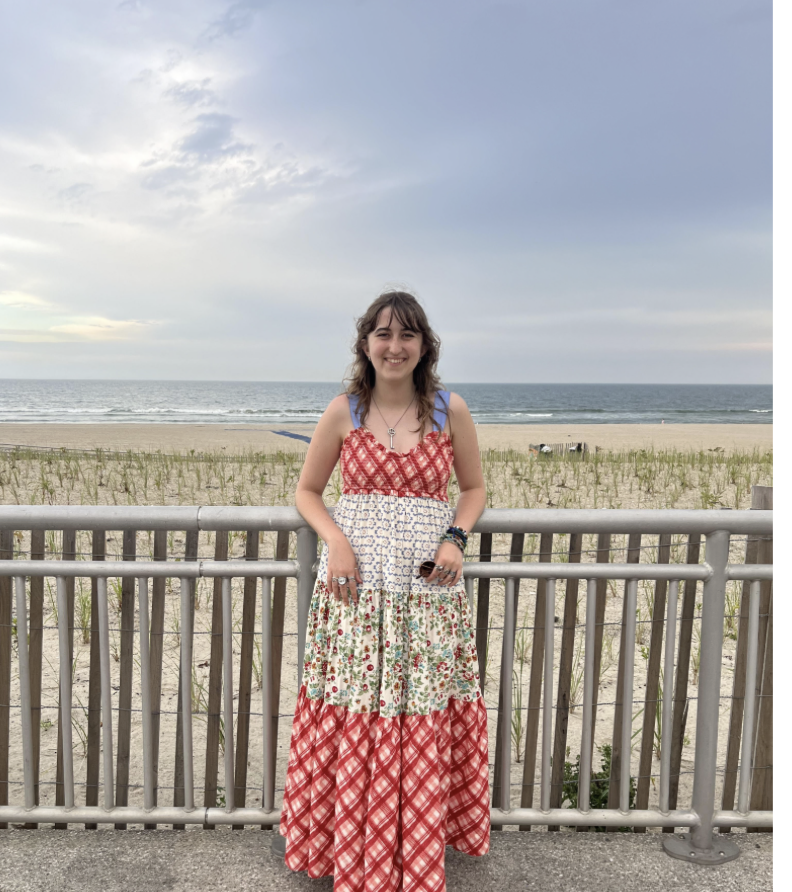
For some, the love of a good story starts with a single book. For senior Lara Blanton, it started before she could even read the words herself. Since she was a small child, Blanton’s favorite place to be was one where she could listen to stories being read aloud, igniting a spark when she realized she could be the one holding the pen.
Blanton’s lifelong passion for narrative follows her everywhere on Colgate University’s campus. Whether she’s discussing the latest page-turner on her weekly WRCU radio show or supporting the complex moving parts of the spring musical, she is constantly immersed in the world of storytelling. But this year, her most ambitious story is not happening on a stage or over the airwaves — it is unfolding across 100 pages of 1880s Manhattan.
Earning a spot in the creative writing thesis cohort is no small feat. It requires a rigorous application process: a 25-page writing sample, a detailed proposal and a list of comparative titles, all of which are reviewed by the entire creative writing faculty. For Blanton, who declared her English major with a creative writing concentration as a first-year student, joining the cohort was the goal from the beginning.
The project, set in 1880s Manhattan, follows a young woman named Sybil as she discovers a “flipside” of our world that must be kept in a delicate balance. The flipside is the home of mythological wonders and the inventive spark that flows into our world. In return, our world gives back what it does not need anymore, such as obsolete technology or fairytales — the world has grown too complex to believe in anymore. As the Industrial Revolution gains steam in our reality, it leeches more energy than the flipside can sustain and the imbalance begins to threaten both worlds. Sybil’s response is to found a society of women dedicated to maintaining that equilibrium and standing up to the industry men who threaten to upend the natural order. It is a story that grew out of a simple, haunting question Blanton asked during a literary tour at NYU.
“Can trees have ghosts?” Blanton had once asked.
Perhaps the most impressive part of Lara’s journey is the restart. In late February, she realized the story she was writing was a bit too ambitious for this endeavor.
She had originally been writing about Sybil’s great-granddaughter in a more modern setting. But the more she wrote, the more inclined she felt to explore Sybil’s own story. In a move that would terrify most writers, she pivoted, setting aside 90 pages of work to start fresh with a new protagonist and era. Most of the current draft was hammered out over spring break, a testament to the invaluable support of her workshop peers and her advisors, Associate Professor of English CJ Hauser and Olive B. O’Connor Writing Fellow Olakunle Ologunro.
To build a world without technology, Blanton spends nearly as much time diving into research as she does at her keyboard. Her process is a mix of narrative flow and deep-dive research into lunar calendars, 19th-century steel mills and social figures.
“I really enjoy the research and the rabbit holes. It gives me something to do when I’m burnt out of writing,” Blanton said.
This historical nitty-gritty allows her to ground her magical elements in a world that feels tactile and real.
As she looks toward graduation, Blanton isn’t putting the pen down. She’s already talking to Colgate alumni in the publishing industry and exploring roles that will allow her to keep writing, whether that’s in a professional firm or a classroom. For now, she’s focused on finishing Sybil’s journey, and perhaps eventually returning to that original 90-page story about the granddaughter, which may one day be a New York Times bestseller.