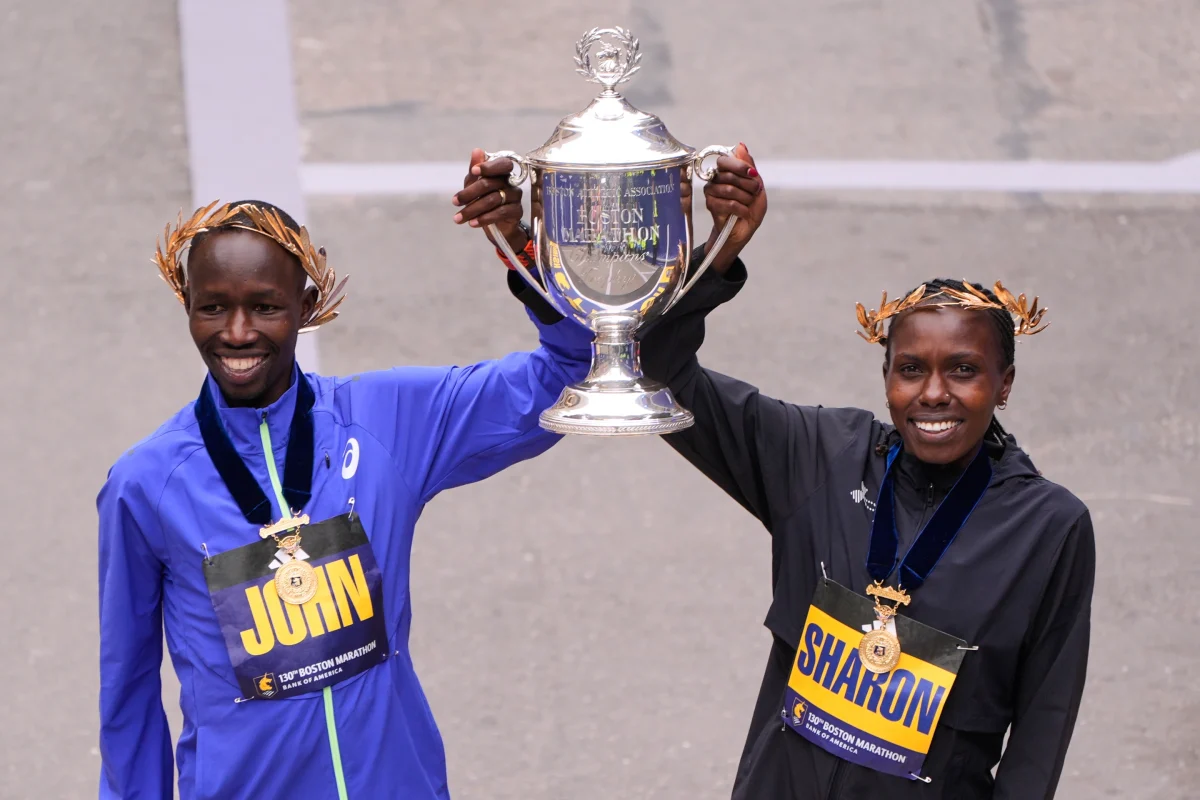
The 130th Boston Marathon on April 20 delivered a historic and electrifying day of racing, highlighted by back-to-back champions in both divisions. Kenya’s John Korir and Sharon Lokedi each defended their titles with commanding performances, reinforcing their respective status among the sport’s premier marathoners.
Korir was at the vanguard of the men’s race with a dominant run that rewrote the record books. Finishing in 2:01:52, he set a new course record and recorded the fifth-fastest marathon time in history, surpassing Geoffrey Mutai’s 2011 record by 70 seconds. Running strategically through the early stages, Korir remained patient within a tightly-packed lead group before making his move around mile 20.
He extended his advantage on the iconic Heartbreak Hill, a decisive stretch that has long defined the Boston course, and steadily pulled away from the field. By the time he reached Boylston Street, Korir was alone, celebrating as he crossed the finish line to secure his second consecutive victory in the Boston Marathon.
The achievement builds on his 2025 victory, when he joined his brother, Wesley Korir, to become the only pair of brothers in history to have each won the marathon. His performance also came with substantial rewards, including a $150,000 winner’s prize and a $50,000 bonus for breaking the course record.
Behind him, Tanzania’s Alphonce Felix Simbu finished second, followed closely by 2021 champion Benson Kipruto in third. Remarkably, both runners posted times faster than the previous course record, highlighting the exceptional depth of the field and the favorable race-day conditions, which featured cool temperatures, clear skies and a helpful tailwind.
In the women’s race, Lokedi delivered a performance defined by resilience and instinct. She crossed the finish line in 2:18:51, securing her second straight Boston title and recording the fourth-fastest time in race history. Unlike Korir’s controlled surge, Lokedi’s victory was shaped by perseverance through early challenges. She struggled with pace and fatigue in the opening miles but maintained contact with the lead group, setting the stage for a decisive push late in the race.
That move came in the closing stretch, particularly through the Newton Hills, where Lokedi broke away from her competitors and never looked back. Her late-race splits were among the fastest of the day, as she powered through miles 22 to 24 with authority to create separation and secure the win. Adding to the drama, Lokedi ran much of the race without closely monitoring her pace after realizing she had forgotten her watch before the start. Relying on feel rather than data, she later explained, “I knew I was going fast, I just didn’t know how fast I was going. I just wanted to run as fast as I could.”
Her victory led an all-Kenyan sweep of the podium, with Loice Chemnung finishing second and Mary Ngugi-Cooper third, further emphasizing Kenya’s continued dominance in distance running. American Jess McClain also made headlines, finishing fifth in 2:20:49 — the fastest time ever recorded by an American woman in Boston.
Beyond the elite races, the marathon featured standout performances across divisions. Switzerland’s Marcel Hug captured his ninth Boston wheelchair title in 1:16:06, continuing an extraordinary run of success that includes four consecutive wins. In the women’s wheelchair race, Britain’s Eden Rainbow-Cooper took the victory, adding another major accomplishment to her career.
The event also showcased its wide-ranging appeal, drawing participants from various walks of life. Chelsea Clinton completed the race in a personal-best time of 3:40:52, while astronaut Suni Williams and former NHL star Zdeno Chara were also among the list of notable finishers. Their presence highlighted the Boston Marathon’s unique blend of elite competition and mass participation.
With record-breaking performances, repeat champions and remarkable depth across all divisions, this year’s Boston Marathon stands as one of the most memorable in its storied history. Korir and Lokedi’s back-to-back victories not only underscore their individual brilliance but also reflect the enduring excellence of Kenyan distance running on the global stage.