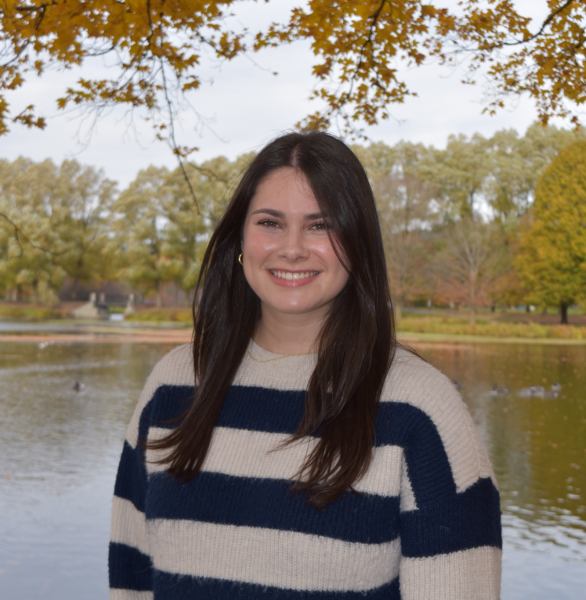
Throughout her time at Colgate University, senior Mary Vertetis has woven her passion for disability advocacy into her many involvements. From her role as a leader of Colgate Buddies to the subjects of her theses to her involvement with the Student Government Association (SGA), Vertetis has continuously focused her energy on providing comfortable and inclusive spaces for people of all abilities.
From a young age, Vertetis was cognizant of issues involving individuals with cognitive and physically disabilities.
“Growing up with an older brother who has autism, my family was very invested in the disability community even before I was born,” Vertetis said. “That’s my family, that’s my life — that’s what I live. And that’s what I want everything I do to reflect.”
Once she arrived at Colgate, she sought to provide all students with the opportunity to form these types of relationships. She immediately joined Colgate Buddies, a club that regularly collaborates with nearby organizations that support individuals with disabilities to create inclusive campus events. By hosting these partnered events, Vertetis has aimed to bridge the gap between the Colgate community and local disabled populations.
Vertetis found that these events were successful not only in changing how Colgate students think about inclusion but also in encouraging genuine, lasting relationships.
“What I found is that the friendships students form with local community members aren’t actually that different from the friendships they have with their typical peers,” Vertetis said. “By opening a space for local people with disabilities to come to Colgate and be part of campus life, we’re inherently helping our students be more inclusive and more aware of the disability community.”
However, Buddies was not the only avenue through which Vertetis sought to advocate for disabled communities. Through her involvement in the SGA, Vertetis led and developed several initiatives aiming to highlight, celebrate and support disabled individuals. Vertetis served as the director of disability services during her sophomore and junior years and currently holds a position as a vice president of student engagement.
“During my time on SGA, I’m proud to have partnered with the current president, Harshitha Talasila, on efforts to bring an American Sign Language course to Colgate, and to have had the opportunity to host and collaborate with a variety of initiatives,” Vertetis said. “I am especially proud of hosting the first Autism Awareness Week, which included a brown bag speaker event, tabling at the Coop culminating [in] a campus-wide Blue Out theme on National Autism Awareness Day and a Colgate Buddies event with local community members with disabilities.”
Outside of her extracurricular involvements, Vertetis has also incorporated her advocacy interests into her theses for her majors in sociology and anthropology. Her anthropology thesis investigated how participation in mixed-ability spaces, such as events sponsored by Colgate Buddies, shaped neurotypical college students’ cultural understandings.
For her sociological research, Vertetis was inspired by her experiences at the Academy of Precision Learning (APL) in Seattle, Wash., an inclusive school offering education to both neurotypical and neurodivergent students. Vertetis attended this school alongside her older brother, who is diagnosed with autism. Vertetis’ experience in this setting fostered comfort and understanding of cognitively disabled groups from a young age. Recent state policy changes in Washington led to a decrease in the number of neurotypical students, shifting the neurodivergent student population to an overwhelming majority. In her thesis, Veretis advocated for inclusive education based on the benefits she saw during her time at APL.
“When APL was fully inclusive, it wasn’t just good for kids with disabilities — it was good for everyone’s development, their sense of community and belonging and their understanding of social equality,” Vertetis said.
Vertetis reflected on her decision to double major in sociology and anthropology, citing it as a solid foundation for the academic path she will pursue in the future.
“I chose anthropology and sociology because I wanted to understand how we think and act as communities so I could better support inclusive education,” Vertetis said. “I wouldn’t change my majors if I looked back — I’m really happy with the path I chose.”
After her graduation in May, Vertetis will attend the Vanderbilt Peabody College of Education and Human Development in Nashville, Tenn., where she will pursue a master’s degree in organizational development for social innovation. Vertetis hopes to bring what she has learned at Colgate and build on this experience during her time in graduate school.
“I’m excited to study educational policy and program development at Vanderbilt and see how I can have an impact in a larger, more urban space like Nashville,” Vertetis said.